
After surgery, pain doesn’t have to mean opioids. For years, patients were sent home with prescriptions for morphine or oxycodone as the default solution. But that’s changing - fast. Today, hospitals and surgical teams are using smarter, safer, and more effective ways to manage pain without relying on opioids. This shift isn’t just a trend. It’s now the standard of care, backed by 14 major medical societies including the American Society of Anesthesiologists. The approach? Multimodal analgesia - combining multiple non-opioid medications and techniques to control pain before, during, and after surgery.
Why Multimodal Analgesia Is the New Standard
Multimodal analgesia (MMA) isn’t about replacing one drug with another. It’s about stacking treatments that work in different ways to block pain signals at multiple points in the nervous system. Think of it like turning off several light switches instead of just one. One drug might calm inflammation, another might quiet overactive nerves, and a third might reduce the brain’s sensitivity to pain. When used together, they do more than add up - they multiply effectiveness. This approach reduces opioid use by 32% to 57%, according to data from 17 randomized trials involving over 1,200 patients. That’s not just a small win. It’s life-changing. Fewer opioids mean fewer side effects: less nausea, less dizziness, less constipation, and far less risk of dependency. At Rush University Medical Center, average daily opioid use dropped from 45.2 morphine milligram equivalents (MME) to just 18.7 MME - a 61% reduction - while keeping patient pain scores under 4 out of 10.What Goes Into a Multimodal Pain Plan?
A solid MMA plan doesn’t start when the patient wakes up. It starts before the first incision. Here’s what a typical protocol includes:- Preoperative: Patients get acetaminophen (1,000 mg), gabapentin (300-600 mg), and celecoxib (400 mg) one to two hours before surgery. This pre-emptive strike helps calm the nervous system before pain even begins.
- Intraoperative: During surgery, anesthesiologists may add ketamine (0.5 mg/kg), lidocaine (1.5 mg/kg IV bolus, then 2 mg/kg/hr infusion), or dexmedetomidine to blunt pain signals and reduce the need for opioids.
- Postoperative: Scheduled doses of acetaminophen (every 6 hours), NSAIDs like naproxen (500 mg every 12 hours), and gabapentin (300 mg three times daily) keep pain under control. Opioids? Only for breakthrough pain - and even then, in tiny doses: 1-2 mg of morphine or 0.2-0.4 mg of hydromorphone, given only when needed.
Who Benefits Most?
MMA works best in surgeries with predictable, localized pain - like joint replacements, spine procedures, and abdominal operations. For major orthopedic surgeries like total knee or hip replacements, MMA can cut opioid needs by 50-60%. For smaller procedures like arthroscopy, the reduction is still strong: 30-40%. Even in non-surgical cases like fractures, opioid use drops by 20-30%. But MMA isn’t just for healthy patients. It’s especially critical for high-risk groups: people with chronic pain, those already on opioids, patients with substance use history, or those who specifically request opioid-free care. For them, protocols expand to include longer infusions of ketamine (0.1-0.3 mg/kg/hr for 24-48 hours), dexmedetomidine (0.2-0.8 mcg/kg/hr), or lidocaine infusions. Some hospitals now offer full opioid-free pathways using regional nerve blocks and targeted non-opioid meds.
Real Results: Less Pain, Shorter Stays
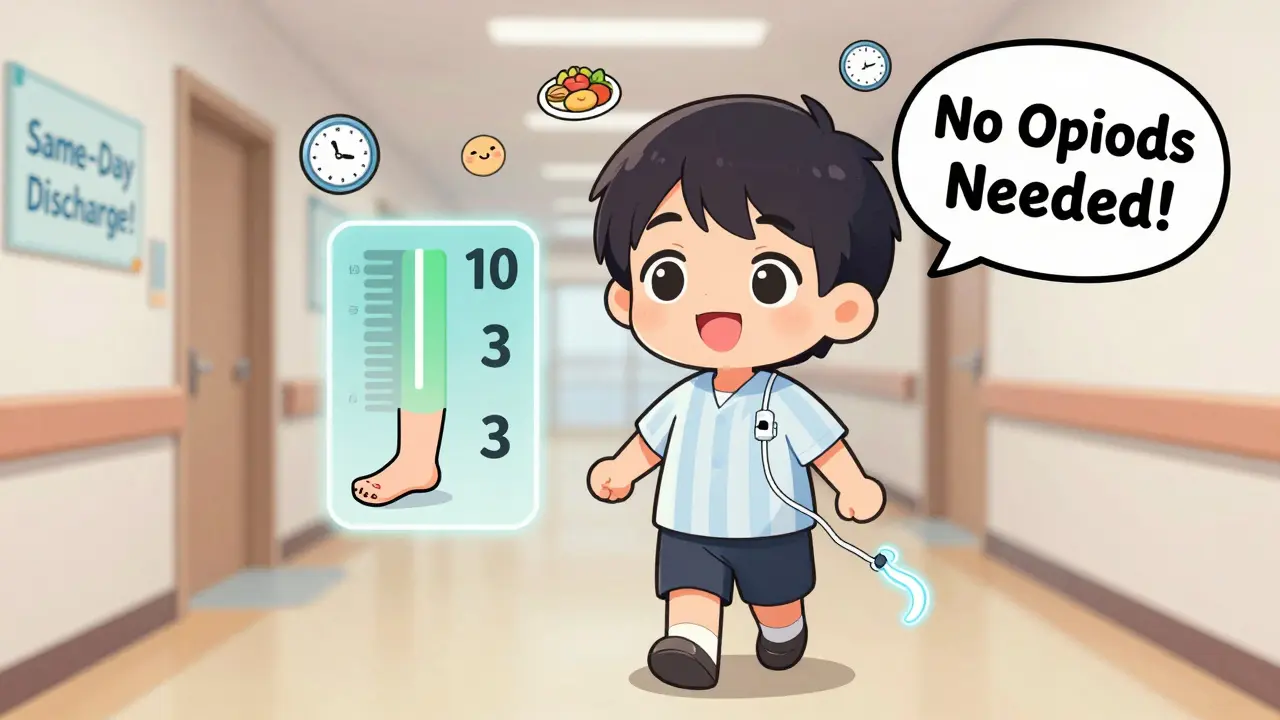
The benefits go beyond just cutting pills. At McGovern Medical School, implementing their trauma pain pathway led to a 1.8-day drop in average hospital stay - from 7.2 days to 5.4. Same-day discharge rates jumped from 12% to 37% for eligible patients. Why? Because patients weren’t stuck in bed from opioid fog. They were alert, walking, eating, and going home faster. Fewer opioids also mean fewer complications. One 2022 review found MMA patients had 28% less postoperative nausea and vomiting (PONV) than those on IV opioids alone. That’s huge. PONV isn’t just uncomfortable - it delays recovery, increases hospital costs, and can lead to readmissions.It’s Not Just About Drugs
MMA isn’t only pills and IV drips. It includes non-drug tools too:- Regional nerve blocks - ultrasound-guided injections that numb specific areas without affecting the whole body.
- Continuous wound infusion catheters - tiny tubes left in the surgical site that slowly deliver numbing medicine for days.
- Physical therapy and early mobilization - movement helps reduce swelling and stiffness, which naturally lowers pain.
- Patient education - telling people what to expect, how to take meds on schedule, and when to call for help reduces anxiety and improves outcomes.
Challenges and Pitfalls
MMA sounds simple. But putting it into practice is hard. It requires coordination across teams: anesthesiologists, surgeons, pharmacists, nurses, and pain specialists. Everyone has to be on the same page - from pre-op planning to discharge instructions. One big hurdle? Access to regional anesthesia. Not every hospital has the equipment or staff trained to do ultrasound-guided nerve blocks. Another? Kidney and liver function. Gabapentin must be reduced for patients with low kidney function (eGFR <30 mL/min). Naproxen is off-limits for those same patients. Dosing isn’t one-size-fits-all. And then there’s culture. Some providers still default to opioids out of habit. Some patients expect them. Changing that mindset takes training, protocols, and persistent follow-up.What Comes Next?
By 2025, experts predict 85% of major surgeries will use formal MMA protocols - up from 60% in 2022. The next frontier is personalization. Not all patients are the same. A 70-year-old with diabetes and arthritis needs a different plan than a 30-year-old athlete. Future protocols will use AI tools to adjust meds based on real-time pain scores, vital signs, and even patient-reported feedback. Another focus: discharge planning. Instead of sending patients home with a 30-day opioid script, many centers now prescribe just 5-10 days of gabapentinoids to prevent the nervous system from getting stuck in pain mode - a key step in avoiding chronic post-surgical pain.What Patients Should Ask
If you’re facing surgery, here’s what to ask your care team:- Will you use a multimodal pain plan? What drugs will I get before, during, and after surgery?
- Will I get nerve blocks or other regional anesthesia?
- How will my pain be tracked? Will you use a pain scale every few hours?
- What’s the plan if I don’t want opioids?
- Will I get written instructions for pain meds after I go home?
What is multimodal analgesia?
Multimodal analgesia (MMA) is the use of multiple pain-relieving medications and techniques that work in different ways to control pain. Instead of relying on one drug - usually an opioid - MMA combines non-opioid drugs like acetaminophen, NSAIDs, gabapentin, and regional nerve blocks to reduce pain while minimizing side effects and opioid use.
How much can MMA reduce opioid use after surgery?
Studies show MMA reduces total opioid consumption by 32% to 57% compared to traditional opioid-only methods. For example, at Rush University Medical Center, average daily opioid use dropped from 45.2 MME to 18.7 MME - a 61% reduction - without worsening pain control.
Is multimodal analgesia safe for everyone?
MMA is safe for most patients but must be tailored. Gabapentin doses need adjustment for patients with kidney disease (eGFR <30 mL/min). NSAIDs like naproxen are avoided in those with poor kidney function or history of ulcers. Patients with liver disease may need lower doses of acetaminophen. A thorough pre-op evaluation ensures the plan matches your health profile.
Can I have surgery without any opioids?
Yes. Many hospitals now offer opioid-free surgical pathways, especially for joint replacements, hernia repairs, and spine surgeries. These use regional nerve blocks, IV lidocaine or ketamine infusions, gabapentinoids, and NSAIDs to fully control pain without opioids. Patients who request this option should discuss it with their surgical team well before the procedure.
Why is preoperative medication important in MMA?
Giving pain meds before surgery - called pre-emptive analgesia - helps stop pain signals from becoming wired into the nervous system. If you wait until after surgery to treat pain, your body may amplify the signals, making pain harder to control. Starting acetaminophen, gabapentin, and NSAIDs before the incision can reduce post-op pain intensity and total opioid needs.
How long should I take non-opioid pain meds after surgery?
Most patients take scheduled non-opioid meds for 5 to 10 days after discharge. For high-risk patients - like those with chronic pain or prior opioid use - doctors may extend gabapentin or other neuropathic agents for up to 2 weeks to prevent the transition to chronic pain. Always follow your provider’s instructions, and don’t stop meds abruptly.
What if my pain isn’t controlled with MMA?
MMA is designed to control most post-surgical pain without opioids. But if pain remains high despite scheduled meds, small, short-acting opioid doses may be used temporarily - for example, 1 mg of morphine every 15 minutes as needed. The goal is always to return to non-opioid control as soon as possible. Your care team will monitor your response closely and adjust the plan.
Does MMA work for all types of surgery?
MMA works best for surgeries with predictable, localized pain - like orthopedic, spine, and abdominal procedures. It’s less predictable for complex cases with multiple pain sources, trauma with nerve damage, or patients with high opioid tolerance. But even in those cases, MMA still reduces opioid needs and improves outcomes when combined with individualized adjustments.


Man, I wish my uncle’s knee replacement had this protocol back in 2018. He was on oxycodone for six weeks and barely walked without nodding off. This stuff? It’s not just smart-it’s humane. I’ve seen friends recover faster, laugh more, and actually enjoy their post-op meals instead of just waiting for the next pill to kick in. No more zombie mode.
Also, the nerve blocks? Absolute game changer. My cousin got one after a hernia repair and was out of the hospital same day. No opioids. No nausea. Just... normal life. Why isn’t this everywhere yet?
As a nurse in a trauma unit, I’ve seen the opioid spiral up close. Patients who came in for minor surgeries ended up addicted because that’s all we were trained to hand out. This multimodal approach? It’s the future we’ve been screaming about for years. The real win? Patients feel more in control. They’re not waiting for the next fix-they’re moving, breathing, healing.
And yes, it takes teamwork. But once the whole team buys in? Magic happens. We cut our opioid prescriptions by 60% last year. No complaints. Just better outcomes.
Let’s be real-this is all just rebranded junk science wrapped in fancy acronyms. Gabapentin for pain? That’s for seizures. Ketamine? That’s a horse tranquilizer. And you’re telling me giving someone a cocktail of unproven drugs is safer than a single, well-dosed opioid? Please. The FDA didn’t approve opioids because they’re lazy-they approved them because they WORK.
Also, ‘opioid-free pathways’? Sounds like a Silicon Valley buzzword. Real medicine isn’t about ideology. It’s about what gets results. And opioids still do.
Yo I just had a shoulder surgery last month and honestly this is the exact plan they used and I’m not even kidding I didn’t take a single opioid pill
acetaminophen every 6 hours like clockwork gabapentin before bed and a nerve block that felt like magic
they gave me one morphine pill just in case and I didn’t even use it
my pain was under 3/10 the whole time and I was walking around the hospital hallway by day 2
also the PT guy made me do squats in the hallway and I thought he was crazy but now my shoulder feels better than it has in years
why isn’t this standard everywhere i swear if this was in every hospital the opioid crisis would’ve been a footnote by now
Wow. A medical protocol that doesn’t involve throwing money at the problem. Who would’ve thought? Maybe if we stopped treating pain like it’s a customer service issue and started treating it like biology, we’d get somewhere.
Also, ‘opioid-free pathways’-because nothing says ‘progress’ like renaming common sense.
THIS. THIS RIGHT HERE. 🙌
I’ve been telling my coworkers for years: stop reaching for the morphine like it’s a magic wand. Pain isn’t a villain to be crushed-it’s a signal. And MMA? It listens.
My mom had a hip replacement last year. No opioids. Just nerve block, gabapentin, and ice packs. She was dancing in the recovery room by noon. No fog. No constipation. Just her. And she didn’t need a single pill after day 2.
Stop being afraid of the meds you’re NOT giving. Start being brave about the ones you ARE.
PS: If your hospital still hands out 30 oxycodone like it’s Halloween candy… you’re doing it wrong.
As someone from a country where opioids are almost impossible to get legally, I’ve seen how this works in practice. We rely on nerve blocks, physical therapy, and traditional NSAIDs. And guess what? Recovery is often faster because people aren’t sedated.
It’s not about being ‘anti-opioid’-it’s about being pro-recovery. The goal isn’t to eliminate pain entirely. It’s to let people live through it, not just endure it.
Also, the cultural bias here in the US? We treat pain like a moral failure. That’s the real problem.
While the statistical reductions in opioid consumption are statistically significant, one must interrogate the underlying methodological rigor of the cited randomized trials. The majority of these studies suffer from selection bias, inadequate blinding, and non-standardized pain assessment instruments. Furthermore, the generalizability of outcomes derived from tertiary academic centers to community hospitals with limited resources remains empirically unvalidated. The conflation of ‘reduced opioid use’ with ‘improved patient outcomes’ constitutes a logical fallacy. Until longitudinal, multicenter, double-blind, placebo-controlled trials demonstrate durable improvements in functional recovery and reduced incidence of chronic postsurgical pain syndromes, such protocols should be regarded as experimental.
Wait-so you’re saying we’ve known for years that combining meds that target different pain pathways is more effective than just hitting the system with one drug? And we only just started doing it systematically? That’s wild.
Also, I’m curious-how many of these protocols include mental health support? Pain isn’t just physical. Anxiety, trauma, and fear can amplify it. Are we just treating the body and ignoring the mind? Because that’s half the battle.