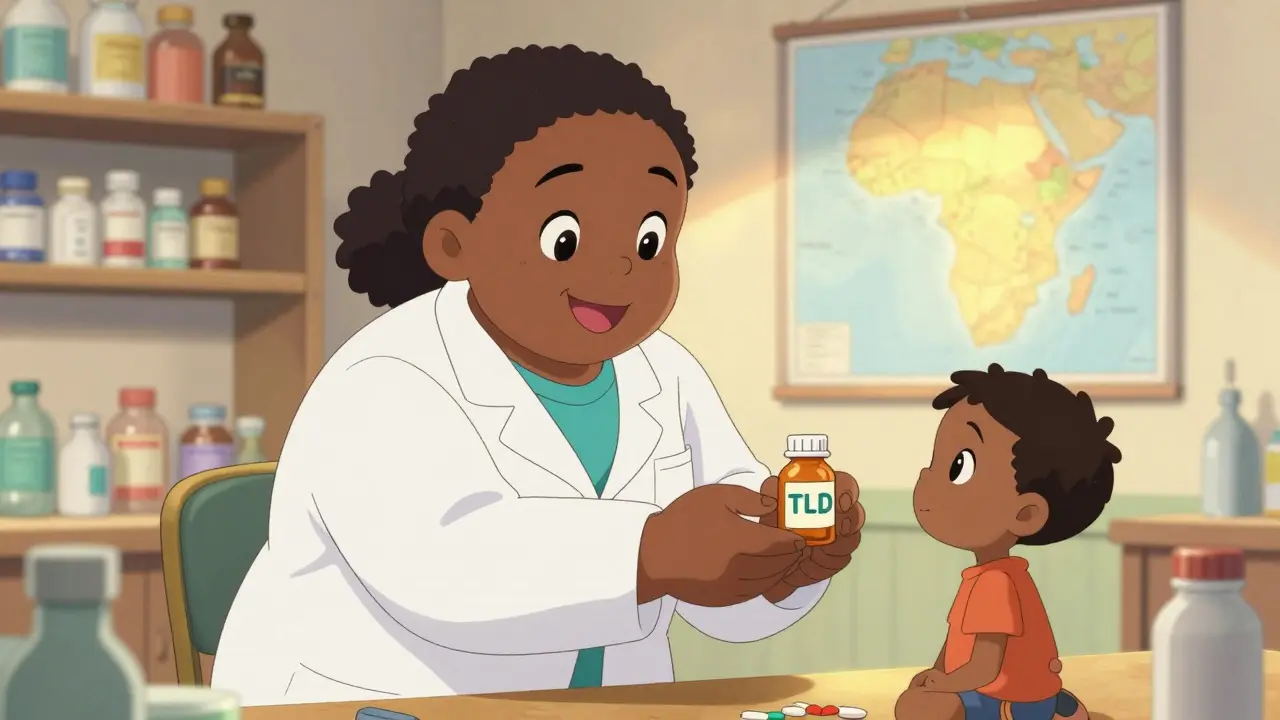
For decades, Africa relied on pills shipped from halfway across the world to treat HIV.
In 2000, it cost more than $10,000 a year to keep one person alive on HIV medication. By 2015, thanks to Indian generic manufacturers, that price dropped below $100. But even at $100 a year, the supply chain was fragile. When global shipping slowed during the pandemic, clinics in rural Mozambique, Malawi, and the Democratic Republic of Congo ran out of medicine. People missed doses. Viral loads rose. Resistance grew.
That changed on May 6, 2025.
For the first time in history, the Global Fund bought an HIV treatment made in Africa. Not India. Not Europe. Not the United States. TLD - a single pill combining tenofovir, lamivudine, and dolutegravir - was manufactured by Universal Corporation Ltd in Kenya. It was shipped to Mozambique, enough to treat over 72,000 people every year. This wasn’t just a shipment. It was a turning point.
Why African-made HIV pills matter more than ever
Sub-Saharan Africa carries 65% of the world’s HIV cases. Yet it produces less than 3% of its own medicines. For years, the continent imported 80% of its pharmaceuticals. That meant delays, price spikes, and zero control over what happened when a factory in India shut down or a container got stuck in a port.
Now, African countries are building their own capacity. Kenya’s Universal Corporation became the first African manufacturer to pass WHO prequalification for TLD in 2023. WHO prequalification isn’t just a stamp - it means the medicine meets the same strict standards as those made in the U.S., EU, or Japan. No compromises. No shortcuts.
When Mozambique’s Health Minister Ussene Hilário Isse said, “Africa’s growing capacity to locally produce lifesaving medications marks a strategic shift,” he wasn’t just speaking diplomatically. He was describing a new reality. Local production means faster restocks. Lower transport costs. More predictable supply. And, crucially, jobs - skilled technicians, quality control experts, logistics managers - all trained and paid within Africa.
The TLD breakthrough: Why this pill is a game-changer
TLD isn’t just another HIV pill. It’s the new global standard for first-line treatment. Compared to older regimens, dolutegravir - the key ingredient - works better, has fewer side effects, and makes it harder for the virus to become resistant. That’s critical in places where people might miss doses due to long distances to clinics or stigma.
Before TLD, many African countries still used older drugs like efavirenz, which caused dizziness, sleep problems, and depression in up to 30% of users. TLD changed that. Now, with African-made TLD available, countries can upgrade their treatment programs without waiting for shipments from overseas.
And the price? It’s competitive. While exact figures aren’t public, experts estimate African-made TLD costs 15-20% less than Indian-made versions - because there’s no long-haul shipping, no import taxes, and no middlemen. That’s money that can be reinvested in clinics, community health workers, or testing programs.
Beyond pills: Building the whole HIV care system in Africa
Producing pills is only half the battle. You also need to know who has HIV - and fast.
In Nigeria, Codix Bio started making HIV rapid diagnostic tests under a technology transfer deal with SD Biosensor, backed by WHO’s Health Technology Access Programme. These are the same finger-prick tests used in villages without labs. Now, they’re made locally. That means faster production, lower costs, and better stock availability.
It’s not just pills and tests. South Africa became the first African country to register a twice-yearly HIV injection - cabotegravir long-acting - in October 2025. No more daily pills. Just two shots a year. Six African companies got licenses from Gilead to make generic versions. Experts say those generics could cost 80-90% less than the brand-name version once they hit the market.
And Gilead isn’t waiting. They’ve signed deals with the U.S. State Department and the Global Fund to supply lenacapavir, a new long-acting PrEP drug, at no profit until generics arrive. They’re submitting regulatory paperwork in 18 high-burden countries by the end of 2025. That’s not charity. It’s market shaping - creating demand so African manufacturers have a clear path to scale.
Challenges still standing in the way
Progress is real. But Africa needs 15 million person-years of first-line ARVs every year. Right now, African manufacturers can cover maybe 5-7% of that. The rest still comes from India, China, or Europe.
Building factories isn’t easy. You need trained chemists, clean rooms, reliable power, and strong regulatory systems. Many African countries still have different drug approval rules. One country’s approval doesn’t mean another will accept it. That’s why the African Union’s Pharmaceutical Manufacturing Plan for Africa (PMPA) is pushing for regional harmonization - one set of standards across the continent.
There’s also the issue of funding. The Global Fund, Unitaid, and the Gates Foundation are stepping up. But long-term sustainability means African governments must invest too. Can national health budgets cover the cost of building and maintaining these factories? Can local banks finance them? Can African investors see pharma as a profitable sector, not just a humanitarian project?
And then there’s the brain drain. The best scientists and engineers still leave for Europe or North America. To keep them, Africa needs not just jobs - but research labs, academic partnerships, and real career paths in drug development.
The road ahead: What 2030 could look like
If current trends hold, by 2030, African-made antiretrovirals could supply 20-30% of the continent’s needs. That’s not full self-reliance - but it’s enough to break the cycle of crisis response.
Imagine a future where:
- A clinic in rural Uganda orders TLD from a warehouse in Nairobi, not from Mumbai.
- A teenager in Lagos gets her HIV prevention shot - a generic version of cabotegravir - for under $5 a year.
- A Nigerian lab tests 10,000 samples a week using locally made rapid kits, with results in 15 minutes.
- African scientists lead clinical trials for new drugs designed for African strains of HIV, not just copied from Western formulas.
This isn’t science fiction. It’s the trajectory we’re on. The Global Fund’s Grant Cycle 7 (GC7) will soon announce which countries get priority for African-made ARVs. That’s the next step - scaling up.
What’s different this time? It’s not just about cheap pills. It’s about ownership. About African leadership. About turning a crisis into an industry. About building systems that don’t collapse when the next pandemic hits.
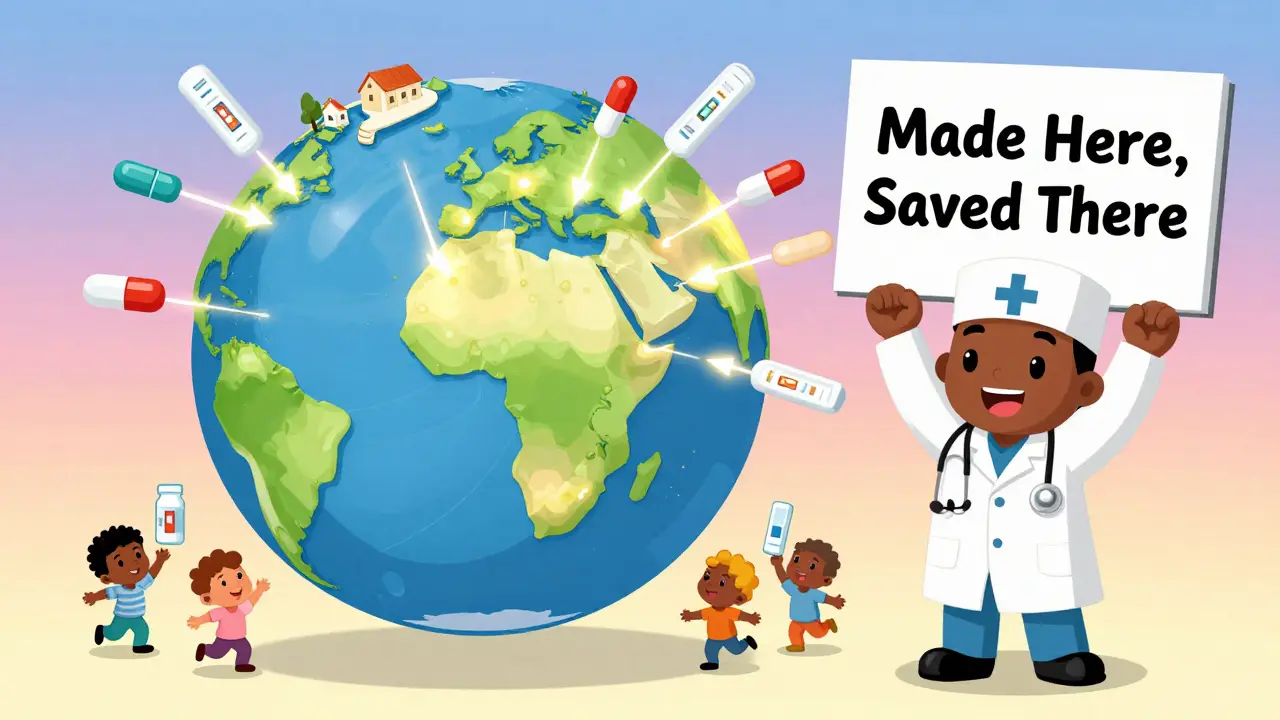
The old model - wait for foreign aid, wait for shipments, hope for the best - is over. The new model? Make it here. Test it here. Deliver it here. And when you’re ready, export it to other low-income countries too.
What this means for global health
Africa’s push for local ARV production isn’t just about HIV. It’s a blueprint for how the world can handle future pandemics. If Africa can build the capacity to make high-quality HIV drugs, it can make vaccines, antibiotics, or cancer treatments too.
The WHO calls this “health sovereignty.” It means countries don’t have to beg for medicine when they’re sick. They can produce it themselves. And when they do, the entire global supply chain becomes more resilient.
This is the quiet revolution in global health - not in a lab in Boston or a factory in Basel. But in Nairobi, Kigali, Abuja, and Cape Town. Where people who have lived with HIV for decades are now helping build the systems that will save the next generation.
Are African-made HIV generics safe and effective?
Yes. African-made antiretrovirals like TLD must pass WHO prequalification, which requires meeting the same strict quality, safety, and efficacy standards as drugs from the U.S. or EU. Universal Corporation Ltd in Kenya, the first African manufacturer to achieve this for TLD, underwent years of inspections and testing. These are not second-rate products - they’re globally approved, life-saving medicines made locally.
How much cheaper are African-made ARVs than imported ones?
African-made ARVs are estimated to cost 15-20% less than Indian-made versions, mainly due to lower shipping, import taxes, and distribution costs. For a country treating hundreds of thousands of people, that adds up to millions saved annually - money that can be redirected to testing, counseling, or health worker salaries.
Why did it take so long for Africa to make its own HIV drugs?
For years, the focus was on lowering prices through Indian generics, not building local capacity. Regulatory systems were weak, funding was scarce, and there was little incentive for African governments to invest in manufacturing. The pandemic exposed how dangerous that reliance was. Now, with global partners like the Global Fund and WHO actively shaping the market, the conditions for local production finally exist.
Can African countries export these generics to other regions?
Absolutely. Once African manufacturers meet international standards, they can export to other low- and middle-income countries - not just in Africa. The goal isn’t just self-sufficiency; it’s becoming a global supplier. This mirrors how India became the world’s pharmacy, but now Africa is building its own version of that model.
What’s next after TLD and long-acting injections?
The next frontier is combination therapies, pediatric formulations, and drugs for drug-resistant HIV - all made in Africa. There are also efforts to develop new antiretrovirals based on African viral strains, not just copy Western designs. African scientists are calling for "Africanizing research and development" - meaning treatments are designed for African bodies, African lifestyles, and African health systems.

This is honestly one of the most hopeful things I've seen in global health in years. 🌍💙 Africa building its own lifeline? Yes please. No more waiting for shipments to get stuck in ports or prices to spike because of some broker's whim. This is real sovereignty.
I'm curious how the quality control compares to Indian generics. I know WHO prequalification is a big deal, but I've heard stories about factories cutting corners when scaling up too fast.
The WHO prequalification protocol for TLD is ISO 13485-compliant with GMP Annex 1 alignment, and Universal Corp's Nairobi facility underwent unannounced audits by WHO's prequalification team across all critical process controls: dissolution profile, polymorphic purity of dolutegravir, and accelerated stability under 40°C/75% RH. The data package exceeded the EU GMP Annex 1 requirements for solid oral dosage forms.
Oh wow, so now we're supposed to clap because Africa finally caught up to India? Please. India's been making these pills for 20 years. This is just a PR stunt by the Global Fund to make themselves look like heroes while pretending they didn't ignore African pharma for decades.
I mean, I get it, it's cool that Kenya made a pill, but like, how many people actually live near these factories? Like, I'm from Missouri and I can't even get my prescription filled on time, so I'm just wondering if this is just a shiny thing that looks good on paper but doesn't actually reach the people who need it most. Also, do they have electricity in the villages to store the meds properly? Asking for a friend who's seen too many 'revolutionary' health projects fail because of logistics.
This gives me chills. Imagine a kid in rural Uganda getting their meds from a warehouse in Nairobi instead of waiting months for a shipment from halfway across the world. That’s not just medicine - that’s dignity. And the fact that African scientists are now designing drugs for African strains? That’s next-level. We need more of this.
I'm not a doctor but I've got a cousin who's been on ARVs for 15 years. He said the new TLD made him feel like he could actually live again - no more dizziness, no more nightmares. If this stuff is real and made locally, then yeah, it's a damn miracle.
They're lying. This is all a cover for Big Pharma to push new patents under the guise of 'local production'. The real goal is to make African countries dependent on new, expensive combo drugs. The Global Fund? Controlled by the same people who made the original drugs unaffordable.
Oh, how delightfully quaint - Africa, the continent that can't even manage its own traffic lights, is now manufacturing WHO-prequalified antiretrovirals? How endearing. I suppose next they'll be launching satellites and inventing quantum computing? The sheer hubris of it all - as if a single factory in Nairobi can outpace decades of pharmaceutical R&D perfected in Basel and Boston. How quaint. How tragic. How… predictable.
The notion that African pharmaceutical manufacturing is 'transformative' is a narrative crafted by Western NGOs to absolve themselves of historical complicity in structural underdevelopment. The 15-20% cost reduction is negligible when weighed against the fact that 93% of Africa’s pharmaceutical inputs are still imported - excipients, API precursors, sterile vials. This is performative autonomy, not sovereignty. The PMPA is a Band-Aid on a hemorrhage.
I'm just here for the part where African scientists design drugs for African strains 😭😭 I mean, imagine that? Like, not just copying what the West did? This is the kind of thing that makes me cry happy tears. Someone get this on a TED Talk.
I’ve been reading up on this for weeks. This is the first time I’ve seen real progress that doesn’t feel like charity. No more begging. No more waiting. Just… making it happen. I’m not from Africa, but I’m proud to see this. You guys are doing something world-changing.