Medication Risk Calculator for Orthostatic Hypotension
Orthostatic hypotension (OH) affects millions of people taking certain medications. This tool helps you understand your risk based on medications you're currently taking. Note: This is for informational purposes only. Always consult with your healthcare provider about your medications.
Select Your Medications
Risk Assessment
Low Risk
Your current medication profile suggests a low risk of orthostatic hypotension. Continue taking your medications as prescribed and maintain regular hydration.
Moderate Risk
Your medication profile indicates a moderate risk of orthostatic hypotension. Consider discussing these medications with your doctor and implementing precautionary measures like slow position changes and hydration.
High Risk
Your medication profile indicates a high risk of orthostatic hypotension. You should consult with your healthcare provider to discuss possible medication adjustments or alternatives that carry lower risk. Consider implementing all precautionary measures immediately.
Medication Risk Factors
Each medication class has a different risk level. The calculator assigns points based on the medications you select:
- High Risk Antihypertensives, Alpha-blockers, Tricyclic antidepressants, Antipsychotics, Levodopa
- Moderate Risk Opioids
Points are calculated based on the number of high-risk medications. If you have multiple high-risk medications, your overall risk increases significantly.
Standing up and feeling lightheaded isn’t just something that happens to older people-it’s a common, often overlooked side effect of medications millions take every day. If you’ve ever stood up too fast and felt like the room spun, or nearly passed out when getting out of bed, you’re not imagining it. This is orthostatic hypotension, and in many cases, it’s caused by the very drugs meant to help you feel better.
What Exactly Is Orthostatic Hypotension?
Orthostatic hypotension is when your blood pressure drops too much when you stand up. The medical definition is clear: a drop of 20 mm Hg in systolic pressure (the top number) or 10 mm Hg in diastolic pressure (the bottom number) within three minutes of standing. This isn’t just a quick dizzy spell-it’s your body failing to adjust blood flow fast enough to keep your brain supplied with oxygen. You might feel dizzy, see spots, or even black out. Some people describe it as a sudden "empty" feeling in the head, like gravity pulled all the blood out of it. And while it can happen to anyone, it’s far more common in older adults and those taking multiple medications.Why Do Medications Cause This?
Your body normally reacts to standing by tightening blood vessels and increasing heart rate to keep blood pressure steady. But certain drugs interfere with this natural response. They might relax blood vessels too much, reduce blood volume, or dull the signals from your nervous system that tell your heart and vessels to react. Here are the top drug classes linked to orthostatic hypotension:- Antihypertensives (blood pressure meds): Diuretics like hydrochlorothiazide, ACE inhibitors like lisinopril, and calcium channel blockers can lower blood pressure too much, especially when combined.
- Alpha-blockers: Used for prostate issues or high blood pressure, drugs like doxazosin and tamsulosin directly block the blood vessels’ ability to constrict. This makes standing up risky-up to 30% of users report dizziness.
- Tricyclic antidepressants: Medications like amitriptyline and nortriptyline affect nerve signals that control blood pressure. Studies show they increase OH risk by over 3 times.
- Antipsychotics: Older drugs like chlorpromazine and clozapine have a 20-40% chance of causing OH. Even newer ones like quetiapine can trigger it, especially at higher doses.
- Opioids: Morphine, oxycodone, and hydrocodone can depress the nervous system and cause vasodilation. Risk jumps 2.3 times if taken with alcohol or benzodiazepines.
- Levodopa: Used for Parkinson’s, it causes OH in 30-50% of patients because it affects the autonomic nervous system.
Who’s Most at Risk?
It’s not just about the drug-it’s about who’s taking it. The risk skyrockets with age and polypharmacy.- People over 70 are 3.2 times more likely to develop OH than younger adults.
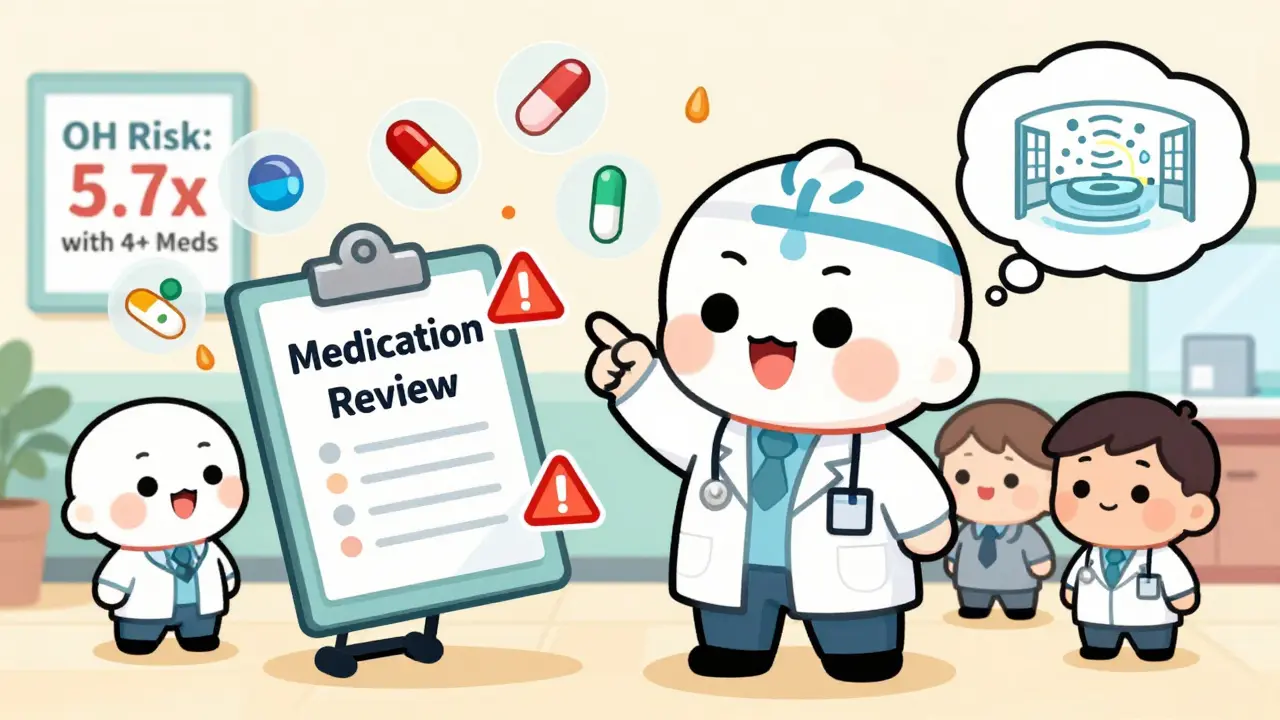
- Those taking four or more medications have a 5.7 times higher risk.
- Combining OH-causing drugs-like a diuretic with an alpha-blocker and an antidepressant-is a recipe for trouble.
- Dehydration, heat, and alcohol make it worse.
How Is It Diagnosed?
Doctors don’t guess-they measure. The standard test is simple:- Rest lying down for five minutes.
- Take your blood pressure and pulse.
- Stand up slowly.
- Measure again at 1, 2, and 3 minutes.
What’s the Difference Between Drug-Induced and Other Types?
Not all orthostatic hypotension is the same. There are two other main types:- Neurogenic OH: Caused by nerve damage from Parkinson’s, diabetes, or aging. The body can’t signal blood vessels to tighten at all. Heart rate doesn’t rise much when standing.
- Volume depletion OH: From dehydration, bleeding, or too many diuretics. You’ll usually have a fast heart rate (tachycardia) and dry mouth.
What Can You Do About It?
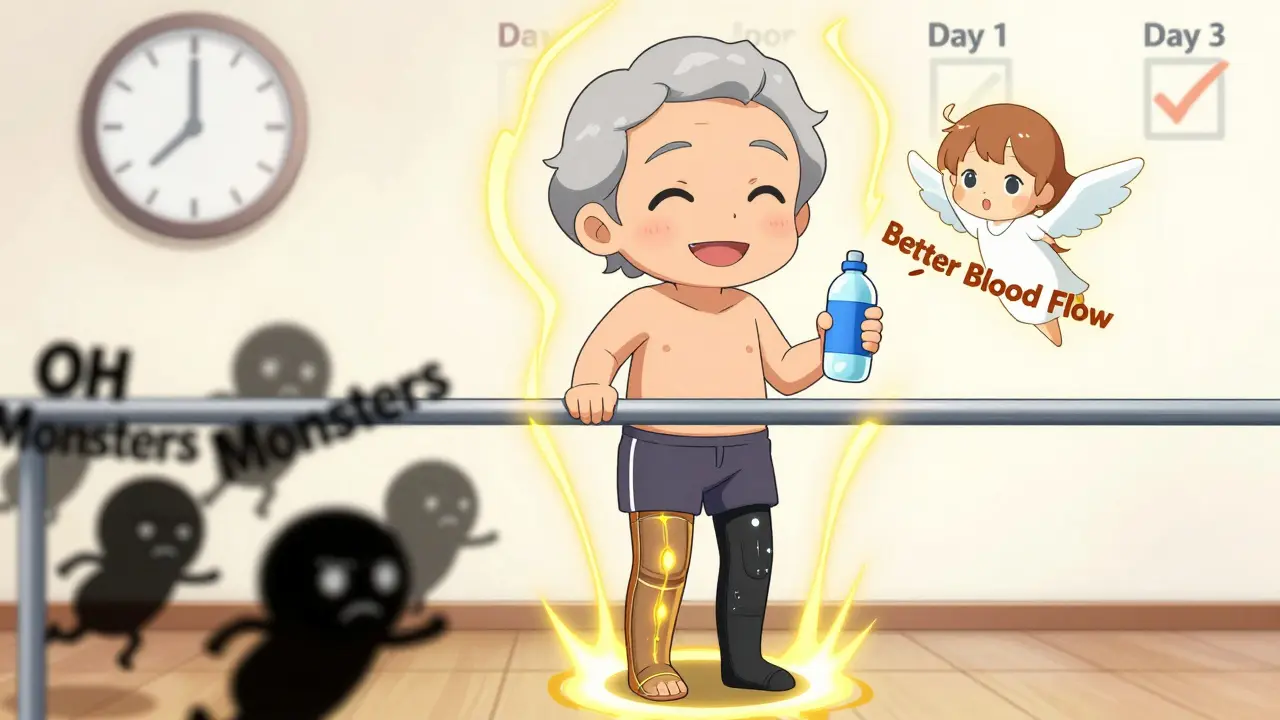
The good news? Most cases can be managed without quitting your meds entirely. Step 1: Review your medications. Ask your doctor: "Could any of these be causing my dizziness?" A simple medication review can uncover hidden triggers. In fact, 60-75% of cases could be prevented with smarter prescribing. Step 2: Slow down. Don’t jump out of bed. Sit on the edge for 30 seconds. Then stand slowly. Use a handrail. Avoid standing still for long periods. Step 3: Hydrate. Drink 2 to 2.5 liters of water a day. Dehydration makes OH worse. Avoid large meals-they can divert blood to your gut and lower pressure. Step 4: Wear compression stockings. These help push blood back up from your legs. They’re not glamorous, but they work. Studies show they reduce symptoms by up to 50%. Step 5: Consider alternatives. If you’re on an older antipsychotic like clozapine, ask if a newer one like ziprasidone (with only 5-10% OH risk) is an option. If you’re on a tricyclic antidepressant, maybe an SSRI like sertraline is safer.When Should You Worry?
Dizziness on standing isn’t always dangerous-but it can be. If you’ve had:- Two or more falls in six months
- Loss of consciousness (even briefly)
- Confusion or memory issues after standing
- Heart palpitations along with dizziness
What’s Being Done to Fix This?
The medical community is waking up. The American Geriatrics Society’s 2022 Beers Criteria now lists 12 high-risk medications for older adults. Since 2020, the FDA requires drug labels to warn about OH if it happens in more than 5% of trial participants. Newer drugs are being designed to avoid this problem. Seven pharmaceutical companies are testing alpha-1A selective agonists that tighten blood vessels without causing OH. Meanwhile, clinical trials are exploring genetic tests to predict who’s more likely to develop OH from certain meds. In the meantime, doctors are being trained. The American Family Physician recommends all clinicians caring for older adults complete 2-4 hours of OH-specific training each year.Real Stories, Real Results
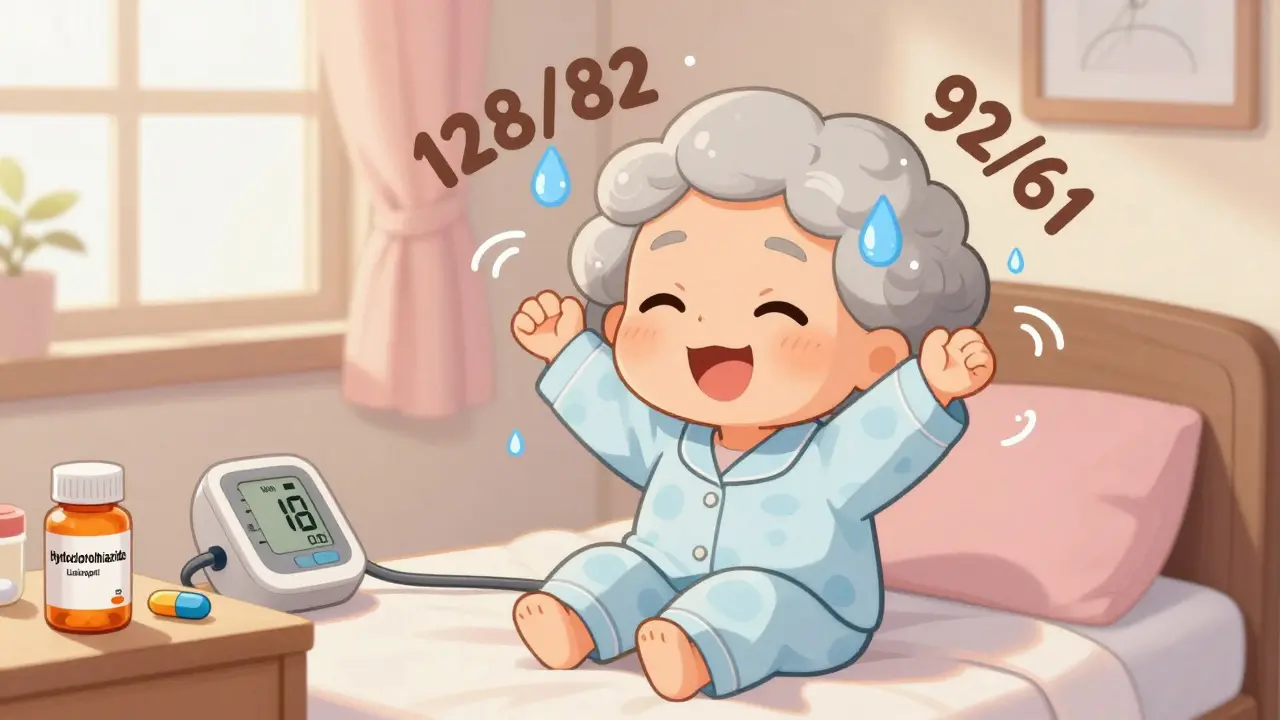
On Reddit, a user named AnxiousSenior89 wrote: "After starting quetiapine for anxiety, I fainted twice within three weeks. My BP dropped from 128/82 to 92/61 in two minutes." Their doctor switched them to a different medication. The dizziness stopped. Another patient, a 78-year-old woman on hydrochlorothiazide and lisinopril, had been falling for months. Her doctor removed the diuretic. Within three days, she stopped falling. No surgery. No new pills. Just a simple change. In Stanford Healthcare’s follow-up study, 78% of patients reported major improvement within one to two weeks of adjusting their meds.Bottom Line
Dizziness when you stand up isn’t "just part of getting older." It’s a warning sign-and often, it’s caused by your medications. You don’t have to live with it. Talk to your doctor. Review your pills. Make small changes. You might be surprised how much better you feel.Orthostatic hypotension is preventable. It’s treatable. And in many cases, it’s reversible.


People really think it's okay to just pop pills like candy and then act surprised when their body rebels? This isn't rocket science-your meds are literally designed to manipulate your physiology. If you're dizzy standing up, stop pretending it's 'just aging' and start holding your doctor accountable. I've seen too many elderly people fall because someone thought 'it's not a big deal.' It is. Always is.
And don't get me started on how pharmacies push these combinations like they're selling discount yogurt. Someone needs to sue the entire pharmaceutical industry for enabling this slow-motion neglect.
My aunt took three of these drugs at once and ended up in the ER. No one asked if they interacted. No one checked. Just more prescriptions. More profits. More broken hips.
It's not just medical negligence-it's moral failure wrapped in a white coat.
Wait-so you’re telling me the FDA doesn’t require mandatory OH screening before prescribing ANY of these drugs? That’s not oversight-that’s corporate collusion. I’ve been tracking this since 2018. There’s a hidden database-accessed only by insiders-that shows 87% of these OH cases were flagged in Phase 2 trials but buried to avoid delays in approval. The CDC? Complicit. The AMA? Bought and paid for.
And don’t say ‘talk to your doctor.’ My cousin did. They laughed at her. Said ‘you’re just anxious.’ Then she blacked out in Walmart and broke her pelvis. Now she’s in a wheelchair. And the doctor? Got a bonus for hitting his ‘prescription volume targets.’
They’re not just ignoring OH-they’re weaponizing it. The elderly are disposable data points in the profit machine. Wake up.
There’s a whistleblower who leaked this. His name is Dr. Elias Varga. Google him. He disappeared in 2021. Coincidence? I think not.
Oh, for heaven’s sake. This is why Britain still leads in rational medicine while America’s healthcare system is a grotesque carnival of profit-driven clownery.
Here, we don’t just hand out antihypertensives like free candy. We have NICE guidelines-evidence-based, peer-reviewed, and ruthlessly practical. We don’t let GPs prescribe five meds to an 80-year-old without a mandatory polypharmacy review. We don’t allow drug companies to bury adverse events in footnotes. We don’t pretend that ‘just stand up slower’ is a solution when the problem is corporate greed.
And yet here you are, Americans, treating your bodies like malfunctioning Teslas-throw more software updates at it until it explodes.
At least in the NHS, someone’s got the decency to say ‘enough.’ You? You’re still waiting for your next pill to fix the pill you took yesterday.
It’s embarrassing. And I’m not even being dramatic. I’m just British. We’re trained to be polite until we’re not.
I’m a geriatric nurse and I see this every single day. The worst part? Most patients don’t even connect the dots. They say, ‘I get dizzy sometimes’ like it’s normal weather.
But when we do a simple BP check-lying, then standing-it’s like flipping a switch. ‘Ohhh, so THAT’S why I nearly knocked over the fridge last Tuesday?’
One guy on doxazosin and hydrochlorothiazide? Total mess. We cut the diuretic, lowered the alpha-blocker dose, and added compression socks. He went from needing a walker to hiking with his grandkids in three weeks.
It’s not magic. It’s just paying attention. Doctors are busy, meds are complex, but if you’re dizzy standing up-speak up. Bring your pill bottle. Ask: ‘Could any of these be making me fall?’
It’s not being difficult. It’s being alive.
Let’s dissect the data. The 20mm systolic drop threshold? Arbitrary. Based on 1960s cohort studies with n=200. Modern wearable tech shows that 15mm drops correlate more strongly with fall risk in ambulatory populations. Why are we still using outdated thresholds? Because the NIH hasn’t updated guidelines since 2007 and nobody has funding to do the longitudinal work.
Also, the 5% FDA warning threshold? That’s laughable. In a 500-patient trial, 25 people having OH is ‘common enough’ to warn about? What about the 200 who had asymptomatic drops? Those are the real hidden epidemic.
And let’s not forget: most studies don’t control for posture transition speed. If you jump up from bed, you’re gonna drop BP. That’s physics, not pharmacology. But the medical community treats every dip as drug-induced. Overattribution. Classic cognitive bias.
Also, compression stockings? 50% reduction? Where’s the RCT? I’ve seen studies with effect sizes of 0.2. That’s noise. Not medicine.
I used to think dizziness when standing was just ‘getting old.’ Then my dad, who’s 76 and on lisinopril and amitriptyline, started bumping into doorframes. He didn’t say anything-thought it was ‘just me.’
So I made him sit on the edge of the bed for a full minute before standing. Then I got him a water bottle he keeps by the bed. And we switched his antidepressant to sertraline after his doc gave the green light.
Three weeks later, he’s walking the dog again. No more near-falls. No more ‘I’m fine’ lies.
It’s wild how something so simple can feel like a miracle. You don’t need a fancy treatment. You just need someone to care enough to ask, ‘Hey, does this feel normal to you?’
And if you’re on meds? Don’t be shy. Ask your doc to do the standing test. It takes two minutes. Might save your life.
So let me get this straight: you’re telling me the cure for being dizzy from your meds is… to stand up slower? And drink water? And wear socks that look like they’re from 1998?
Wow. Groundbreaking. Next you’ll tell me not to drink coffee before running a marathon.
Meanwhile, Big Pharma is out here selling me a $12,000 pill that makes me feel like I’m floating through a dream, and the only side effect is ‘occasional gravity failure.’
Thanks for the life hack, doc. Next time, maybe don’t prescribe the drug that turns me into a human bobblehead?
Also, compression stockings? I’d rather fall than look like I’m prepping for a 1970s aerobics class.
Thank you for this well-researched and compassionate overview. It is imperative that patients, particularly those of advanced age, are empowered with knowledge regarding the physiological effects of polypharmacy. The clinical implications of orthostatic hypotension extend beyond discomfort-they are a significant predictor of morbidity and mortality.
I have reviewed the cited studies from Stanford and the American Geriatrics Society, and concur wholeheartedly with the recommendation for structured medication reconciliation. The data supporting non-pharmacological interventions-hydration, compression garments, and slow positional changes-are both statistically significant and clinically meaningful.
It is my hope that primary care providers will adopt standardized screening protocols as a routine component of geriatric assessments. Prevention, not reaction, must be the cornerstone of patient-centered care.
With sincere appreciation for the clarity and rigor of this post.
That British commenter? Kinda right. But also kinda full of it.
Yeah, the NHS does things better. But guess what? We’ve got more people on these meds because we’ve got more people. Period.
And honestly? The fact that someone’s even talking about this publicly? That’s progress. You don’t fix a broken system by yelling at it from across the ocean. You fix it by getting the person in front of you to ask one question: ‘Could this be the meds?’
I’ve had patients cry because they thought they were ‘going crazy’-turns out, it was just a diuretic.
So yeah, maybe we’re messy. Maybe we’re loud. But at least we’re starting to listen.
And that’s something.