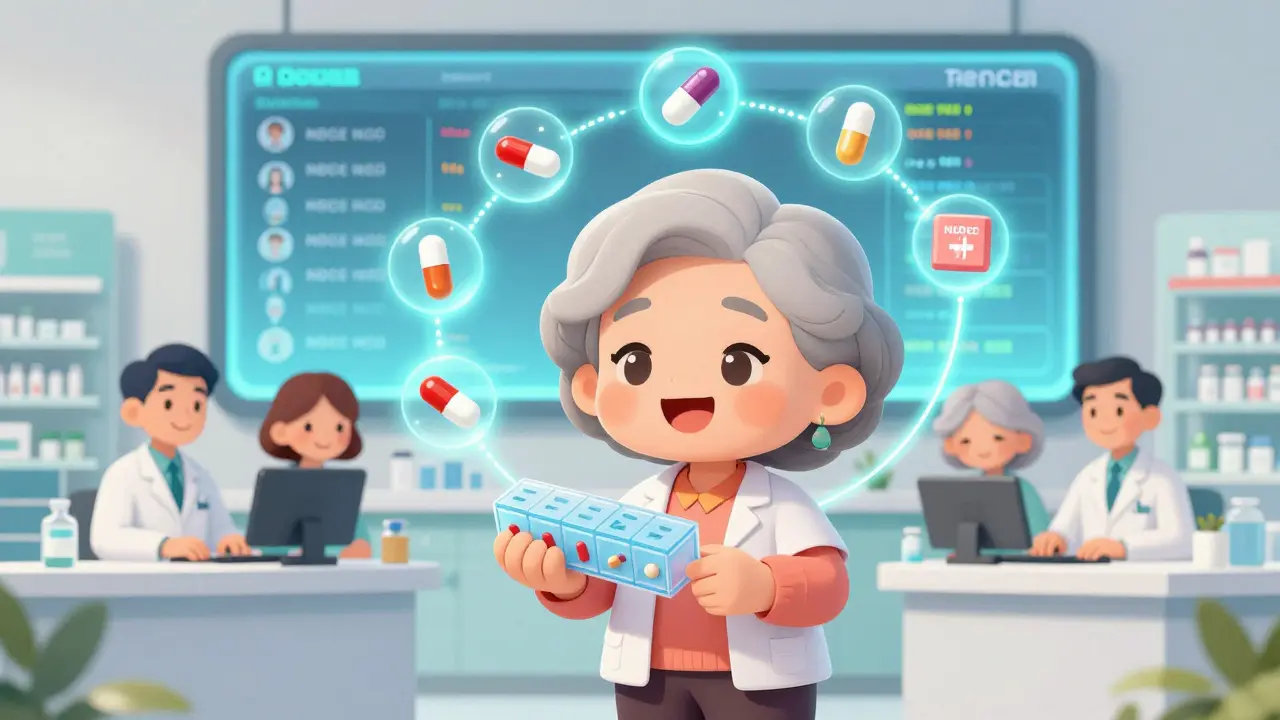
Managing multiple pharmacies and prescribers isn't just about keeping inventory straight or scheduling shifts. When seniors are taking five, six, or even more medications across several pharmacies, the risk of dangerous errors goes up fast. A pill that’s labeled differently at one location. A drug interaction missed because one pharmacy doesn’t know what another is filling. A prescriber changing a dose but not telling the pharmacist. These aren’t hypotheticals-they happen every day, and they can kill.
The solution isn’t more staff or more meetings. It’s a centralized system that connects every pharmacy, every prescriber, and every patient record into one clear, real-time view. This isn’t science fiction. It’s what top pharmacy chains use today to keep seniors safe.
Why Centralized Systems Are Non-Negotiable
Without a central system, each pharmacy operates like an island. One store has Mrs. Johnson’s blood pressure meds. Another has her diabetes script. A third has her painkiller. No one talks. No one sees the full picture. That’s how duplicate prescriptions happen. That’s how dangerous interactions slip through.
Research shows that multi-location pharmacies without centralized drug databases make medication errors in 1.3% of all prescriptions. That might sound small, but for a senior on six drugs, that’s a 1 in 77 chance of getting something harmful. And those errors don’t just cause stomach upset-they lead to ER visits, hospitalizations, and death.
Centralized systems fix this by enforcing one universal drug file. Every pharmacy, no matter the location, uses the same name, strength, and NDC code for every medication. No more confusion between “Lisinopril 10 mg” and “Lisinopril-HCTZ 10-12.5.” No more mix-ups from different brand names. It’s simple: one standard across all locations.
Key Features That Save Lives
Not all pharmacy software is built the same. The best systems for managing multiple locations have four non-negotiable features:
- Universal Drug File: Every medication has one approved name, dosage, and code across all pharmacies. This eliminates 17% of errors caused by inconsistent naming.
- Real-Time Patient Profiles: When a pharmacist at Store A fills a script, Store B instantly sees it. No waiting. No faxing. No guesswork. EnterpriseRx’s real-time access has been shown to cut duplicate therapy incidents by 29%.
- Automated Interactions and Alerts: If a new prescription conflicts with an existing one-say, adding an NSAID to someone already on blood thinners-the system flags it before the pill leaves the counter.
- Watchdog Monitoring: Systems like Datascan’s AI Watchdog 2.0 scan all locations 24/7 for patterns that suggest diversion or abuse. In beta tests, it caught 92.4% of suspicious activity before it became a problem.
These aren’t optional upgrades. They’re safety nets. And for seniors on complex regimens, that’s everything.
Top Systems Compared
There are three major platforms dominating the market today. Each has strengths depending on your needs.
| System | Best For | Key Advantage | Limitation |
|---|---|---|---|
| EnterpriseRx by McKesson | Large chains with high volume | Reduces prescription wait times by 32% with load balancing; integrates with Epic EHR for direct prescriber communication | $450/month per location (discounts at 15+ stores); requires Windows 10+ server |
| PrimeRx by PioneerRX | Chains focused on patient convenience | 99.98% uptime; lets patients choose any location as their preferred pickup spot | Less robust clinical decision support compared to others |
| DocStation | Chains offering clinical services | 87% of users report higher revenue from vaccines and billing; FIDO2 security keys cut unauthorized access by 94% | Complex setup; training takes 3+ weeks for full adoption |
For most chains, EnterpriseRx is the gold standard. It’s used by 31% of pharmacies with 10+ locations. But if your focus is on immunizations, flu shots, or chronic care management, DocStation’s integrated billing tools make it the better pick. And if patient choice matters most-like letting Grandma pick up her meds at the store near her daughter’s house-PrimeRx delivers.

How to Avoid Implementation Mistakes
Switching systems sounds simple. But 27% of chains experience prescription history errors during migration. That means patients show up with no record of their meds. That’s dangerous.
Here’s how to do it right:
- Start with one hub. Pick one location as the central database. All drug files, pricing, and patient records live here first.
- Migrate slowly. Don’t move all 12 stores at once. Do 2-3 per week. Monitor for errors. Fix before moving on.
- Train like it’s life-or-death. Pharmacists need 24 hours of training. Technicians need 16. Use vendor-certified trainers, not internal staff. Chains that do this see 12% higher adoption.
- Verify 100% of active profiles. After migration, manually check 10% of each patient’s history. If you find discrepancies, pause and fix them before continuing.
And never forget: the system doesn’t replace the pharmacist. It supports them. The best systems use the hub-and-spoke model-centralized data, but local clinical judgment. A pharmacist at each location still reviews every script. The system just gives them the full picture.
What Happens If You Don’t Act
Regulators aren’t waiting. CMS now requires multi-location pharmacies to prove they track cross-location errors to qualify for Medicare Part D contracts. Chains without centralized systems are being denied participation.
And it’s only getting stricter. By 2027, the Pharmacy Quality Alliance predicts that any chain with 3+ locations must use a centralized system to operate legally. Why? Because the number of multi-pharmacy regulatory requirements has jumped 22% every year since 2020.
Meanwhile, the cost of doing nothing is rising. A 2023 study found that chains using non-centralized software had 23% more billing discrepancies between locations. That’s lost revenue. But worse-it’s patient risk.
What’s Next? AI and Blockchain
The next wave is already here. Datascan’s AI Watchdog 2.0, launched in January 2024, analyzes prescription patterns across all locations to spot diversion before it happens. It’s not just flagging duplicates-it’s predicting abuse.
And blockchain? Outcomes.com’s 2023 pilot reduced prescription fraud by 67% in multi-location settings by creating an unchangeable digital trail for every script. No more forged prescriptions. No more “lost” refill requests.
But here’s the catch: these upgrades cost money. By 2025, CMS will require all systems to support FHIR APIs. Sixty-three percent of current software can’t do that without a $200,000+ overhaul. If you’re still using a basic system from 2018, you’re not just behind-you’re at risk.
Final Thought: Safety Isn’t a Feature. It’s the Foundation.
Managing multiple pharmacies and prescribers isn’t about efficiency. It’s about survival. Seniors don’t care how fast your system runs. They care that their meds don’t clash. That their refill doesn’t vanish because one pharmacy didn’t sync. That their doctor’s new instructions actually reached the pharmacist.
The right system doesn’t just track pills. It connects people. It stops errors before they start. And in a world where one wrong dose can end a life, that’s not just smart-it’s essential.

This is straight-up life or death stuff. I've seen grandmas get double-prescribed because one pharmacy didn't talk to the other. One wrong pill. One silent error. That's it. No second chances.
Centralized systems aren't a luxury. They're the bare minimum.
My aunt’s pharmacy switched to one of these systems last year and honestly? She hasn’t had a single mix-up since. She says the pharmacists actually have time to talk to her now instead of scrambling with paperwork. Small wins matter.
I just want to say thank you to whoever wrote this 🙏 I’ve been worried about my mom’s meds for years. This made me feel like there’s hope. I’m gonna print this out and show her pharmacist tomorrow 💯
so like... i work at a small chain and we use some ancient software from like 2015 and yeah we probs have errors but like... its not that bad right? i mean people still get their meds and no one's died yet? also why is everyone so obsessed with enterprise rx? its so expensive and my boss says we cant afford it
I work in a pharmacy in Manchester and we’re on PrimeRx. The patient choice feature? Game changer. My 78-year-old mum can pick up her meds at my sister’s local store 20 miles away. She doesn’t have to drive across town. That’s dignity. That’s care. And yeah, the clinical alerts aren’t perfect - but they’re better than nothing. Don’t let perfect be the enemy of good.
This whole post is just corporate propaganda. You want us to hand over patient data to some Silicon Valley software giant? What’s next? NSA monitoring prescriptions? We don’t need ‘centralized systems’ - we need less government meddling and more personal responsibility.
There’s a deeper philosophical question here: if a system prevents harm by removing human judgment, are we trading autonomy for safety? A pharmacist’s intuition - their experience reading between the lines - can sometimes catch what algorithms miss. Maybe the goal isn’t total centralization, but augmentation. The machine sees patterns. The human sees context.
Oh wow. Another ‘trust the tech’ sermon. Let me guess - you also think self-driving cars will eliminate all accidents? That AI will never make a mistake? Wake up. These systems are built by people who’ve never met a patient. They don’t know Mrs. Johnson takes her blood pressure med with grapefruit juice because she hates water. Algorithms can’t account for that. And yet they’re being forced on us. This isn’t progress. It’s control.
I’ve been thinking about this a lot lately... especially after my grandma’s hospitalization last year. It wasn’t one mistake. It was a chain. One pharmacy didn’t update. The prescriber forgot to notify. The nurse misread the label. The system didn’t connect them. I just... I wish we’d had this. Not because it’s perfect, but because it could’ve stopped the first domino.
this is so important thank you for sharing i just started working at a multi location pharmacy and i had no idea how bad it was until last week when a patient came in asking why they were getting two different versions of the same med lol i cried a little then i went to my manager and now we’re pushing for an upgrade 💕
Let’s cut the crap. EnterpriseRx isn’t just ‘the gold standard’ - it’s the only one that actually saves lives. DocStation? Great for vaccines. PrimeRx? Cute for convenience. But if you’re managing 10+ locations and you’re not on EnterpriseRx, you’re gambling with people’s lives. Stop making excuses. Upgrade or get out.
i read this on my phone at 2am after a double shift. i work in a small town. we dont have the budget. but i still check every script twice. and i still talk to every patient. maybe the system helps... but its the people who keep them safe. just wanted to say that. sorry for the typos. tired.
Honestly? If you’re still using anything before 2020, you’re basically running a pharmacy out of a shoebox. 🤦♀️ I’ve seen the data. Chains without FHIR compliance are already being audited. You think CMS is playing around? They’re coming for you. And if you don’t have the budget? Then you shouldn’t be in this business. Period.
Wow. So we’re just supposed to blindly trust that the ‘AI Watchdog 2.0’ won’t flag my diabetic aunt’s insulin because it ‘looks suspicious’? Oh wait - it already did. Last month. They locked her account. Took three days to fix. Turns out she was refilling early because her dog knocked over the bottle. 🤡 So now what? We replace human judgment with a bot that thinks a 72-year-old woman is a ‘diversion risk’? Brilliant.
I appreciate the depth of this post. As a professional in health systems management, I can confirm the data presented is accurate and well-sourced. The hub-and-spoke model isn't just ideal - it's the only ethically defensible approach. We must balance operational efficiency with clinical integrity. The technology exists. The question is whether we have the collective will to implement it.