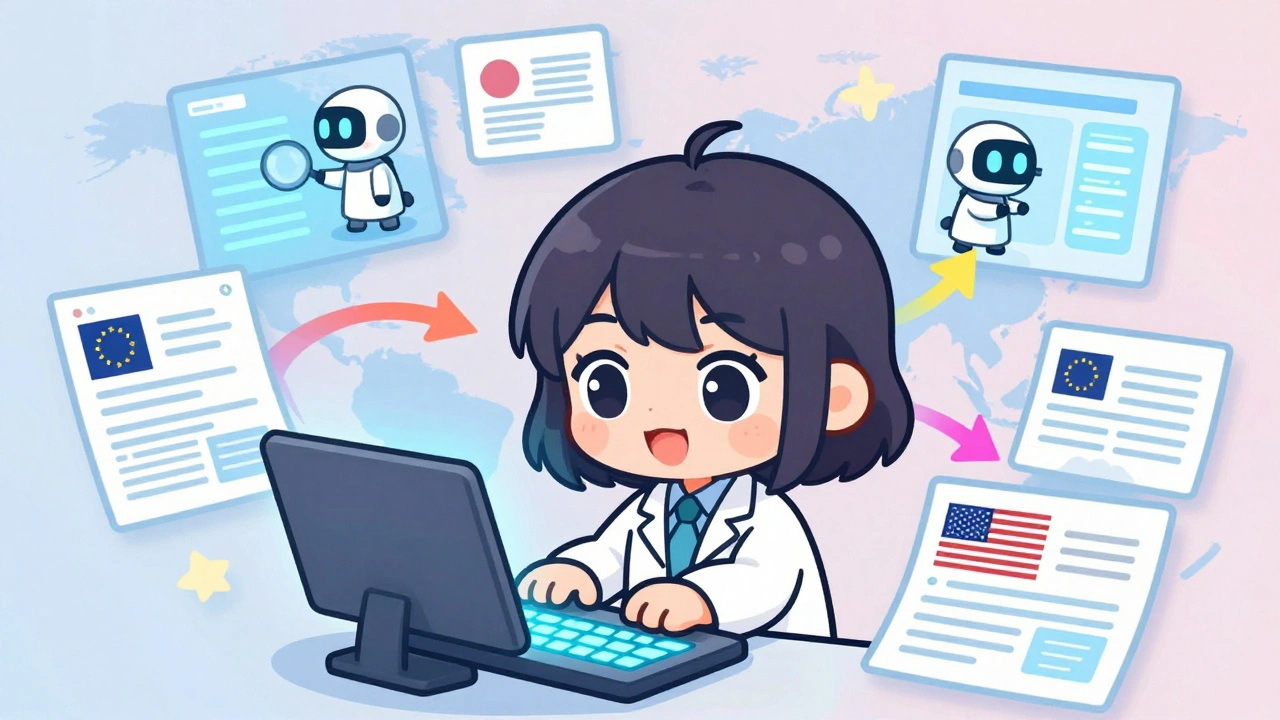
Every year, millions of people take generic medicines made in one country and used in another. But when something goes wrong-a rare side effect, a dangerous interaction, an unexpected reaction-how do regulators know? And how do they act fast enough to protect patients across borders? The answer lies in pharmacovigilance harmonization, the quiet but critical effort to make drug safety monitoring the same everywhere.
Why harmonization matters more than ever
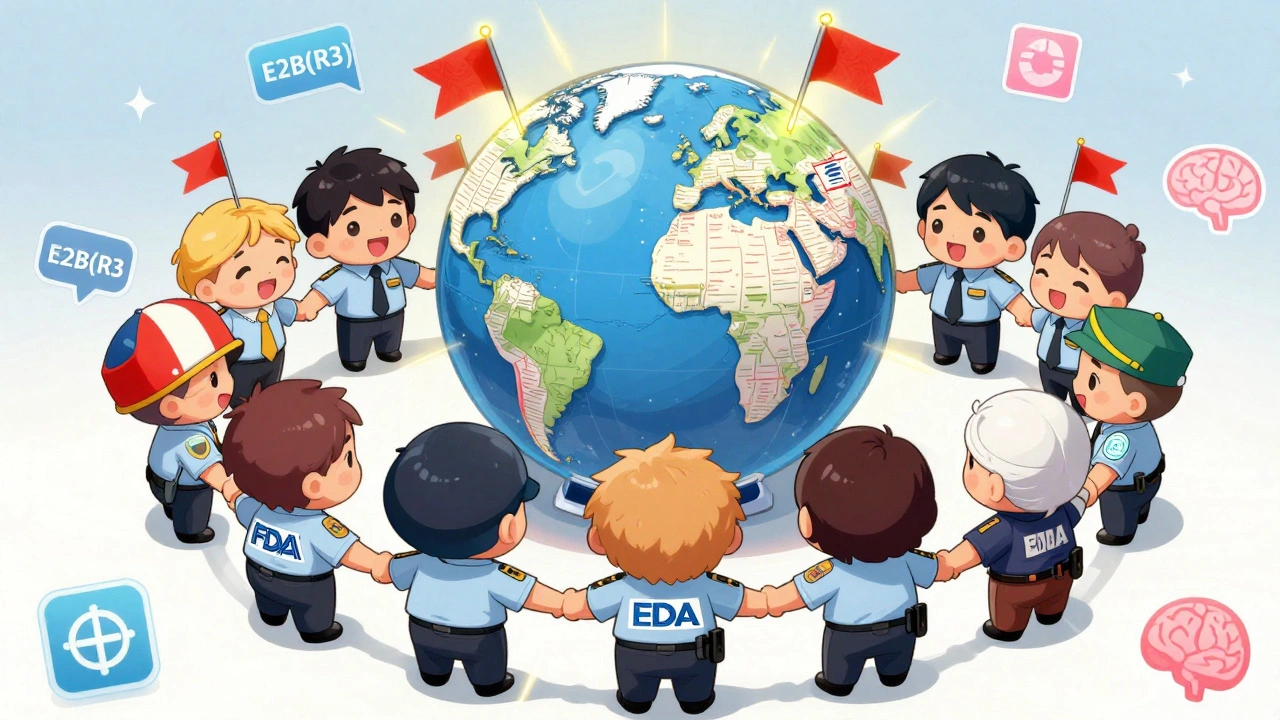
Before 1990, every country had its own rules for tracking bad reactions to drugs. A patient in Germany had a reaction to a medicine made in India. The same drug was sold in Brazil. But the reports didn’t connect. The signal got lost. That’s not just inefficient-it’s dangerous. The International Council for Harmonisation (ICH) was created to fix that. Its goal? Make sure a serious adverse event reported in Tokyo is treated the same way as one reported in Chicago or Cape Town. Today, over 130 countries use the ICH E2B(R3) standard to send safety reports electronically. That means data flows faster, duplicates drop, and red flags show up sooner. The impact is real. The FDA estimates harmonization cuts time to market by 15-20%. It also prevents unnecessary clinical trials involving about 2.5 million patients every year. That’s not just cost savings-it’s lives saved by avoiding redundant exposure to unproven risks.How the system works: ICH guidelines and real-world tools
The backbone of global pharmacovigilance is the ICH E2 series. These aren’t suggestions. They’re binding standards for how companies report adverse events, manage risks, and update safety data.- E2B(R3): The electronic format for Individual Case Safety Reports (ICSRs). Used by 89% of the top 50 pharma companies since 2020.
- E2E: Defines how Risk Management Plans (RMPs) should be structured-what to include, how to update, how to communicate.
- PSURs: Periodic Safety Update Reports that summarize all known risks after a drug is on the market.
Regional differences: Who’s ahead, who’s behind
The U.S. FDA, the European Medicines Agency (EMA), and Japan’s PMDA are the big three. They’ve mostly aligned on core reporting formats. But their rules still clash.- USA: Only sponsor-adjudicated serious events need expedited reporting. The FDA focuses on what’s truly unexpected and likely caused by the drug.
- EU: All serious adverse events, regardless of causality, must be reported within 15 days. More data, more noise.
- Japan: Uses its J-STAR system to analyze 12 million patient records. Their AI models cut false positives by 25% since 2023.
- China: Requires local reporting within 15 days-same as the EU-creating duplication for global firms.
- Canada: Follows ICH closely but requires 30-day reporting for serious events.
Technology is changing the game
The old way? Humans reading through thousands of paper reports. Today? AI is stepping in. The EMA and FDA started using machine learning in 2022 to scan safety data. Results? Signal detection got 30-40% faster. Japan’s PMDA built an AI model that reduced false alarms by 25%. That’s huge. False positives waste time, delay real actions, and burn out teams. Real-world data (RWD) is another game-changer. The EU now requires EHR integration for signal detection. The FDA’s Sentinel Initiative monitors 300 million patient records. EMA’s DARWIN EU covers 100 million. That’s not just clinical trial data-it’s what’s happening in real clinics, pharmacies, and homes. But here’s the problem: not all countries can afford this. Brazil and South Africa can’t process more than 15% of their potential RWD sources. The tech gap isn’t just about money-it’s about training, language, and systems.The hidden cost of not being aligned
Harmonization isn’t just about safety. It’s about money. TransCelerate Biopharma, which represents Pfizer, Johnson & Johnson, and 17 other big players, found that inconsistent rules raise global pharmacovigilance costs by 22%. Why? Because companies have to run parallel systems: one for the EU, one for the U.S., one for Japan, and then patchwork solutions for emerging markets. A Novartis case study showed that switching to a single global safety database cut duplicate case entry by 92%. It also cut the time to detect critical safety signals by 38 days. That’s two months faster to act when a drug might be harming people. The global pharmacovigilance market is worth $5.8 billion in 2023 and will hit $11.2 billion by 2028. But most of that growth is in AI tools and outsourced services. The top five providers-Parexel, IQVIA, PPD, ICON, Syneos Health-control 62% of the market. Companies are outsourcing more because keeping it in-house is too complex.
It's wild how we treat drug safety like it's a national sport instead of a global human right. I grew up seeing generics from India save my grandma's life - cheap, effective, no drama. But then I learned how many places can't even report a bad reaction because their internet cuts out at 6 PM. We're not just failing systems - we're failing people. Why does a patient in Lagos deserve less protection than one in Boston? It's not about tech. It's about will.
So we spent 30 years building a global safety net... and now we're outsourcing it to AI that doesn't speak Hindi or Swahili? Cool. Real cool.
The ICH E2B(R3) standard is a masterpiece of bureaucratic elegance - standardized, machine-readable, and universally adopted by 89% of top-tier pharma. Yet, the real bottleneck isn't the format - it's the human infrastructure. In low-resource settings, pharmacovigilance officers still fax reports on carbon paper. The digital divide isn't a gap - it's a canyon. And until we fund training, translation, and local regulatory capacity, we're just digitizing inequality.
It is, of course, profoundly regressive to suggest that harmonization could lead to a reduction in preventable mortality - particularly when one considers the epistemological limitations inherent in post-marketing surveillance frameworks predicated upon voluntary reporting. One must interrogate the ontological status of 'safety' itself when it is operationalized through algorithmic proxies in contexts devoid of clinical epistemic authority.
Wait - so you're telling me the FDA and EMA are finally getting along? That's cute. Like two toddlers sharing a toy. Meanwhile, the rest of the world is still using sticky notes and hope. And don't even get me started on how 'AI detects signals' - yeah, right. Last time I checked, AI just finds patterns in garbage data. If the input is trash, the output is just trash with a fancy label.
India makes 40% of the world's generics. But our reporting system? Still stuck in 2005. No AI. No E2B. Just a guy in a cubicle with Excel. We're the backbone of global medicine and the blind spot of safety. Fix this or we'll keep being the graveyard for side effects no one sees
So now we're supposed to trust a bunch of foreign regulators who can't even spell 'pharmacovigilance' correctly? The U.S. has the best system. The rest of the world is just trying to copy us while using outdated tech. Why not just let America lead? We know what's safe. We have the FDA. End of story.
My cousin in Manila took a generic antibiotic and got sick. No one ever heard about it. But when my friend in LA had a reaction to a brand-name drug? The whole FDA website lit up. That's not safety - that's privilege. We need to fix this. Not because it's efficient. Because it's right.
AI detecting signals? Sure. And I'm sure the same AI that 'reduced false positives by 25%' also flagged my cat's sneeze as a 'life-threatening cardiac event'. This whole system is a corporate shell game. Big Pharma funds the AI, the regulators depend on their data, and the patients? They're the lab rats in a global spreadsheet. You think they care about ICH standards? They care if their medicine kills them. And right now? Too many are just numbers in a database.
I've read this entire post twice. It's complex, but it makes sense. The real challenge isn't the tech or the standards - it's the human cost of misalignment. A woman in Jakarta might take the same pill as a man in Toronto, but if one gets help and the other doesn't, what does 'harmonization' even mean? We need equity, not just efficiency. And that means listening to the people who report the reactions, not just the ones who write the reports.
Let's be honest - this whole harmonization push is just Big Pharma's way of cutting costs. They don't care about Nairobi or Lima. They care that their compliance teams aren't wasting time rewriting reports. And now they want AI to do the rest? You think a machine understands cultural context? That a woman in rural India reporting a rash isn't just scared, but also ashamed? No. It just codes it as 'skin eruption' and moves on. This isn't progress. It's erasure.