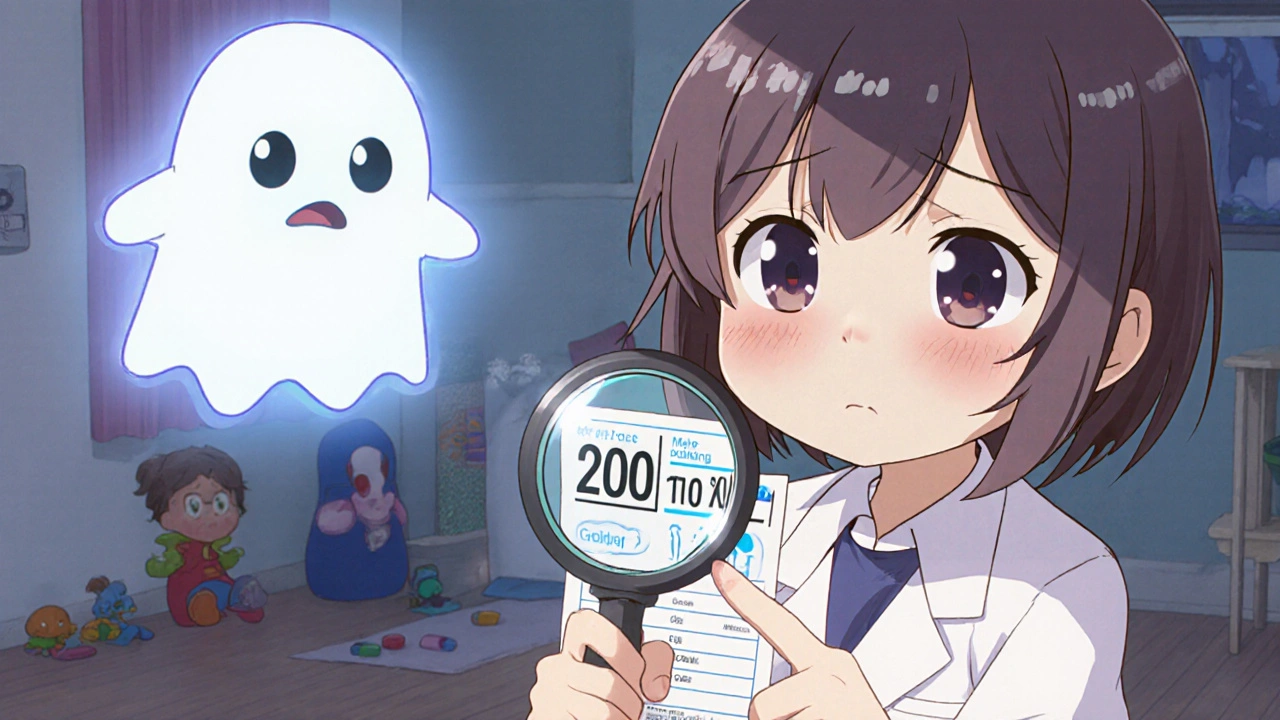
When your child gets a new prescription, the label might say 10 mL - but that’s not the dose. The real dose is 200 mg. Mixing up volume and medication amount is one of the most dangerous mistakes parents and even some providers make. Every year, thousands of children are at risk because dosing errors slip through. The good news? You can catch them - if you know what to look for.
Why Pediatric Dosing Is Different
Children aren’t small adults. Their bodies process medicine differently. A dose that’s safe for a 150-pound teen could be deadly for a 20-pound toddler. That’s why pediatric dosing isn’t based on age alone - it’s calculated using weight, usually in kilograms (kg). The American Society of Health-System Pharmacists (ASHP) and the American Academy of Pediatrics (AAP) both require weight-based calculations for all children’s prescriptions. This isn’t just best practice - it’s the standard. And according to the Institute for Safe Medication Practices, over half of all pediatric medication errors are dosing mistakes.One wrong decimal point. One missed conversion from pounds to kilograms. One confusing concentration. That’s all it takes. Pennsylvania Patient Safety Authority data shows that 91.6% of serious pediatric medication incidents involved dose calculation issues. Most of these aren’t caused by doctors being careless - they’re caused by systems that don’t catch simple errors.
What to Look for on the Prescription Label
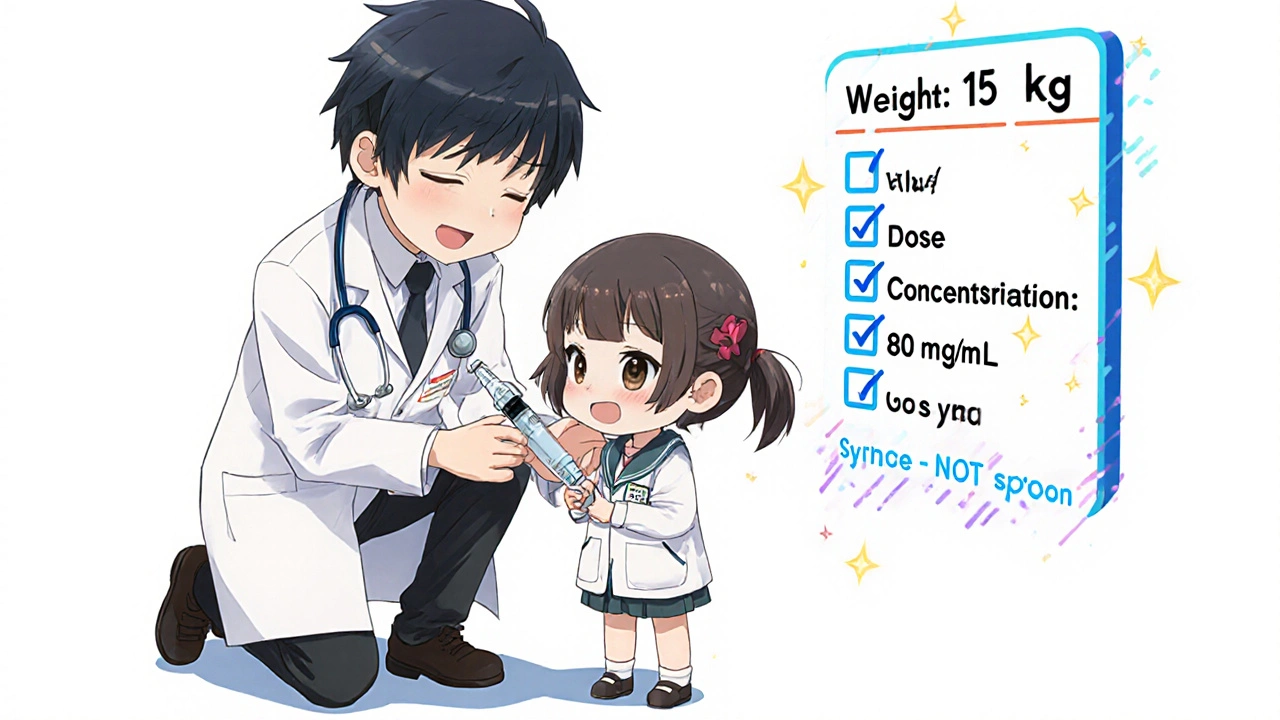
The label should include four critical pieces of information - if it doesn’t, ask for them:- The child’s weight in kilograms (kg) - not pounds. If you see lbs, ask for the kg equivalent.
- The exact dose in milligrams (mg) - not milliliters (mL). The mg is the actual amount of medicine. The mL is just how much liquid to give.
- The concentration - usually written as mg/mL (e.g., 80 mg/mL or 40 mg/mL). This tells you how strong the liquid is.
- The frequency - how many times per day (e.g., every 8 hours, twice daily).
For example, a correct label might read: “Weight: 15 kg. Dose: 300 mg amoxicillin. Concentration: 80 mg/mL. Give 3.75 mL every 12 hours.” If you see only “Give 3.75 mL” without the mg, that’s a red flag.
How to Verify the Dose Yourself
You don’t need to be a pharmacist to double-check. Here’s how to do it in four simple steps:- Convert weight to kg - If your child weighs 33 pounds, divide by 2.2: 33 ÷ 2.2 = 15 kg. Never round this number. Even 0.1 kg matters.
- Find the dose per kg - The prescription should say something like “10 mg/kg.” Multiply that by your child’s weight: 10 mg/kg × 15 kg = 150 mg total daily dose.
- Divide by frequency - If it’s given twice a day, divide the daily dose: 150 mg ÷ 2 = 75 mg per dose.
- Check the concentration - If the liquid is 80 mg/mL, divide the dose by the concentration: 75 mg ÷ 80 mg/mL = 0.94 mL. That’s less than 1 mL. If the label says “1 mL,” it’s wrong. The pharmacy should use a syringe that measures to 0.1 mL.
Here’s a real example from a parent’s near-miss: A 4-year-old was prescribed amoxicillin at 200 mg per dose. The label said “10 mL.” But the concentration was 20 mg/mL - so 10 mL meant 200 mg. That’s correct. But if the concentration had been 80 mg/mL, 10 mL would have been 800 mg - a 4x overdose. The parent caught it because they checked the mg, not just the mL.
Common Mistakes and How to Avoid Them
The biggest errors aren’t complicated - they’re subtle:- Confusing mL with mg - This is the #1 mistake. A dose of 10 mL is not 10 mg. Always ask: “What’s the mg amount?”
- Wrong concentration - Amoxicillin comes in different strengths: 40 mg/mL, 80 mg/mL, 125 mg/mL. Using the wrong one changes the dose dramatically. Always check the bottle’s label and the prescription together.
- Incorrect rounding - Some systems round 1.88 mL to 2 mL. That’s fine for some meds - but not for others. For antibiotics like amoxicillin-clavulanate, rounding can cause underdosing. Ask: “Is this rounded? Is it still safe?”
- Using kitchen spoons - A teaspoon isn’t 5 mL. A tablespoon isn’t 15 mL. Always use the syringe or dosing cup that comes with the medicine.
A 2022 study in BMC Pediatrics found that 43.5% of preventable adverse events in children came from mg/mL confusion. That’s not a small risk - it’s a major one.
What Pharmacists Are Required to Do
In hospitals and most pharmacies, pharmacists must verify pediatric doses using a dual-check system. That means two trained professionals independently calculate the dose. They document:“Ordered: 40 mg/kg/day. Reference range: 30-50 mg/kg/day.”
This isn’t optional. The ASHP’s 2021 guidelines make it mandatory. Even if you’re getting the prescription from a local pharmacy, ask: “Did two people check this dose?” If they say no, push for it. You’re not being difficult - you’re preventing a mistake.
Technology Is Helping - But You Still Need to Double-Check
EHR systems like EPIC and Cerner now flag unsafe doses. DoseSpot’s AI tool checks against 15,000+ guidelines with 99.2% accuracy. Smart pumps and connected scales are being tested to auto-verify doses. But none of these are perfect. EPIC’s system still missed 1.3% of dangerous doses in its 2022 validation study.Technology reduces risk - it doesn’t eliminate it. The FDA’s 2023 Safe Use of Pediatric Liquid Medicines guide says: “Parents are the final safety check.” That’s why they now require all liquid pediatric meds to show both metric and non-metric measurements on labels.

What to Ask the Pharmacist
Don’t just take the label. Ask these three questions:- “What is the exact dose in milligrams?” - Not mL. Not teaspoons. Milligrams.
- “Is this dose appropriate for my child’s current weight?” - Give them the weight in kg if you know it.
- “Can you show me how to measure this with the syringe?” - Watch them. Make sure they use the right tool.
One mother in Seattle caught a 3x overdose because she compared the label to the manufacturer’s dosing chart. The prescription said “10 mL,” but the chart said “2.5 mL” for her 18-month-old. She called the pharmacy - and they corrected it.
What to Do If Something Feels Off
Trust your gut. If the dose seems too small - like a drop for a 40-pound child - it might be right. Children need far less than adults. But if it seems too large - like 15 mL for a 15-pound baby - it’s probably wrong.Call the pharmacy. Call your pediatrician. Don’t wait. A 2022 Reddit analysis of 1,247 parenting threads showed that 68% of parents felt unsure about their child’s dose - and nearly half of those who spoke up caught an error.
And if you’re ever in doubt - don’t give the medicine. Call first. It’s better to be late than wrong.
Final Reminder: Always Use the Right Tool
Never use a kitchen spoon. Never guess. Always use the syringe or dosing cup that came with the medicine. If it’s missing, ask for one. Most pharmacies will give you one for free. A 1 mL syringe with 0.1 mL markings is ideal for small doses. A 5 mL syringe is fine for larger ones. But make sure you’re reading the numbers correctly - not the side of the syringe, but the top of the liquid.Medicine for children isn’t a guess. It’s a calculation. And you have the power to make sure it’s right.


Oh, wonderful. Another article that assumes parents are capable of doing high school math while juggling a screaming toddler, a laundry pile taller than Mount Everest, and a dog that just ate the prescription bottle. Of course, I’ll just whip out my calculator and convert 33 pounds to 15 kg… while simultaneously trying to stop my 2-year-old from licking the syringe. And yes, I’m sure the pharmacist will have time to walk me through the concentration like I’m a first-year med student-while I’m standing there in my pajamas at 2 a.m., holding a child who’s feverish and sobbing. Brilliant. Truly. 🤦♀️
While the emotional tone of this piece may be perceived as alarmist, the clinical and procedural rigor it upholds is both commendable and necessary. The Institute for Safe Medication Practices data cited is not merely anecdotal-it reflects systemic vulnerabilities in pediatric pharmacovigilance that have persisted for decades. The dual-check protocol mandated by ASHP is not a luxury; it is a non-negotiable safeguard. Moreover, the emphasis on weight-based dosing in kilograms aligns with international standards established by the WHO and the International Council for Harmonisation. This is not pedantry-it is precision. And in pediatric medicine, precision is the only acceptable standard.
India has been doing this since the 1980s-weight-based dosing, concentration labels, mandatory syringes. We don’t have time for ‘mommy blogs’ to discover what our pediatricians have known for generations. 😒 Also, why do Americans think 10 mL is a ‘dose’? In Delhi, we teach nurses this in nursing school. 🤷♂️ And yes, we use the syringe. No spoons. Ever. 🙃
I remember when my daughter was prescribed amoxicillin and the label just said ‘give 5 mL twice a day.’ I didn’t know the concentration. I was terrified. I called the pharmacy three times. They were annoyed. But I kept asking. Finally, they showed me the bottle: 40 mg/mL. That meant 200 mg per dose. Her weight was 12 kg. The recommended dose was 15–20 mg/kg. So 180–240 mg. 200 mg was perfect. I cried. Not because I was scared-I was proud. I did the math. I didn’t trust the label. I trusted myself. And I’m not a nurse. I’m just a mom who learned how to read. You can too. You already have the strength. You just didn’t know it yet.
Wait-did you just say EPIC missed 1.3% of dangerous doses? That’s 13 out of 1000. Thirteen children. That’s not a bug. That’s a failure. And you’re telling me parents are the ‘final safety check’? That’s not a feature-it’s a systemic abdication of responsibility. Hospitals have AI, smart pumps, dual verification-and yet they still push the burden onto exhausted caregivers? That’s not safety. That’s negligence dressed up as empowerment. We need mandatory federal labeling standards. We need pharmacist liability. We need audits. And we need to stop pretending that ‘asking questions’ is enough. It’s not. It’s a Band-Aid on a hemorrhage.
My kid’s prescription said ‘10 mL’ and I thought it was 10 mg. I almost gave it. Then I saw the concentration: 125 mg/mL. That’s 1250 mg. I called the pharmacy. They said, ‘Oh, that’s for a 70-pound kid.’ My kid’s 35. We had to get a new bottle. So yeah-check the mg. Don’t trust the mL. And if they don’t give you a syringe? Demand one. They’re free. Seriously. Just ask.
LOL Americans still don’t know how to read a label? 😂 In India, even rickshaw drivers know that 80 mg/mL means 1 mL = 80 mg. You think your kid’s dose is ‘safe’ because it’s ‘prescribed’? Newsflash: doctors make mistakes too. Always check. Always ask. Always use the syringe. And if you can’t do math? Get someone who can. Or don’t give the medicine. Simple. 🇮🇳
I want to thank the author for writing this. I didn’t know any of this until my son had a near-miss last year. I thought ‘mL’ was the dose. I didn’t know about concentration. I felt stupid. But I didn’t give up. I asked. I learned. And now I teach other parents. You’re not alone. You’re not dumb. You’re just not trained. And this guide? It’s the training you didn’t know you needed. Please, share it. With your friends. With your family. With your neighbor who just got a prescription. This isn’t just information. It’s protection.