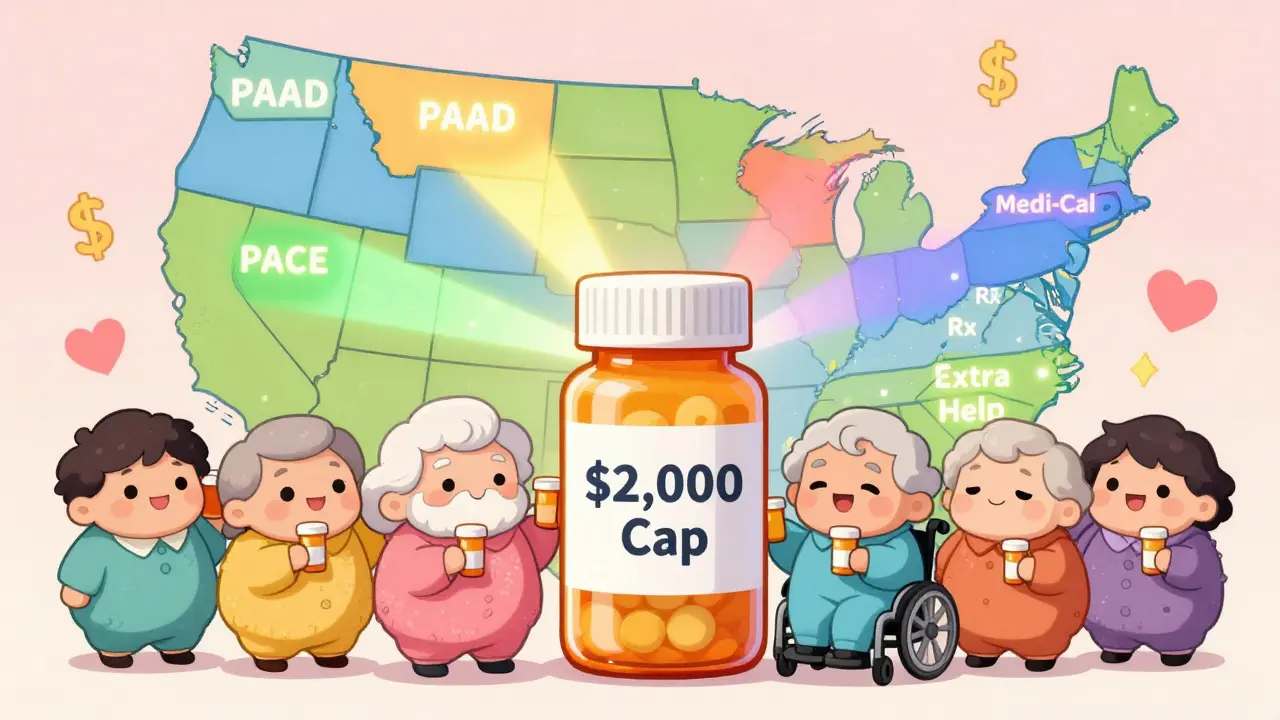
Getting prescription drugs shouldn’t mean choosing between medicine and groceries. For millions of Americans, government medication assistance programs at the state level are the only thing standing between them and skipping doses or going without. But these programs aren’t the same from one state to the next. What works in New Jersey might not help someone in Texas. And if you’re on Medicare, you might be eligible for help from both federal and state programs - if you know how to navigate them.
What Exactly Are State Pharmaceutical Assistance Programs?
State Pharmaceutical Assistance Programs, or SPAPs, are run by individual states to help people pay for prescription drugs. They’re not part of Medicare or Medicaid, though they often work alongside them. These programs mostly help seniors, people with disabilities, and those with low incomes. In 2025, 32 states had active SPAPs, with budgets ranging from $15 million in Wyoming to over $200 million in Pennsylvania and New Jersey.
Each program has its own rules. Some cover only insulin. Others cover all prescription drugs. Some pay for premiums on Medicare Part D plans. Others just reduce co-pays. In New Jersey, PAAD (Pharmaceutical Assistance to the Aged and Disabled) charges $5 for generics and $7 for brand-name drugs - a huge difference from the $20-$50 co-pays many people face without help. Pennsylvania’s PACE program goes further: it pays for both Part D premiums and medications that Medicare won’t cover at all.
But here’s the catch: you can’t assume you qualify just because you’re over 65 or on Social Security. Income and asset limits vary. In 2025, New Jersey’s PAAD lets individuals earn up to $39,840 annually and have up to $100,000 in assets. Pennsylvania’s PACE allows $27,470 in income and $42,000 in assets. Meanwhile, the federal Extra Help program (which many people confuse with state programs) has much tighter limits: $23,475 income and $17,600 in resources for a single person. That’s less than the cost of a used car in many places.
Medicare Extra Help: The Federal Safety Net
If you’re on Medicare and struggling with drug costs, Extra Help is your most powerful tool. It’s run by the Social Security Administration and reduces what you pay for Part D premiums, deductibles, and co-pays. In 2025, if you qualify, you pay $0 for premiums and deductibles. Generic drugs cost $4.90 per prescription. Brand-name drugs cost $12.15. That’s it. No surprise bills.
You automatically qualify if you get Medicaid, Supplemental Security Income (SSI), or a Medicare Savings Program. But if you don’t, you still might qualify. The income limits for 2025 are $23,475 for individuals and $31,725 for couples. Resource limits are $17,600 and $35,130, respectively. That includes bank accounts, stocks, and property - but not your home or car.
Here’s what most people don’t know: Extra Help also gives you more flexibility. Starting in 2025, if you’re on Extra Help or Medicaid, you can switch your Medicare drug plan once a month instead of just once a year. That means if your medication gets pulled from your plan’s formulary, you can switch plans immediately - no waiting.
And the Inflation Reduction Act made it even better. In 2025, your total out-of-pocket drug costs are capped at $2,000 per year. Before, you could hit $7,050 before catastrophic coverage kicked in. Now, once you hit $2,000, the rest is covered. That’s a 44% drop in maximum spending.
How State Programs Compare to Extra Help
Extra Help is powerful, but it’s not for everyone. Its income limits are strict. Many people who are barely over the limit still can’t afford their meds. That’s where state programs step in.
Take California’s Medi-Cal Rx. It’s not just a Medicaid drug program - it covers 127 specialty drugs that Medicare Part D doesn’t include. That’s critical for people with conditions like multiple sclerosis, rheumatoid arthritis, or cancer. In states like New Jersey and Pennsylvania, SPAPs cover drugs that Medicare leaves out, too. But unlike Extra Help, most state programs don’t cap your total annual spending. You still pay $5 or $7 per prescription - and if you need 20 prescriptions a month, that adds up.
Here’s a quick comparison:
| Feature | Medicare Extra Help | New Jersey PAAD | Pennsylvania PACE | California Medi-Cal Rx |
|---|---|---|---|---|
| Income Limit (Single) | $23,475 | $39,840 | $27,470 | Based on Medicaid eligibility |
| Asset Limit (Single) | $17,600 | $100,000 | $42,000 | Based on Medicaid eligibility |
| Generic Drug Co-Pay | $4.90 | $5.00 | $0-$5 | $0-$1 |
| Brand-Name Drug Co-Pay | $12.15 | $7.00 | $0-$10 | $0-$2 |
| Part D Premium Covered? | Yes | Yes (if under $34.70/month) | Yes | Yes |
| Annual Out-of-Pocket Cap | $2,000 | No | No | No |
| Specialty Drugs Covered? | Only if on Part D formulary | Yes, if on PAAD formulary | Yes, if on PACE formulary | Yes, 127+ extra drugs |
Extra Help wins on simplicity and cost caps. But state programs often have higher income limits and broader drug coverage. If you’re just above Extra Help’s limit, your state’s SPAP might be your only option.
Who Gets Left Out?
Despite all this help, 28% of Medicare beneficiaries still say they can’t afford their medications, according to KFF’s 2024 survey. Why? Three big reasons.
First, complexity. Applying for Extra Help takes an average of 8.5 hours. You need tax returns, bank statements, proof of residency, and medical bills. The Social Security Administration says it takes 90 days to process applications. During that time, you pay full price - and for some, that’s hundreds or even over $1,000 in out-of-pocket costs.
Second, formulary gaps. Just because a drug is covered by Medicare doesn’t mean your state program covers it. In New Jersey, a user on the PAAD Facebook group reported waiting 6-8 weeks for an appeal when her doctor switched her to a new medication not on the formulary. She went without. That’s not rare. 18 states have cut formulary coverage since 2023 to save money, affecting over 2 million people.
Third, the asset trap. Extra Help’s $17,600 resource limit doesn’t adjust for cost of living. In San Francisco or New York City, that’s not enough to cover rent, let alone savings. A 2024 Harvard Medical School study found that many people in high-cost states are denied Extra Help even though they can barely afford groceries. They’re not rich - they’re just living in expensive places.
How to Apply - And What to Do If You’re Denied
Applying is easier than you think - if you know where to start.
For Extra Help: Go to SSA.gov/extrahelp or call 1-800-772-1213. You can apply online in under 30 minutes. You’ll need your Social Security number, proof of income (tax return or pay stubs), and bank account info. If you’re denied, you can appeal. Don’t give up - 30% of initial denials are overturned on appeal.
For state programs: Visit your state’s health department website or call the State Health Insurance Assistance Program (SHIP). Every state has free, local counselors who help people apply. There are 14,000 of them nationwide. They don’t push products. They don’t charge fees. They just help you figure out what you qualify for.
If you’re turned down, ask for a written explanation. Sometimes it’s a simple mistake - a missed signature, an outdated bank statement. Other times, you might be eligible for a different program. In Pennsylvania, you have to apply for Extra Help first. Then PACE pays the rest. In New Jersey, you can apply for PAAD even if you’re not on Medicare - as long as you’re 65+ or disabled and meet income rules.
What’s Changing in 2026?
Big changes are coming. Starting in January 2026, the Centers for Medicare & Medicaid Services will roll out a new, standardized Extra Help application form. It’s shorter. It’s simpler. It’s designed to cut processing time by 30% and boost enrollment by 15%. That’s huge for people who’ve been stuck in limbo for months.
More states are also expanding. California, Texas, and Florida are planning to add more specialty drugs to their formularies. By 2027, 12 more states are expected to launch or expand their SPAPs. Why? Because drug prices keep rising - especially for specialty drugs like insulin, which has gone up 300% in the last decade.
But the pressure is real. State budgets are growing at 4-6% a year. Drug costs are rising at 12.3%. Seven states are projected to run out of money by 2026. That means more restrictions. More prior authorizations. Fewer covered drugs.
Bottom line: If you or someone you know is struggling with prescription costs, don’t wait. Apply now. Use SHIP. Ask for help. The system is messy - but it works if you push through the red tape.
Real Stories, Real Savings
A 72-year-old in New Jersey lost her employer coverage at 65. Her diabetes meds cost $480 a month before PAAD. After applying, she pays $7 per prescription and gets her $34.70 Part D premium covered. Her monthly drug bill dropped to $52. That’s $400 saved every month.
A retired couple in Pennsylvania had heart meds, arthritis drugs, and insulin. Their total out-of-pocket was $1,200 a month. After enrolling in PACE and Extra Help, they pay $0 for premiums and $5-$10 per prescription. Their annual drug cost? Under $600.
And then there’s the person who didn’t apply. A 68-year-old in Florida skipped her blood pressure medication for three months because she thought she made too much money for Extra Help. She ended up in the ER. Her hospital bill: $8,700. She qualified for Extra Help - and could’ve avoided it all with a 20-minute phone call.
Do I qualify for Medicare Extra Help if I have a Medicare Advantage plan?
Yes. Extra Help works with any Medicare Part D plan, including those bundled into Medicare Advantage plans. If you qualify, your co-pays and premiums will be reduced regardless of whether you’re in a traditional Medicare plan or an Advantage plan. Just make sure your plan includes drug coverage.
Can I apply for state assistance even if I don’t have Medicare?
Yes, in many states. Programs like New Jersey’s PAAD and Ohio’s OPAP help people who are under 65 but disabled and meet income guidelines. You don’t need to be on Medicare to qualify - just meet your state’s age, disability, and financial requirements.
What if my medication isn’t on my state’s formulary?
You can file an appeal. Every state has a process to request coverage for a drug not on their list. You’ll need a letter from your doctor explaining why it’s medically necessary. Processing can take 6-8 weeks, but some states offer emergency overrides for life-threatening conditions. Don’t assume it’s denied - ask for help from SHIP counselors.
How often do I need to reapply for state medication assistance?
Most programs require annual re-certification. New Jersey’s PAAD asks for updated income and asset information every year. Pennsylvania’s PACE does too. If your income changes - say, you get a small Social Security raise - you must report it. Failing to do so can result in overpayment and penalties.
Is there help for people who make too much for Extra Help but still can’t afford drugs?
Yes. Many state SPAPs have higher income limits than Extra Help. For example, New Jersey allows up to $39,840 for individuals. Also, some drug manufacturers offer patient assistance programs (PAPs) for brand-name drugs. These are separate from government programs and often require a doctor’s letter. SHIP counselors can help you find them.
Can I get help if I’m not a U.S. citizen?
Medicare Extra Help requires U.S. citizenship or qualified immigration status. But some state programs, like California’s Medi-Cal Rx, don’t require citizenship - only residency. Check with your state’s health department. Non-citizens who are legally present may still qualify for state-level aid.
What’s the fastest way to get started?
Call 1-800-MEDICARE (1-800-633-4227) and ask for your local SHIP counselor. They’ll walk you through your options in 15 minutes. Or go to SHIPhelp.org and enter your zip code. You’ll get a direct phone number to someone in your area who’s trained to help with these programs. No forms. No waiting. Just help.
What to Do Next
If you’re paying more than $50 a month for prescriptions and you’re over 65 or disabled, you’re likely eligible for some kind of help - even if you think you’re not. Don’t guess. Don’t wait. Call SHIP. Apply for Extra Help. Check your state’s SPAP. Save money. Save your health.
Every year, 42% of eligible people don’t enroll because the process seems too confusing. But it doesn’t have to be. You don’t need a lawyer. You don’t need a financial planner. You just need to pick up the phone and ask.


This is why we need to stop giving handouts to people who can't even budget right. If you can't afford your meds, maybe you shouldn't have spent last month's check on a new phone and Netflix subscription.
Wait-so you’re telling me that someone making $24,000 a year qualifies for $0 co-pays, but a person making $25,000-same job, same meds, same life-gets nothing? That’s not a safety net; it’s a cliff. And the asset limit? $17,600? That’s less than the cost of a reliable used car in rural Ohio. This system isn’t broken-it was designed to fail people like my aunt, who’s got a $300-a-month insulin bill and $18,000 in savings because she’s terrified of nursing homes.
It’s not about laziness. It’s about a system that punishes thrift.
Frankly, the structural inefficiencies inherent in state-level SPAPs reflect a pathological lack of federal coordination. The fragmentation of eligibility criteria, formulary inconsistencies, and non-standardized application protocols constitute a classic case of regulatory arbitrage-where the most vulnerable are subjected to administrative friction as a de facto rationing mechanism. The Inflation Reduction Act’s $2,000 cap is a necessary but insufficient intervention; what we require is a unified, single-payer pharmaceutical subsidy architecture, not a patchwork of state-level Band-Aids.
Let me say this plainly: if you're alive and you need medicine to stay that way, you deserve it-not as a privilege, not as a reward for being ‘deserving,’ but as a basic human right. We live in the richest country in human history, and we've built a system where a senior has to choose between insulin and heating their home in winter? That’s not capitalism. That’s not efficiency. That’s moral failure dressed up in bureaucratic jargon.
And yes, the forms are long. Yes, the rules are confusing. Yes, the appeals process takes months. But that’s not an accident-it’s intentional. It’s designed to exhaust people until they give up. And that’s the real scandal. The system doesn’t just fail the sick-it preys on their hope.
So if you’re reading this and you’re afraid to apply? Don’t be. Call SHIP. Ask for help. Someone, somewhere, is waiting to help you. And if they don’t? Keep calling. Keep pushing. Because your life isn’t a line item on a spreadsheet.
Hey, just wanted to say I shared this with my grandma in Georgia. She’s 74, on a fixed income, and was paying $80 a month for her blood pressure med. She applied for Extra Help last week-got approved in 11 days. Now she pays $4.90. She cried when she told me. Not because she was sad-but because she finally felt seen. Thank you for writing this. People like you make the world less cold.
I remember sitting across from my mom in that dimly lit SHIP office, her hands shaking as she handed over her bank statements. She’d saved every penny since 1987-$19,000 in a savings account-thinking it would keep her safe. But the system said it was too much. Too much to qualify for Extra Help. Too much to be ‘poor.’
She didn’t get approved. But we appealed. And we kept going. We called. We wrote letters. We got her doctor to write a medical necessity note that was longer than my college thesis. And then-after 14 weeks-we got a letter: approved. Her co-pay dropped from $45 to $1.25. She started buying groceries again. She bought new shoes.
Don’t let the bureaucracy make you feel small. You are not a number. You are not a line on a form. You are someone’s mother, father, sibling, friend. And you matter enough to fight for.
If you’re reading this and you’re scared? I was too. But I’m here. And I’m still fighting. So are you.
Oh, darling, this is just the latest tragedy in the grand opera of American healthcare-where the poor are forced to perform gratitude for scraps while the pharmaceutical CEOs sip champagne in their penthouses. I mean, really-$17,600 in assets? That’s what you call ‘wealth’? In London, that’s a deposit on a studio flat. In New York, it’s a month’s rent. And yet we’re supposed to be impressed that someone gets to pay $4.90 for a pill? Please. This isn’t assistance. It’s a performance of compassion designed to make the middle class feel better about their own privilege.
Meanwhile, the real solution? Nationalize insulin. Tax the billionaires who fund lobbyists to block it. And then, maybe, we can stop pretending that co-pays are the issue when the whole damn system is a house of cards built on greed.
So I got denied for Extra Help last year. Said I had too many assets. I had $19,000 in savings. I didn’t own a car. I lived in my sister’s basement. I was working part-time at Walmart. I cried in the parking lot. But I didn’t give up. I called SHIP. They helped me reapply with a letter from my doctor. Got approved. Now I pay $0 for my heart meds. I’m not rich. I’m not special. I’m just stubborn. And if you’re reading this and you’re scared to try? I was too. But I did it. So can you.
so like... i just found out that my mom's state program only covers 80% of her meds and she's been paying the rest out of pocket for 3 years?? and she thought it was 'normal'?? i mean... i know this is a big topic but like... why is this so hard? like why do we have to be doctors and lawyers just to get a pill? and why does it take 6 weeks to get a drug approved?? i just... i don't get it. and now i'm mad. like really mad. like i want to scream at congress. but i don't know how to. so i'm just typing this. and hoping someone sees it. because my mom is 71 and she's tired. and she shouldn't be.