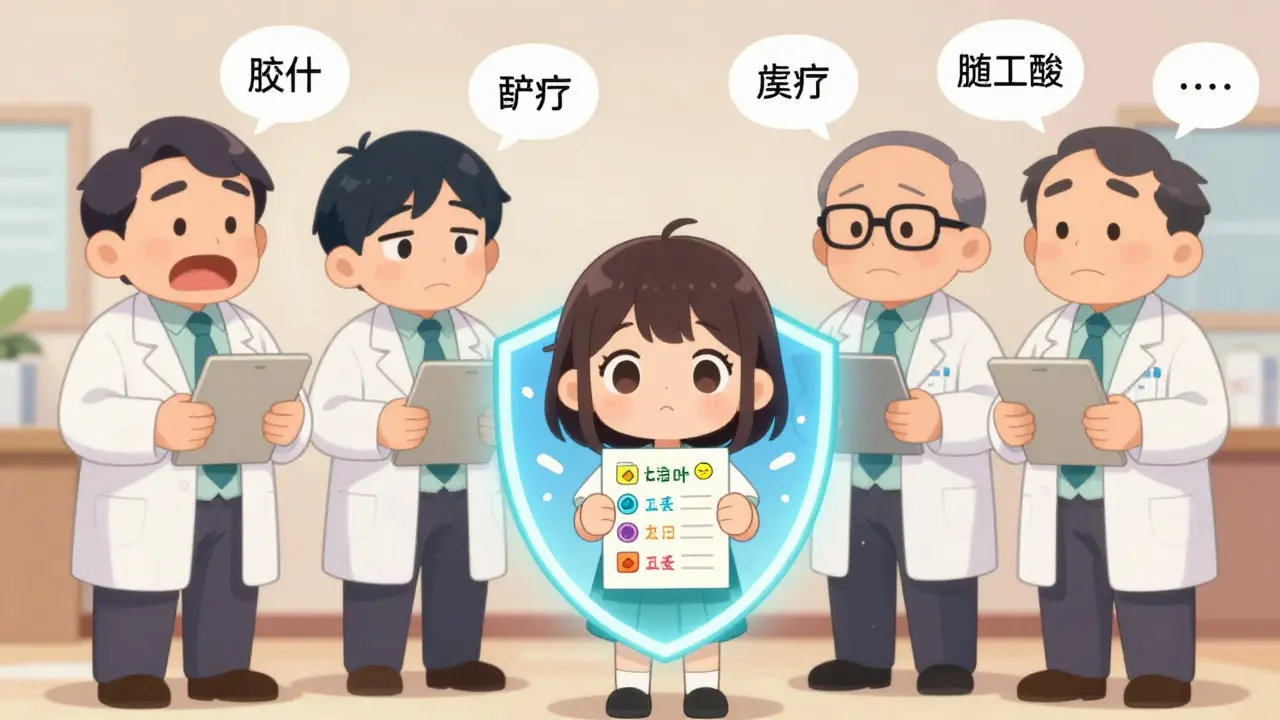
When you’re seeing more than one doctor, pharmacist, or specialist, keeping your medications straight isn’t just confusing-it’s dangerous. In the U.S., medication errors linked to poor communication between providers send over 1.5 million people to the emergency room every year. That’s not a rare mistake. It’s a system-wide problem. And if you’re juggling prescriptions from a cardiologist, a rheumatologist, a pain specialist, and your primary care doctor, you’re at high risk.
Why Medication Communication Breaks Down
Most people assume their doctors talk to each other. They don’t. Not unless someone forces them to. A 2022 study from the NIH found that 68% of patients seeing three or more providers had at least one medication error because no one checked what the others had prescribed. Specialists often add new drugs without knowing what’s already in use. Primary care doctors are left guessing. And patients? They’re stuck in the middle. One patient in Seattle, who asked to remain anonymous, was taking five different medications for chronic pain, high blood pressure, and arthritis. Her rheumatologist added a new NSAID. Her cardiologist prescribed a diuretic. Her pain specialist gave her a muscle relaxant. None of them knew about the others’ prescriptions. She ended up in the ER with dangerously low blood pressure and kidney stress. The fix? Someone finally sat down with all her medication lists and found three interactions that could have killed her. The problem isn’t just bad luck. It’s structural. Electronic health records (EHRs) don’t talk to each other. A hospital system’s software won’t automatically share data with a private clinic. Even if they do, the information is often buried in unreadable formats. A 2023 CMS report showed that 43% of providers struggle to get a full picture of a patient’s meds across different systems. And 57% of patients say specialists make changes without telling their main doctor.What You Need to Know About Your Own Medications
You are the only person who sees all your providers. That means you’re the only one who can catch the gaps. Start with a simple, accurate list. Not a mental note. Not a scrap of paper. A real, updated document. Every medication on your list needs four things:- Name (brand and generic, if applicable)
- Dosage (e.g., 10 mg, 500 mg)
- Frequency (e.g., once daily, twice a week, as needed)
- Purpose (e.g., “for high blood pressure,” “for nerve pain,” “to prevent blood clots”)
Who Should Be Talking to Whom
Medication communication isn’t just between doctors. It’s a team effort. And you’re the captain. Your primary care provider should be the hub. They see the whole picture. But specialists often act independently. That’s where you step in. After every specialist visit, ask: “Will you send a summary of any changes to my primary doctor?” If they say no, say, “Can you help me send it?” Pharmacists are your secret weapon. Most people think pharmacists just hand out pills. They’re trained to spot interactions, redundancies, and dangerous combinations. A 2023 study by Asteroid Health showed that patients who worked directly with a clinical pharmacist had 32% higher adherence rates and 63% more confidence in their meds. If you’re on Medicare, check if your plan offers Medication Therapy Management (MTM). It’s free. A pharmacist reviews all your meds, calls your doctors, and gives you a written plan. By 2025, 78% of independent pharmacies will offer this service-up from 42% in 2022. Nurses and care coordinators in Accountable Care Organizations (ACOs) also play a big role. ACOs are groups of providers paid to keep you healthy, not just treat you when you’re sick. CMS data shows ACO patients have 27% fewer hospital readmissions because their teams actually talk to each other.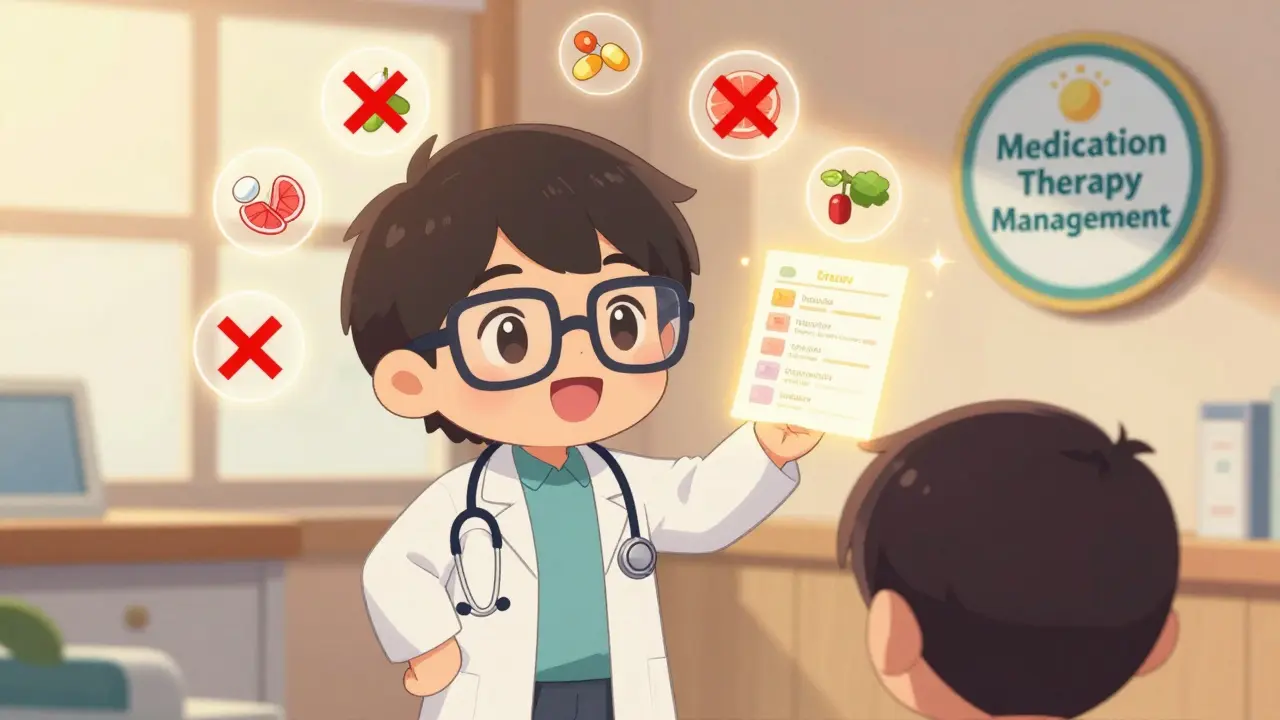
How to Prevent Dangerous Interactions
Some medications are fine alone. Together, they can be deadly. Here are the most common dangerous combos:- NSAIDs + Blood thinners (e.g., ibuprofen + warfarin): Increases risk of internal bleeding.
- SSRIs + Pain meds like tramadol: Can cause serotonin syndrome-a life-threatening surge in brain chemicals.
- Statins + Grapefruit juice: Can cause muscle damage and kidney failure.
- Diuretics + Potassium supplements: Can lead to heart rhythm problems if levels get too high.
Track What You Can’t See
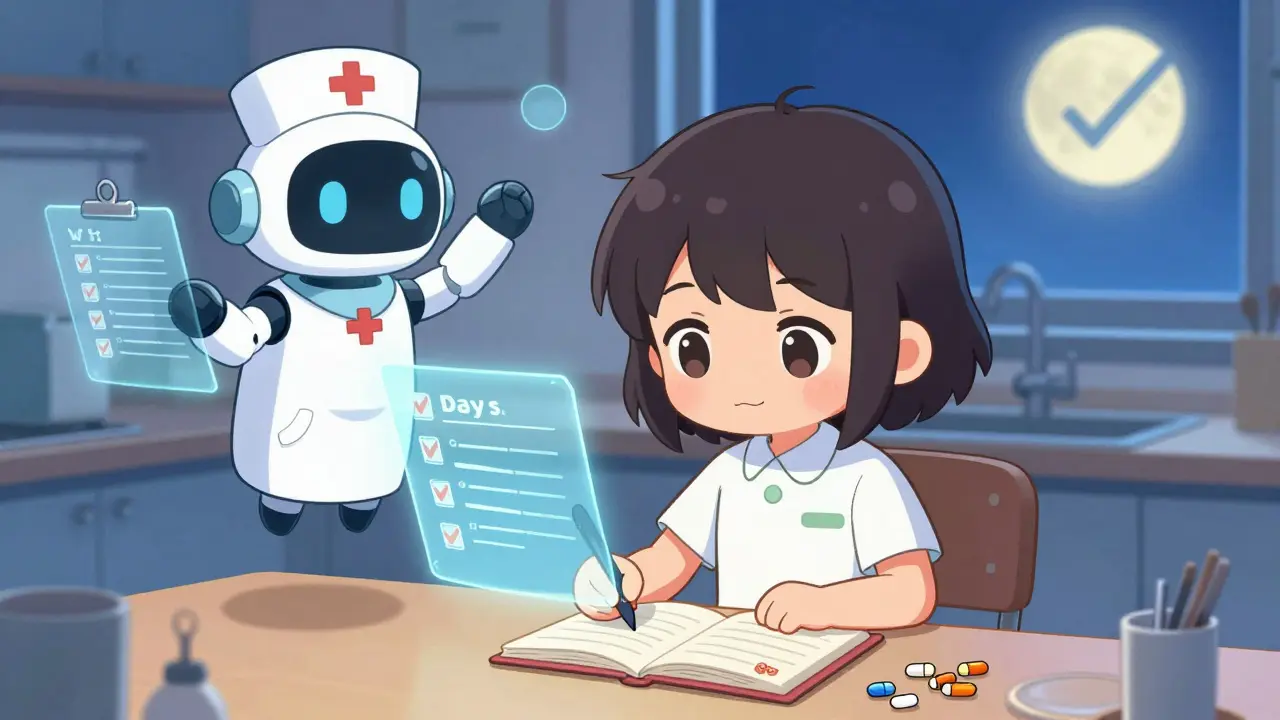
Side effects don’t always show up right away. They creep in. Fatigue. Confusion. Dizziness. Mood swings. Sleep changes. Start a health journal. Not a fancy app. A notebook. Or a note on your phone. Each day, write:- What meds you took
- Any new symptoms
- Changes in appetite, sleep, or mood
- Any falls, dizziness, or confusion
What to Do When Nothing’s Working
If you’re still getting conflicting advice, or your meds aren’t working, or you’re having side effects, it’s time to escalate. Ask for a care coordinator. Many hospitals and ACOs now have them. They’re the people who organize your care across providers. Tell them: “I’m seeing multiple doctors and I’m worried my medications aren’t being coordinated. Can you help me set up a medication review?” If you’re on Medicare, call your plan’s member services. Ask: “Do you offer Medication Therapy Management? Can you connect me with a pharmacist?” You can also request a medication reconciliation before leaving the hospital or after a specialist visit. This is a formal process where your meds are reviewed and corrected. It’s your right. And it’s required by CMS in the Primary Care First program as of January 2024.What’s Changing for the Better
The system is slowly improving. The 21st Century Cures Act of 2016 forced EHRs to be interoperable. But only 38% of providers can currently access full medication histories across systems. New tools are emerging. Mayo Clinic now uses AI to scan patient records and flag medication discrepancies in under a minute-down from 15 minutes. The Commonwealth Fund estimates that every $1 spent on better medication communication saves $7.30 in avoided hospital visits. More practices are hiring pharmacists as part of the care team. More insurers are paying for care coordination. More patients are learning to ask the right questions. But none of this matters unless you act.Your Action Plan
Here’s what to do this week:- Make your official medication list with name, dose, frequency, and purpose.
- Update it after every new prescription or change.
- Bring it to your next appointment-even if you think you’re “just checking in.”
- Ask your pharmacist: “Can you review all my meds for interactions?”
- Start a daily journal: meds taken + any new symptoms.
- Ask your primary doctor: “Can you coordinate with my other providers?”
What should I do if my doctors don’t talk to each other?
You become the bridge. Bring your updated medication list to every appointment. Ask each provider: “Can you send a summary of changes to my primary doctor?” If they refuse, ask for a printed copy to give to them yourself. You can also request a formal medication reconciliation or ask your pharmacist to coordinate with your providers-many now offer this service for free, especially under Medicare.
Can I ask my pharmacist to review all my medications?
Yes, absolutely. Pharmacists are trained to catch drug interactions, duplicate prescriptions, and dangerous dosages. If you’re on Medicare, you’re eligible for free Medication Therapy Management (MTM). Even if you’re not, many independent pharmacies offer this service at no cost. Just ask: “Can you do a full med review?” They’ll call your doctors, check for conflicts, and give you a written plan.
How do I know if a new medication is safe with my others?
Don’t rely on memory or guesswork. Always ask your doctor or pharmacist: “Could this interact with any of my other meds?” Then show them your list. Common dangerous combos include NSAIDs with blood thinners, SSRIs with tramadol, and statins with grapefruit juice. Use the Teach-Back Method: repeat the instructions back in your own words. If they correct you, you just avoided a mistake.
Why do specialists often prescribe without checking my other meds?
Specialists focus on one part of your body. They’re trained to treat their specialty, not manage your whole medication list. Plus, most electronic health records don’t share data between different systems. So even if your cardiologist and rheumatologist are in the same hospital network, they might not see each other’s notes. It’s a system flaw-not your fault. That’s why you need to be the one to connect the dots.
Is there a free tool to help me track my medications?
Yes. The CDC and AHRQ both recommend using a simple paper list or a free app like MyTherapy, Medisafe, or the CDC’s Medication Tracker. But even a note on your phone works. The key isn’t the tool-it’s consistency. Update it after every change. Bring it to every appointment. And use it to track side effects daily. That’s what turns a list into a safety net.

Just brought my med list to my doc last week. Handed it over like a boss. She actually looked at it. Said, 'Why didn't you bring this sooner?'
Turns out I was double-dosing on blood pressure stuff. Saved me a trip to the ER.
Do this. Now.
People are so lazy. You think your doctors are mind readers? You’re 50, not 25. If you can’t keep track of 5 pills, maybe you shouldn’t be taking them.
My grandma took 12 meds and never had a problem. She wrote them down on index cards. In pen. No apps. No excuses.
Yo this is 100% real. My aunt got hospitalized last year ‘cause her pain doc gave her muscle relaxers and her cardiologist threw her on a beta blocker. No one talked. She ended up with like 80 bpm and nearly crashed.
Then her pharmacist caught it. Like, full review. Called all three docs. Got her meds cleaned up in 48 hours.
Stop waiting for doctors to be perfect. Be the damn adult. Get a pharmacist involved. They’re the real MVPs.
Also - grapefruit juice is a trap. Just say no.
And yeah, the Teach-Back thing works. I used it last week. Doc said ‘huh, you’re the first one who actually repeated it back right.’
You are NOT powerless. Seriously.
Every single person reading this? You have more control than you think.
That list? Make it today. Right now. Open Notes on your phone. Type it out.
Then tomorrow, walk into your next appointment and say: ‘I’ve got this. I’m not waiting for anyone else to fix this.’
You got this. I believe in you.
And yes - your pharmacist will help you. Just ask. No shame. No hesitation.
The structural failures in our healthcare system are indeed alarming. However, the onus of responsibility cannot be placed solely upon the patient. While personal agency is commendable, it is unreasonable to expect individuals to function as de facto care coordinators in the absence of systemic interoperability.
That said, the practical steps outlined here are commendable and should be institutionalized as standard protocol.
Wow. So the solution to a broken system is… make the sick person do the work of 10 administrators?
Brilliant.
Meanwhile, my doctor’s office still uses fax machines. And they lost my med list last Tuesday.
Thanks for the advice, I guess. I’ll just add ‘superhero’ to my resume.
USA healthcare be like: ‘You got 7 meds? Cool. Now go figure it out yourself while we bill you $2000 for a 5-minute visit.’
Meanwhile, in Nigeria, my cousin takes 3 pills and his uncle who’s a herbalist checks them with his eyes closed. He don’t need no app. 😎
But y’all keep paying for EHRs that don’t talk. 🤡
Medication Therapy Management? Free? Why we pay taxes then? 🇳🇬🔥
It is imperative that patients assume an active role in their own healthcare management. The documentation of medication regimens, including generic and brand names, dosages, frequencies, and therapeutic purposes, constitutes a foundational element of patient safety.
Furthermore, the utilization of the Teach-Back Method has been empirically validated to reduce miscommunication by nearly half, as cited by the Agency for Healthcare Research and Quality.
These practices are not merely recommendations-they are clinical best practices that must be consistently implemented.
Oh wow. You mean I have to do more than just show up and hope for the best? 😱
And I thought my $10,000 deductible was the hard part.
Now I gotta keep a journal? Bring a list? Ask questions? 😭
Who gave you a PhD in common sense? I’m just here for the free Xanax.
Also, I use a sticky note. It’s fine. 🤷♂️
My mom’s on 11 meds. I help her update her list every Sunday night. We watch True Crime and she tells me what changed. It’s our thing.
She’s 82. I’m 34. We’re both alive because of it.
Also, pharmacists are legends. My local one remembers my dog’s name. And my meds.
Ah, the neoliberal myth of patient agency as panacea. You’re telling me the solution to the commodification of healthcare is… individualized self-surveillance? The med list becomes a Foucauldian docile body, disciplined by the very system that failed it.
Meanwhile, the EHRs remain siloed, algorithmically biased, and profit-driven. Your ‘action plan’ is a Band-Aid on a hemorrhage.
What we need is structural abolition. Not a fucking notebook.
I never thought to ask my pharmacist to review everything. I thought they just handed out pills.
Went in last week, asked. They found two duplicates and a dangerous combo with my new antidepressant.
Called my doctors. Fixed it before I left the store.
They didn’t charge me a dime.
Why didn’t anyone tell me this before?
This post made me cry a little. Not because it’s sad - because it’s so simple.
I’ve been taking 6 meds for 4 years. Never wrote them down. Thought I’d remember.
Turns out, I forgot one. Twice.
Started the list last Tuesday. Updated it after every appointment since.
My anxiety dropped. Not because the meds changed - because I finally felt in control.
You’re not broken. You’re just trying to survive a broken system.
You’re doing better than you think.
My dad had a stroke last year. After he got out, he was on 14 meds. We were drowning.
Then we found a care coordinator through his ACO. She set up a med review call with all his docs. Had the pharmacist on the line. Even got his neurologist to talk to his PCP.
Two weeks later, he was down to 9 meds. No more dizziness. No more falls.
They didn’t charge us. Medicare paid for it.
Don’t wait until you’re in the ER. Call your plan. Ask for help. They’re paid to give it to you.
MY DOCTOR GAVE ME A NEW PILL AND SAID ‘DON’T DRINK GRAPEFRUIT JUICE’
THEN HE WENT TO THE FRIDGE AND POUR HIMSELF A GLASS 😭
WHY DO I TRUST ANYONE IN THIS SYSTEM?
MY MED LIST IS ON A POST-IT. I’M JUST GONNA ROLL THE DICE.
💀🍷