
Psoriasis isn’t just a rash. It’s a lifelong battle where your immune system turns against your skin, forcing cells to multiply ten times faster than normal. Instead of taking 28 days to renew, skin cells rush to the surface in just 3 to 4 days, piling up into thick, red, scaly plaques-often on elbows, knees, scalp, and lower back. This isn’t contagious. It’s not caused by poor hygiene. It’s a chronic inflammatory disease, rooted in genetics and immune dysfunction, affecting nearly 3.2% of people in the U.S. alone.
Understanding the Real Impact of Psoriasis
Most people think psoriasis is only a skin problem. It’s not. The inflammation doesn’t stop at the surface. It travels through your body, raising your risk for heart attacks, diabetes, depression, and joint damage. People under 50 with psoriasis have a 58% higher chance of having a heart attack than those without it. Up to 30% develop psoriatic arthritis, where joints swell, stiffen, and hurt-sometimes before the skin even flares up. Depression hits 17 to 37% of psoriasis patients, compared to just 6 to 7% in the general population. That’s not coincidence. It’s biology.Types of Psoriasis: Not All Plaques Are the Same
There are five main types, and knowing which one you have changes how you treat it. Plaque psoriasis is the most common-80 to 90% of cases. It shows up as raised, red patches covered in silvery scales. Guttate psoriasis looks like small, teardrop-shaped spots, often triggered by strep throat. Inverse psoriasis hides in skin folds-under the breasts, in the groin, or between buttocks-smooth, shiny, and irritated by sweat and friction. Pustular psoriasis is rare but serious: white, pus-filled bumps appear suddenly, sometimes with fever and chills. Erythrodermic psoriasis is the most dangerous. It covers large areas of skin in fiery redness, disrupting body temperature and fluid balance. This is a medical emergency.Topical Treatments: The First Line of Defense
For mild to moderate cases, creams and ointments are the starting point. The most common combo is calcipotriol (a vitamin D analog) and betamethasone (a steroid). It works fast-often clearing plaques in weeks. But steroids can thin skin if used too long, especially on the face, eyelids, or genitals. That’s why doctors now recommend using them only short-term, then switching to non-steroid options like calcipotriol alone or tacrolimus for sensitive areas. Scalp psoriasis? Foam versions work better than lotions. For nails, topical solutions with salicylic acid help soften the buildup. But here’s the catch: most people don’t use topicals consistently. A 2023 survey found 67% of users skip applications because they’re messy, time-consuming, or leave residue on clothes. Simplifying routines-like switching from twice-daily to once-daily-boosts adherence by 40%.Phototherapy: Light as Medicine
When creams aren’t enough, light therapy steps in. Narrowband UVB is the gold standard-patients go to the clinic 2 to 3 times a week for 8 to 12 weeks. About 75% see major improvement. Home units are an option, but they cost $2,500 to $5,000 upfront, plus $100 a month for bulb replacements. PUVA (psoralen plus UVA) is older and riskier-long-term use raises skin cancer risk. It’s mostly used now when UVB fails. Phototherapy doesn’t cure psoriasis, but it can keep it under control for months. The downside? It’s a time commitment. Miss a few sessions, and plaques creep back.
Systemic Drugs: When Psoriasis Goes Deeper
If your psoriasis covers more than 5% of your body, or if it’s affecting your joints or quality of life, it’s time to think beyond the skin. Oral medications like methotrexate, cyclosporine, and acitretin work by suppressing the immune system. Methotrexate is common, but it can damage the liver and cause nausea. Cyclosporine protects the kidneys short-term but isn’t safe for long use. Acitretin helps with pustular and plaque types but can dry out skin and raise cholesterol. All require monthly blood tests. These drugs aren’t glamorous, but they’re affordable and effective for many.Biologics: Targeting the Root Cause
Biologics are the biggest leap forward in psoriasis treatment. These are injectable or infused drugs that block specific parts of the immune system-like TNF-alpha, IL-17, or IL-23-that drive inflammation. Drugs like adalimumab (Humira), secukinumab (Cosentyx), and guselkumab (Tremfya) don’t just reduce plaques-they can clear them almost completely. Studies show 75% to 90% of patients reach PASI75 or PASI90 (75% or 90% skin clearance). That’s life-changing. But they’re expensive. Out-of-pocket costs can hit $1,200 to $5,500 a month without good insurance. Many patients delay or skip doses because of price. A 2022 survey found 41% of people with psoriasis skip treatment due to cost. Still, patient satisfaction is high-82% of biologic users report improved quality of life. Before starting, you’ll need screening for TB, hepatitis, and HIV. Injections are done at home after 15 to 20 minutes of training.The Hidden Battle: Comorbidities and Long-Term Health
Treating psoriasis means treating your whole body. Every visit should include checking blood pressure, cholesterol, and BMI. You need a diabetes screen if you’re over 40. Mental health matters too-annual depression screenings are now part of standard care. Psoriasis isn’t just skin deep; it’s a marker for metabolic syndrome, which includes high blood sugar, belly fat, and abnormal lipids. The American Academy of Dermatology and the American College of Cardiology are now working together to create unified screening guidelines. Why? Because managing psoriasis without managing heart risk is like putting a bandage on a broken leg.What Works Best? A Personalized Approach
There’s no one-size-fits-all treatment. A 25-year-old with mild scalp psoriasis might do fine with a foam and a moisturizer. A 55-year-old with joint pain, high blood pressure, and plaques on their back needs a different plan. The old step-up model-start with creams, then pills, then biologics-is fading. Experts now say: match the treatment to the disease from the start. If your psoriasis is severe, don’t waste months on topicals. Go straight to a biologic. Your time, your health, and your quality of life matter too much.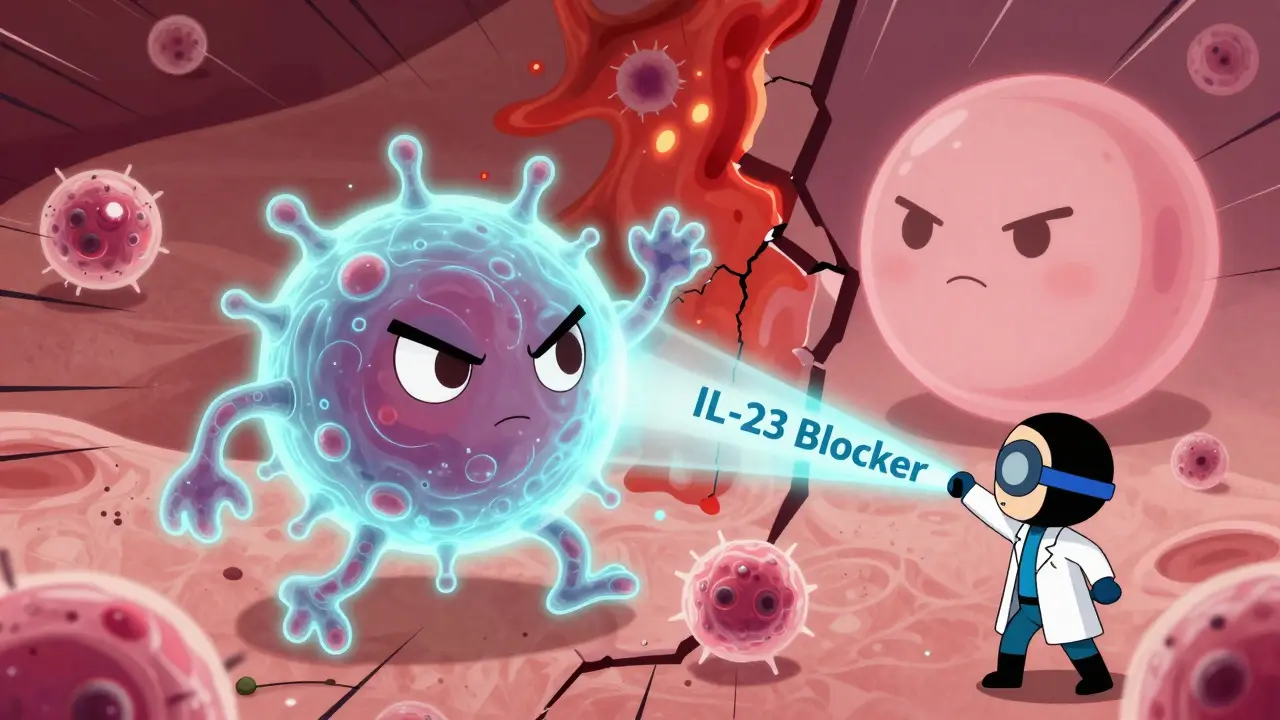
Practical Daily Care: Beyond the Prescription
Medication isn’t everything. Daily skin care makes a huge difference. Use fragrance-free, petrolatum-based moisturizers right after showering. Keep showers short and lukewarm-hot water strips natural oils. Avoid harsh soaps. Pat skin dry, don’t rub. Identify triggers: stress, alcohol, smoking, infections, and certain medications (like beta-blockers or lithium) can make flare-ups worse. Keep a symptom journal. Many patients find that tracking what they eat, how much they sleep, and their stress levels helps them predict flares. Apps like MyPsoriasisTeam let you log symptoms, share experiences, and connect with others who get it.The Future: Where Psoriasis Treatment Is Headed
New drugs are coming fast. Deucravacitinib, a once-daily oral pill approved in 2022, blocks a different immune pathway and cleared 90% of plaques in half of patients in trials. Oral RORγt inhibitors are in Phase 2 and may soon offer another pill alternative to injections. The biggest shift? Personalized medicine. Researchers are starting to match treatments to genetic profiles. Some people respond better to IL-17 blockers. Others do better with IL-23 inhibitors. Soon, a simple blood test might tell you which drug will work best for you-before you even start. But there’s a catch: 80% of research funding still goes to biologics. That’s great for innovation, but it’s driving up costs. Biosimilars help, but they only cut prices by 15 to 30%. The real challenge isn’t just finding better drugs-it’s making them accessible to everyone.Support Is Out There
You don’t have to do this alone. The National Psoriasis Foundation offers free virtual support groups with 12,000+ monthly participants. PCDS now provides QR-coded leaflets with updated info you can scan on your phone. Online communities like Reddit’s r/psoriasis (with 156,000 members) are full of real stories, tips, and emotional support. Talking to others who understand the frustration, the embarrassment, the fatigue-it helps more than you think.Is psoriasis curable?
No, psoriasis is not curable with current treatments. It’s a lifelong condition driven by genetics and immune dysfunction. But it is highly manageable. Many people achieve near-complete or complete skin clearance with the right combination of therapies. The goal isn’t just to reduce plaques-it’s to prevent long-term damage to joints, heart, and mental health.
Can stress cause psoriasis?
Stress doesn’t cause psoriasis, but it’s one of the most common triggers for flares. Emotional stress, trauma, or even physical stress like an injury or infection can activate the immune system and make symptoms worse. Many patients notice flares after major life events-divorce, job loss, surgery. Managing stress through sleep, exercise, or therapy isn’t a cure, but it’s a critical part of controlling the disease.
Are biologics safe for long-term use?
Biologics are generally safe for long-term use, but they require monitoring. Because they suppress part of the immune system, there’s a slightly higher risk of infections like tuberculosis or hepatitis. That’s why screening is required before starting. Long-term studies show they don’t increase cancer risk more than the general population. The bigger concern is cost and access-not safety. Most patients tolerate them well for years, especially when monitored by a dermatologist.
Why do some people stop taking their psoriasis meds?
Cost is the biggest reason-41% of patients delay or skip treatment because of price. Side effects matter too: nausea from methotrexate, kidney concerns with cyclosporine, or injection fatigue with biologics. Some find the routine too burdensome. Others feel better after a few months and assume they’re cured, so they stop. But psoriasis doesn’t go away-it comes back, often worse. Stopping treatment can lead to rebound flares. Always talk to your doctor before quitting.
Does diet affect psoriasis?
There’s no single "psoriasis diet," but some changes help. Losing weight-even 5 to 10%-can significantly improve symptoms. Reducing alcohol, sugar, and processed foods may lower inflammation. Some people report benefits from omega-3s (fish oil), vitamin D, or gluten-free diets, but evidence is mixed. The most important thing? Avoid triggers you know affect you. If red wine makes your plaques flare, skip it. Diet won’t cure psoriasis, but it can help you feel better and reduce your overall inflammation.
How do I know if my psoriasis is severe enough for systemic therapy?
Your doctor uses two main tools: the PASI score (measures how much skin is affected and how inflamed it is) and the DLQI (how much it impacts your daily life). If your PASI is over 10 or your DLQI is over 10, you likely qualify for systemic treatment. But numbers aren’t everything. If your psoriasis is on your hands, scalp, or genitals-areas that affect work, intimacy, or self-esteem-you may need stronger therapy even if the area seems small. Quality of life matters as much as skin coverage.


I’ve had plaque psoriasis for 12 years-and yes, it’s brutal-but the biggest shock? Learning it’s not just skin-deep. I had a heart scare last year and my dermatologist said, ‘Your psoriasis is why.’ I didn’t even connect it. Now I get blood work every 3 months. If you think it’s just about creams, you’re lying to yourself.
Also, moisturizing right after the shower? Non-negotiable. I use pure petrolatum. No fragrance. No ‘natural’ nonsense. Just grease. It’s gross, but it works.
And stop blaming stress. It triggers, sure-but it doesn’t cause it. Stop making it a mindfulness problem. This is immunology, not yoga.
Oh wow. Another ‘psoriasis is a systemic disease’ lecture. Did you write this for a pharma ad? Let me guess-your biologic rep gave you this script.
Fact: 80% of people with mild psoriasis never need biologics. You’re scaring people into $5k/month injections because ‘you might get heart disease.’ Newsflash: most people die of old age. Not because their elbows were itchy.
Also, ‘don’t use steroids long-term’-says the guy who’s never had to live with 40% body coverage while waiting for insurance to approve a drug that costs more than my car.
Stop medicalizing normal skin. It’s not a war. It’s a condition. Learn to live with it, not bankrupt yourself chasing ‘clear skin.’
Thank you for this comprehensive and deeply informative piece! 🙏
As someone from India, I’ve seen how stigma around skin conditions still persists-even among doctors. Many patients here are told to ‘use coconut oil’ or ‘avoid non-veg’ as if psoriasis is karma. This article is a breath of fresh air.
Biologics are expensive here too-but the government is now including some in the National Health Mission. Hope this spreads globally!
Also, I’ve been using aloe vera + turmeric paste after showers for 3 years. Not a cure, but it calms the burning. And yes-stress management through yoga and breathing? Game-changer. Not magic. Just science.
Keep sharing knowledge. We need more of this. 🌿🫶
Bro, I used to think psoriasis was just ‘dry skin’ until my cousin got it after his dad passed. He cried every time he looked in the mirror. I didn’t know what to say.
Then I saw this video of a guy in Canada who cleared 95% of his plaques with guselkumab. He was dancing in his kitchen. I cried too.
It’s not just about skin. It’s about dignity. About being able to wear shorts. About not being stared at on the bus.
Thank you for writing this. I’m sharing it with everyone I know. 🙏❤️
Wait-you said biologics don’t increase cancer risk? That’s not what the FDA’s 2021 meta-analysis said. You’re cherry-picking data.
Also, ‘PASI75’? That’s a marketing term. 75% clearance still leaves 25% of your body covered in scales. That’s not ‘clear.’ That’s ‘less terrible.’
And why is everyone ignoring the fact that UVB therapy is literally just sunlight? Why are we paying $2,500 for a lamp when you can walk outside? Are we that disconnected from nature?
Also, ‘diet doesn’t cure’? Sure. But if you eat sugar and processed junk, you’re basically feeding your inflammation. That’s not rocket science. It’s basic biology. Stop pretending we need a PhD to understand this.
Cost is the real issue. I skipped my biologic for 4 months. Didn’t die. My skin got worse. Then I got a job with insurance. Started again. Skin cleared in 6 weeks.
Stop acting like this is a medical mystery. It’s a money problem.
And yes, I cried in the dermatologist’s office last week. Not because of the plaques. Because I had to choose between my meds and my rent.
That’s not healthcare. That’s cruelty.
bro i had this for like 8 years and i just stopped caring. now i just wear long sleeves and don’t think about it. why do people make this so hard?
also i use vaseline and call it a day. no doctor told me to do that but it works better than all the fancy creams.
ps: i still get weird looks at the pool. but honestly? i don’t care anymore.
It is both intellectually and ethically irresponsible to present biologics as a panacea without contextualizing their long-term immunological consequences. The reductionist framing of psoriasis as a mere ‘inflammatory condition’ obscures the fact that systemic immune modulation may induce unforeseen dysregulation in other physiological pathways-particularly in the gut microbiome and T-cell memory pools. Furthermore, the statistical normalization of PASI scores as clinical success metrics neglects the qualitative lived experience of chronic disease, wherein the psychological burden of treatment adherence, injection fatigue, and financial toxicity often outweighs the aesthetic improvement. The current paradigm of ‘early escalation’ risks medicalizing a condition that, for many, remains functionally tolerable. One must ask: are we treating the disease-or the anxiety surrounding it?
You say ‘don’t stop meds because it comes back worse’-but you never mention what happens when you *do* stop. The rebound flares are brutal. I went from 5% coverage to 60% in three weeks after skipping a dose because I was tired of the injections.
And now I’m stuck on cyclosporine. My kidneys are fine. But my blood pressure? Not so much.
So yeah. I get it. You want us to stay on the drugs. But you don’t talk about the cost of staying on them. The anxiety. The fear of side effects. The guilt when you miss a dose because you’re broke.
It’s not just about science. It’s about survival.
Let’s be real: this whole ‘psoriasis is a systemic disease’ narrative was invented by Big Pharma to sell more drugs. You want to know what’s really going on? Modern life. Processed food. Sitting all day. Toxic stress. Lack of sunlight. We’re not broken. We’re just living wrong.
My grandfather had psoriasis. He never took a pill. He worked in the fields. Ate real food. Walked everywhere. Lived to 92.
Now we’ve got people injecting $5k/month drugs because they’re too lazy to eat vegetables or get outside.
This isn’t medicine. It’s surrender.
And don’t tell me about ‘genetics.’ My genes didn’t change. My environment did.
Stop outsourcing your health to a lab. Fix your life first.