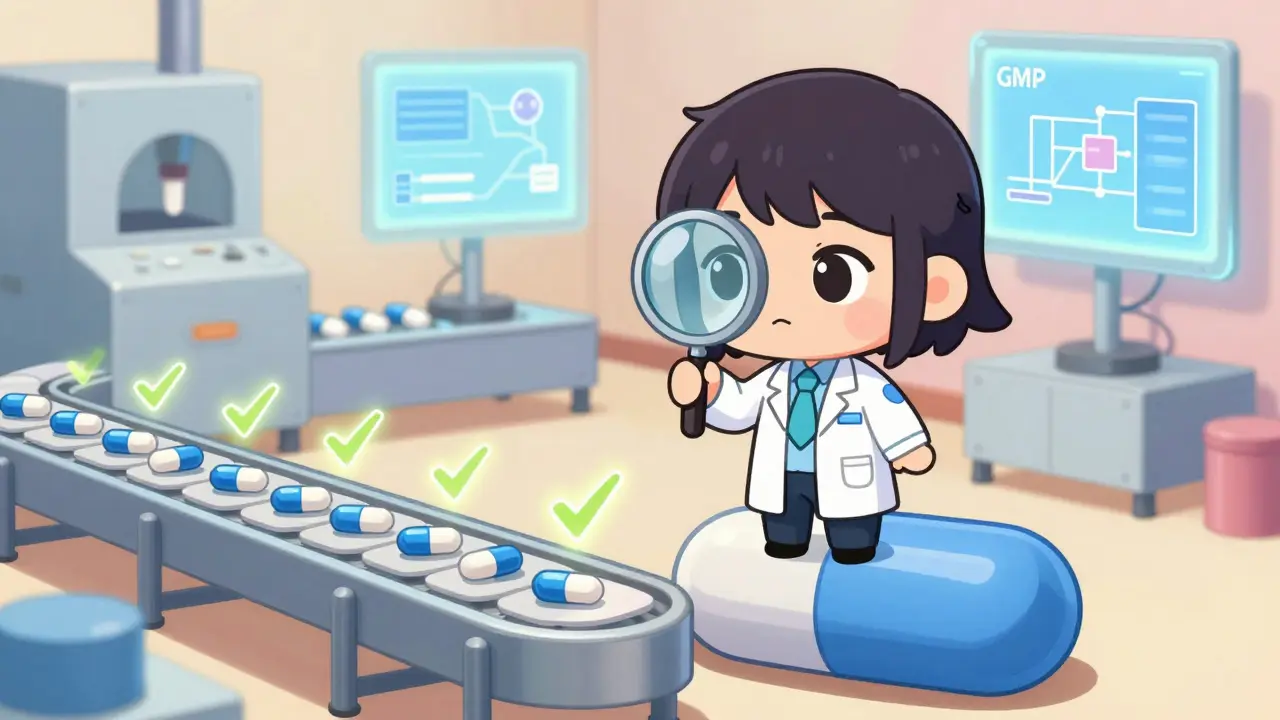
The U.S. Food and Drug Administration doesn’t just approve generic drugs - it ensures they’re made the same way every single time. That’s not a guarantee you get from just any regulator. It’s the result of a system built on strict rules, constant oversight, and a deep understanding that a pill’s effectiveness doesn’t end when it leaves the factory. If you’re taking a generic medication, you’re relying on this system to work. Here’s how it actually happens - from the moment raw ingredients arrive at a plant to the final box shipped to your pharmacy.
Quality Isn’t Tested at the End - It’s Built In
For decades, drug makers tested finished pills to see if they met standards. That changed after a major review in the 1960s found that about 8% of approved drugs were either too weak or too strong. That’s not a small number when millions of people rely on those pills daily. The FDA shifted from checking the final product to controlling how it’s made. This approach, called Current Good Manufacturing Practices (cGMP), became the foundation of every generic drug made in the U.S.cGMP isn’t a checklist. It’s a mindset. Every step - from mixing powder to sealing blister packs - must follow written, validated procedures. If something goes wrong, the system catches it before bad batches leave the facility. The goal? Make sure every tablet, capsule, or injection has the exact same strength, purity, and performance as the brand-name version.
The Five Pillars of FDA’s Quality System
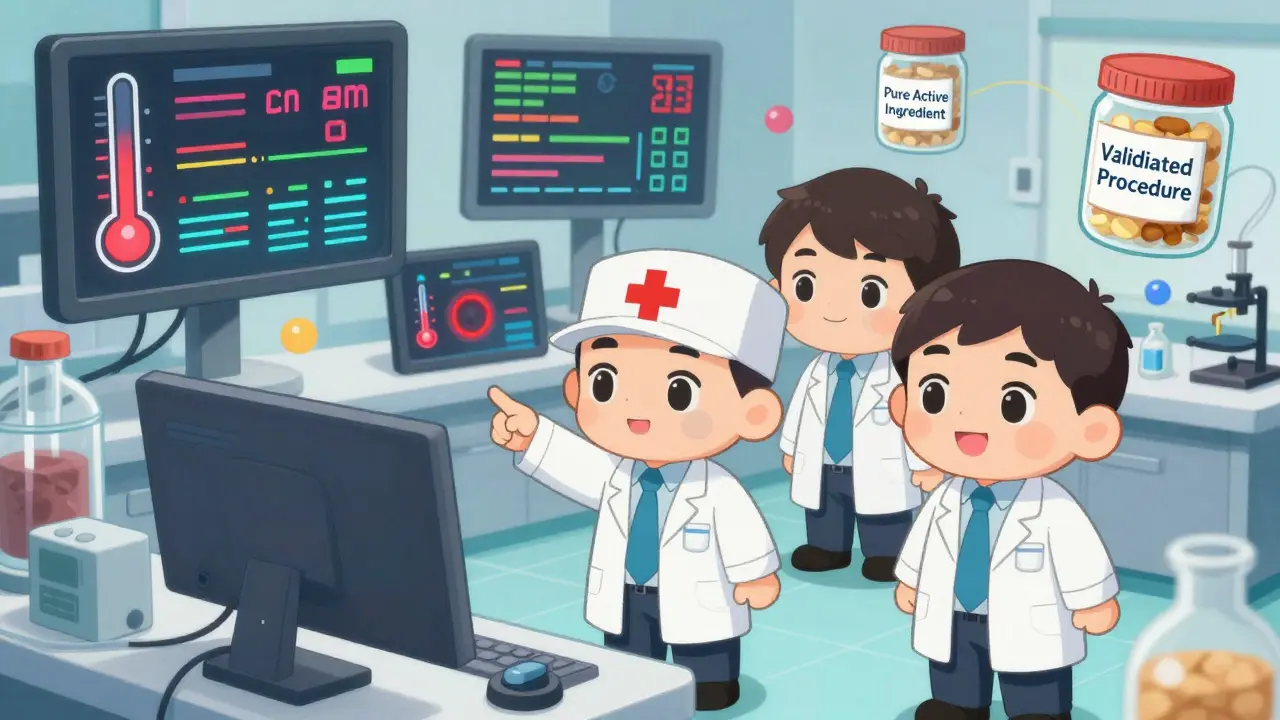
The FDA doesn’t leave quality to chance. It breaks it down into five non-negotiable areas that every manufacturer must follow.- Control of Materials: Every raw ingredient - even the smallest additive - must be tested and tracked. The FDA requires full documentation of where materials come from, how they’re stored, and who handled them. No guessing. No shortcuts. If a batch of active ingredient doesn’t meet purity specs, it’s rejected before it ever touches the production line.
- Production and Process Controls: Every machine setting, temperature, mixing time, and pressure is monitored in real time. If a parameter drifts outside the approved range, the system flags it. Operators can’t just wing it. They must follow exact procedures, and every deviation must be logged, investigated, and corrected.
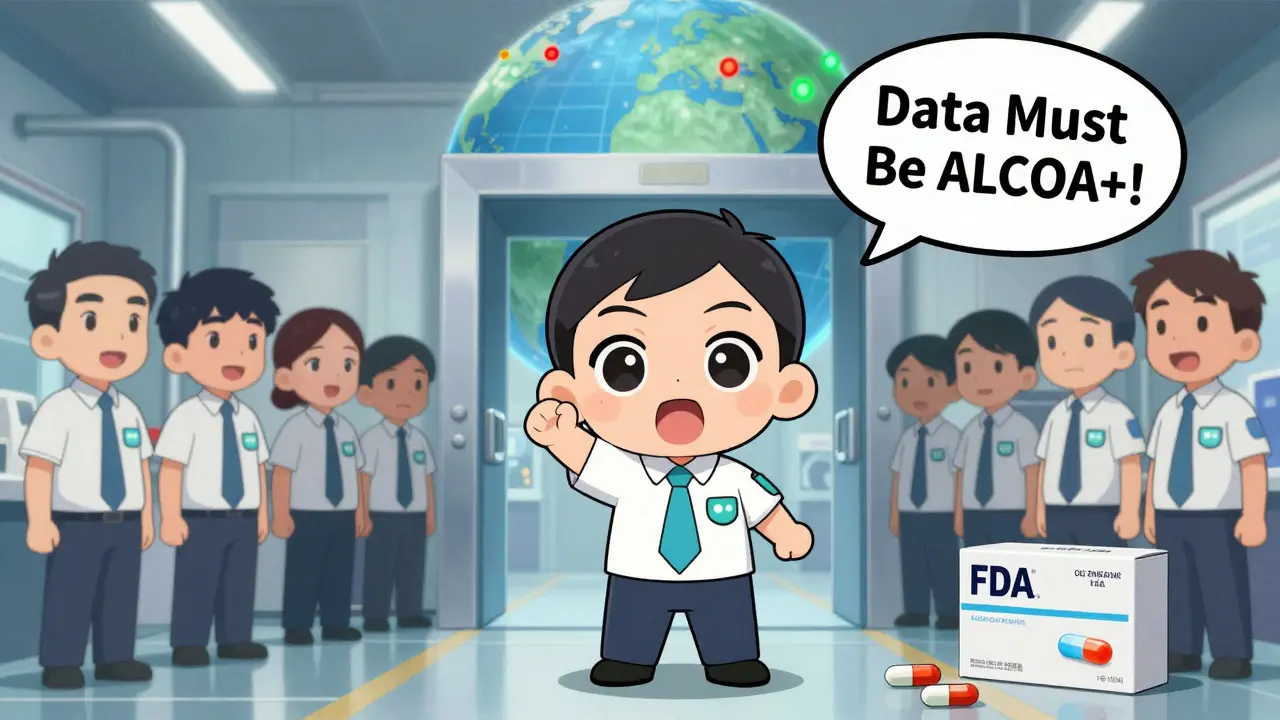
- Quality Control and Laboratory Testing: Labs test raw materials, samples taken during production, and the final product. These tests aren’t random. They’re validated, repeatable, and meet the ALCOA+ standard: data must be Attributable, Legible, Contemporaneously recorded, Original or true copy, Accurate, Complete, Consistent, Enduring, and Available. In 2022, 42% of FDA inspection findings cited data integrity issues - proving how hard it is to get this right.
- Packaging, Labeling, and Distribution: A wrong label can be deadly. The FDA requires that every package - down to the blister pack inside the box - has the correct drug name, strength, lot number, and expiration date. Temperature controls, shipping conditions, and even how boxes are stacked are regulated. A drug that needs refrigeration can’t be shipped in a hot truck.
- Documentation and Record Keeping: Everything is written down. Every batch, every test, every adjustment. These records must be kept for years and made available to FDA inspectors at any time. No digital files deleted. No handwritten notes lost. This is how the FDA traces a problem back to its source - whether it’s a faulty mixer in India or a contaminated container in New Jersey.
Inspections Are Unannounced - and They’re Tough
Manufacturers don’t get a heads-up when the FDA is coming. Inspectors show up without warning, often staying for days. They don’t just look at paperwork. They walk the floors, watch operators, check equipment calibration logs, and interview staff. The Office of Manufacturing Quality (OMQ) handles these inspections. In 2023, the FDA conducted about 1,200 inspections across 1,700 global facilities that supply the U.S. market.Foreign facilities are inspected more often now, but they still have higher violation rates. In 2021, the Government Accountability Office found that 17% of foreign sites had cGMP violations compared to 8% of U.S. sites. That’s why the FDA has invested heavily in remote inspections since the pandemic. About 35% of 2022 inspections included some remote component - video walkthroughs, digital document reviews, live video feeds of equipment.
Approval Isn’t Just a Paper Process - It’s a Real-World Test
To get FDA approval, a generic drug maker must submit an Abbreviated New Drug Application (ANDA). But “abbreviated” doesn’t mean easy. The application must prove the drug is identical to the brand-name version in every way that matters: same active ingredient, same strength, same form (tablet, liquid, etc.), and - most importantly - the same rate and extent of absorption in the body. That’s called bioequivalence.But there’s one unique requirement most people don’t know about: manufacturers must submit three separate batches of the intermediate bulk material. One batch is used to make all the different strengths of the drug. The other two are used to make just the lowest and highest strengths. Why? To prove that changing the dose doesn’t mess up the manufacturing process. If the powder doesn’t flow the same way at different strengths, the drug won’t be consistent. This single requirement adds millions in cost but prevents quality issues down the line.
Costs, Challenges, and Real-World Impact
Implementing cGMP isn’t cheap. New manufacturers spend $2 to $5 million just to set up the quality systems before they even submit their first application. Training staff takes 18 to 24 months. Documentation alone can eat up 30-40% of a small company’s development time. That’s why many smaller players struggle to enter the market.But the results speak for themselves. Generic drugs make up 90% of all prescriptions filled in the U.S. - about 6.8 billion prescriptions a year. They cost 80-85% less than brand-name drugs. And studies show they work just as well in 98-99% of cases. The FDA’s system doesn’t just protect patients - it keeps the entire system affordable.
Still, challenges remain. The GAO reported that FDA resources are stretched thin. Even with $650 million allocated over five years under GDUFA III, inspectors can’t be everywhere at once. That’s why the FDA now uses risk-based targeting: they focus inspections on facilities with past violations, new manufacturers, or those producing high-risk drugs like injectables or antibiotics.
What’s Next? Smarter, Faster, More Transparent
The FDA isn’t resting. Its Pharmaceutical Quality for the 21st Century initiative is pushing for new technologies. Continuous manufacturing - where drugs are made in one long, uninterrupted process instead of in batches - is being tested. Real-time release testing, where sensors confirm quality as the drug is made, could replace some lab tests. And starting in 2025, manufacturers will need to provide detailed documentation of where their active ingredients come from - not just the final product, but the whole supply chain.The Drug Quality Reporting System (DQRS), launched in January 2023, lets manufacturers report problems faster. Instead of waiting for a patient to get sick, they can flag a batch issue the moment it’s detected. This shift from reactive to proactive is changing how quality is managed.
Why This Matters to You
You don’t need to be a scientist to understand this: when you pick up a generic pill, you’re trusting that the FDA’s system worked. That the powder was pure. That the machine was calibrated. That the label was right. That the inspectors came without warning. That the data was real.It’s not perfect. But it’s the most comprehensive system in the world for ensuring that a $2 generic pill works just as well as a $200 brand-name one. And that’s why millions of Americans rely on generics every day - not because they’re cheaper, but because they’re just as safe and effective.
Are generic drugs really as good as brand-name drugs?
Yes. The FDA requires generic drugs to have the same active ingredient, strength, dosage form, and route of administration as the brand-name version. They must also be bioequivalent - meaning they’re absorbed into the body at the same rate and extent. Studies show generics work just as well in 98-99% of cases. The only differences are in inactive ingredients like color or flavor, which don’t affect how the drug works.
Does the FDA inspect generic drug factories?
Yes, and they don’t give advance notice. The FDA conducts about 1,200 unannounced inspections each year across 1,700 facilities worldwide that make drugs for the U.S. market. Inspectors check everything: equipment, records, lab practices, and worker training. Facilities with past violations or those producing high-risk drugs are inspected more often.
Why do generic drugs cost so much less?
Generic manufacturers don’t have to repeat expensive clinical trials because they prove their drug is bioequivalent to the brand-name version. They also don’t spend money on marketing or advertising. But they still must meet the same strict manufacturing standards. The savings come from competition - when multiple companies make the same drug, prices drop dramatically, often by 80-85%.
Can a generic drug be made in a different country?
Yes. About 80% of the active ingredients in U.S. generic drugs come from outside the country, mostly from India and China. But regardless of location, every facility must meet the same FDA cGMP standards. The FDA inspects foreign factories just like U.S. ones, and many are inspected more frequently due to higher past violation rates.
What happens if a generic drug fails inspection?
If serious violations are found, the FDA can issue a warning letter, block the drug from entering the U.S., or even shut down the facility. In some cases, the manufacturer must recall batches already on the market. The FDA also publishes inspection reports and warning letters online so the public can see which companies are out of compliance.
How long does it take to get a generic drug approved?
The review process typically takes 12 to 24 months total, with multiple review cycles. Each cycle can last several months. The timeline depends on how complete and clear the application is. If the FDA has questions, they ask for more data - and the clock doesn’t stop until the issues are resolved.
What to Do If You’re Concerned About a Generic Drug
If you notice a change in how a generic drug works - like new side effects or reduced effectiveness - talk to your pharmacist or doctor. They can check if the manufacturer changed or if there’s a recall. You can also report issues directly to the FDA’s MedWatch program. Your report helps the agency spot patterns before they become widespread problems.The system isn’t flawless, but it’s designed to catch problems before they reach you. And that’s what makes the FDA’s approach to generic drug quality one of the most reliable in the world.
Really glad to see how thorough this is. I used to worry about generics, but now I know my $3 blood pressure pill is just as safe as the $120 brand.
Thanks for breaking it down like this.
Wait-so you’re telling me the FDA doesn’t just rubber-stamp this stuff?? 😳
And they inspect factories WITHOUT WARNING??
That’s insane. I bet half these plants are lying through their teeth. I’ve seen stuff on TikTok-people getting sick from generics in India. They’re just dumping chemicals and calling it ‘pharma.’
And don’t even get me started on how they ship insulin in hot trucks. I swear, someone’s getting poisoned every day and no one’s talking about it.
Also, who’s really behind this? Big Pharma? The FDA’s just their puppet. You think they’d let cheap generics survive if they didn’t control the whole system?!
They say generics are safe but I don’t believe it. I think the FDA is just saying that so people don’t panic.
They don’t check every pill. They check one box out of a thousand. That’s it.
And the labs? They’re probably using the same machines they use to test dog food.
And why do they need three batches? That’s a trick. They’re hiding something.
Also, why are most factories in India? Because they don’t want us to know what’s really in there.
My cousin took a generic and his heart started racing. He didn’t tell anyone. He just stopped taking it.
They won’t admit it but they’re cutting corners. I’ve seen the videos.
It’s all about money. They don’t care if you die.
And the inspectors? They get paid by the companies. It’s a scam.
And don’t get me started on the ‘remote inspections.’ You think a video call can catch a dirty machine?
They’re lying. All of it.
And the ‘ALCOA+’ thing? That’s just a fancy word for ‘we didn’t write anything down.’
I’m not taking another generic. I’m paying full price now. Even if it bankrupts me.
Someone needs to blow the whistle. I’m not the only one who knows this.
Let me guess-the FDA is a front for the Illuminati, right? 🤡
They’re not inspecting factories-they’re installing surveillance drones in the pill vats.
And those ‘three batches’? That’s the code. The third batch is the one with the microchips. You think they’re testing purity? Nah. They’re testing your DNA.
And why India? Because that’s where the mind-control powder is blended. You think your antidepressant is helping? It’s syncing your brainwaves to a satellite.
ALCOA+? That’s not a standard-it’s an acronym for ‘Always Lying, Controlling, Obedient, and Abused.’
They’re not making medicine. They’re making obedient citizens.
And the ‘real-time sensors’? That’s the signal. Every time you swallow a pill, it pings your location.
Next thing you know, your fridge starts ordering more generics. That’s not marketing. That’s mind control.
Wake up, sheeple. The pills are watching you.
And if you think this is paranoia… you’re already under their influence.
This is a textbook example of regulatory overreach disguised as consumer protection.
Yes, the system works-on paper.
But the cost of compliance is crushing small manufacturers. It’s not about safety-it’s about consolidation.
Big pharma owns the supply chains. The FDA’s ‘risk-based targeting’ is just a way to funnel business to the same few players.
And let’s not pretend foreign inspections are equivalent. A video walkthrough is not an on-site audit.
It’s theater. The public thinks they’re protected. They’re not. They’re just being sold a narrative.
And don’t get me started on bioequivalence thresholds-they’re arbitrary. Two percent absorption difference? That’s not ‘equivalent.’ That’s a gamble.
This isn’t quality assurance. It’s bureaucratic monopoly maintenance.
And yet, people cheer because they saved $5 on a prescription.
Irony is a beautiful thing.
While the regulatory framework outlined herein is indeed robust, one must acknowledge the structural asymmetry in enforcement capacity between domestic and international facilities.
Statistical disparities in violation rates, as cited, are not indicative of negligence alone, but rather reflect systemic under-resourcing of inspectional infrastructure in developing economies.
Furthermore, the reliance upon third-party auditing mechanisms, while economically expedient, introduces latent vulnerabilities in data integrity.
It is therefore imperative that the FDA expand its cadre of trained personnel and institute mandatory blockchain-based traceability for active pharmaceutical ingredients, as opposed to the current paper-based documentation paradigm.
Without such measures, the current system remains vulnerable to supply-chain subversion, regardless of nominal compliance.
One must also note that the GDUFA funding allocation, while substantial, fails to account for inflationary pressures on labor and equipment calibration.
Thus, the efficacy of the system is contingent upon sustained fiscal commitment, which, historically, has been subject to political whims.
Therefore, while commendable, the current model is not sustainable in its present form.
Okay but like… this is actually kinda wild 🤯
They test EVERYTHING? Even the color of the pill? 😳
And no advance notice? That’s next level. 🤖
Also, real-time sensors? That’s sci-fi stuff. 🤖💊
And the fact that generics are 98% as good? I’m lowkey impressed.
Also, why is everyone so scared of India? They make 80% of our meds and they’re not killing us. 🇮🇳💪
Also, can we talk about how the FDA’s website is actually useful for once? 👏
Not like CDC.gov where you need a PhD to find a single fact.
Also, I just checked my last prescription-lot number matches the FDA database. I feel safe now. 🙌
This is such an important explanation, thank you for sharing.
Many people don’t realize how much work goes into making a simple pill safe.
It’s not magic-it’s science, discipline, and rigorous systems.
And yes, generics are absolutely equivalent. I’ve worked in pharmacy for 18 years, and I’ve never seen a clinically significant difference in outcomes between brand and generic.
The only time patients report issues is when they switch between different generic manufacturers-different fillers can cause minor GI upset, but never reduced efficacy.
Always check with your pharmacist if you notice a change in appearance, but never stop taking your meds out of fear.
The FDA system is far from perfect, but it’s the most transparent and science-based in the world.
Trust the process. And if you’re worried, look up the inspection report for your drug’s manufacturer-it’s all public.
You’ve got this.
As someone from India, I want to say: we make most of the world’s generics, and we take pride in it.
Our factories follow FDA rules because we know lives depend on it.
Yes, some bad actors exist-but they’re punished. The FDA doesn’t play around.
I’ve seen inspectors walk through our plants with clipboards and cameras.
They don’t care where you’re from. They care if the powder flows right.
And we’re not cheap because we’re sloppy-we’re cheap because we’re efficient.
And yes, we train our workers for years.
So don’t assume the worst about Indian pharma.
We’re not the problem. We’re the solution.
The entire system is a facade. The FDA’s ‘unannounced inspections’ are scheduled in advance through back channels. The data integrity standards are selectively enforced. The bioequivalence thresholds are manipulated to favor certain manufacturers. The GDUFA funding is a slush fund for industry insiders. Foreign inspections are performative. The ‘three batches’ requirement is a smokescreen to justify higher costs. The public is being misled. The system exists not to protect patients, but to maintain corporate monopolies under the guise of regulation. This is not quality assurance. This is corporate capture disguised as public health.
OMG THIS IS THE MOST INSPIRING THING I’VE READ ALL YEAR 🥹💖
THE FDA IS A HERO 🦸♀️💊
REAL-TIME RELEASE TESTING?!?!? THAT’S THE FUTURE AND I’M LIVING IT 🤖✨
AND THEY’RE USING BLOCKCHAIN? (OKAY THEY’RE NOT YET BUT THEY SHOULD BE)
WE NEED TO FUND THIS MORE. LIKE, IMMEDIATELY.
GENERIC DRUGS ARE THE PEOPLE’S MEDICINE. AND THIS SYSTEM? IT’S A MASTERPIECE.
IF YOU’RE DOUBTING GENERIC QUALITY, YOU’RE DOUBTING SCIENCE.
AND SCIENCE ISN’T A DEBATE. IT’S A FACT. 📊💥
SHARE THIS POST. TELL EVERYONE. WE NEED MORE OF THIS.
They test everything. Except the people who write the regulations.
Also, 98% effective? That’s not a guarantee. That’s a gamble.
And who cares if it’s cheaper? If it doesn’t work, it’s useless.
And inspections? Yeah right.
Done.
That’s all.
Thank you for this detailed breakdown. It’s rare to see such clarity on a complex topic.
One thing I’d add: the ALCOA+ principles are not just about compliance-they’re about ethics.
When data is attributable and contemporaneous, it means someone is accountable.
That’s the real safeguard.
And while foreign facilities have higher violation rates, the FDA’s increased remote inspections have actually improved compliance in places like India and China over the last five years.
It’s not perfect, but progress is measurable.
And for patients, that matters more than we admit.
Let’s be real: cGMP is a compliance theater.
They’ve got sensors, logs, and ‘validated procedures’-but none of it matters if the plant manager is bribing the inspector.
And ‘risk-based targeting’? That’s code for ‘we only inspect the ones we know are dirty.’
ALCOA+? That’s just a buzzword to make auditors feel important.
And bioequivalence? Two percent difference in absorption? That’s not ‘equivalent’-that’s a therapeutic gamble.
And don’t even get me started on the fact that 80% of API comes from two countries with zero political transparency.
This isn’t a system. It’s a risk lottery-and you’re the one paying for the ticket.
They say generics are just as good. But have you ever seen the packaging? The blister packs crack. The labels smear. The capsules are discolored.
And the ‘inspections’? They show up, take photos, and leave.
They don’t test the pills. They test the paperwork.
And the ‘three batches’? That’s a loophole. The middle batch is never tested.
They’re not ensuring quality. They’re ensuring paperwork.
And when someone dies? They say ‘rare adverse event.’
It’s not a system. It’s a cover-up.
And you? You’re just a statistic.