
Thiazide Diuretic Risk Calculator
This tool estimates your risk of developing gout while taking thiazide diuretics based on your current uric acid level, dosage, and other risk factors. Data based on clinical studies showing thiazides can increase uric acid by 6-21%.
Thiazide diuretics like hydrochlorothiazide (HCTZ) are among the most common blood pressure medications in the world. In the U.S. alone, over 35 million prescriptions were filled in 2022. They work well, are cheap, and have been used for over 60 years. But for people with gout or high uric acid levels, these drugs can make things worse-sometimes quickly.
How Thiazide Diuretics Raise Uric Acid
Thiazide diuretics don’t just flush out salt and water. They also mess with how your kidneys handle uric acid. Normally, your kidneys filter uric acid out of your blood and send it into your urine. But when you take a thiazide, it competes with uric acid for the same transporters in the kidney tubules-specifically the OAT1 and OAT4 proteins. Instead of uric acid being pushed out, it gets pulled back into your bloodstream. The result? Uric acid levels rise.
This isn’t a slow process. Studies show uric acid can jump within just 3 to 7 days of starting the drug. The higher the dose, the bigger the spike. A 2017 review in Oxford Academic found that thiazides can raise serum uric acid by 6% to 21% compared to baseline. That might not sound like much, but if your uric acid was already near the danger zone (6.8 mg/dL), even a small bump can trigger crystals to form in your joints.
Who’s at Risk for Gout?
Not everyone on thiazides gets gout. About 12% to 15% develop high uric acid levels, but only 1% to 2% end up with painful gout attacks. So why do some people get it and others don’t?
Genetics play a big role. If your family has a history of gout, you’re more likely to be sensitive to this side effect. Other factors include being overweight, drinking alcohol (especially beer), eating red meat or shellfish, and having kidney disease. Hypertension itself is also a risk factor-people with high blood pressure are nearly twice as likely to develop gout, making it hard to tell if the diuretic or the high blood pressure is the real culprit.
Still, the numbers don’t lie. A 2024 study tracking over 247,000 people found that those on thiazides were 18% more likely to get an antigout prescription after 30 days, and that risk climbed to 41% after more than 180 days of use. That means if you’re on this medication long-term, your chances of needing gout treatment go up significantly.
Is Chlorthalidone Worse Than Hydrochlorothiazide?
For years, doctors assumed chlorthalidone-a longer-acting thiazide-like drug-was riskier for gout. But a 2019 study found no meaningful difference in gout risk between chlorthalidone and hydrochlorothiazide when given at similar doses. Both raise uric acid. Both can trigger attacks. The myth that one is safer than the other isn’t backed by evidence.
What does matter is dose. Higher doses (like 50 mg of HCTZ) carry more risk than lower ones (12.5 mg). But even low doses can cause problems in sensitive people. That’s why checking your uric acid before starting the drug is critical.
What Does a Gout Attack Look Like?
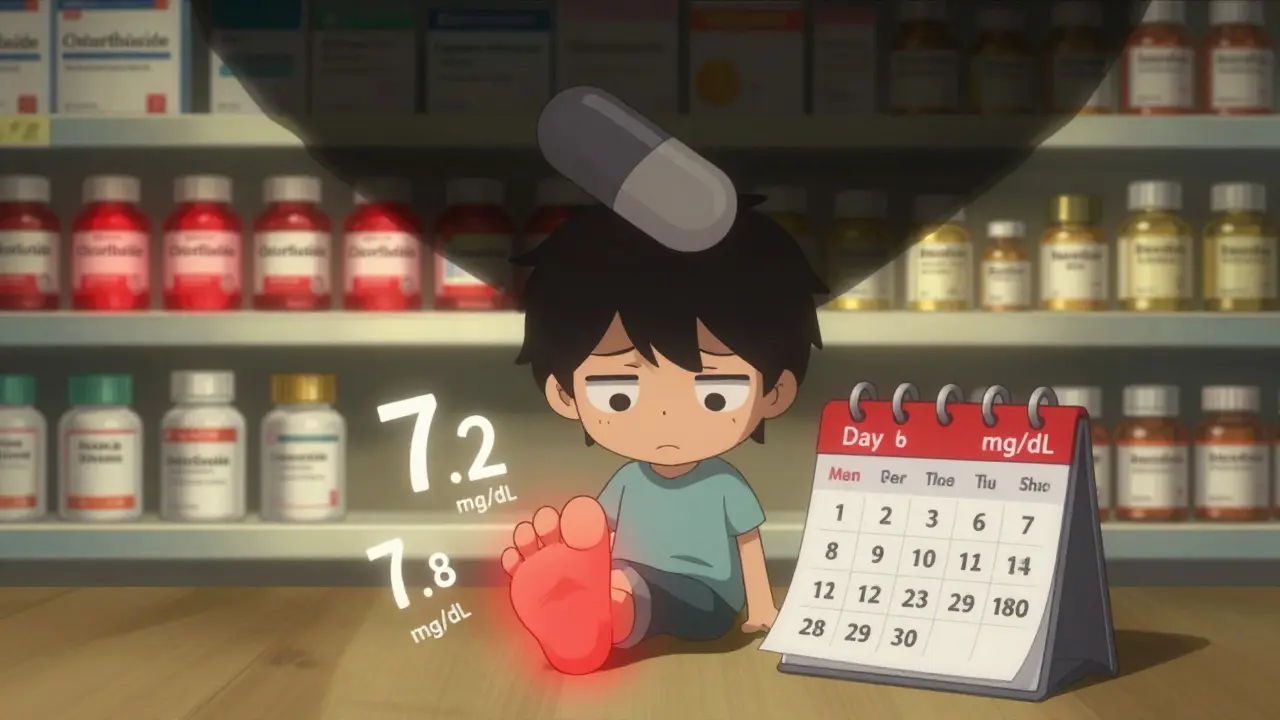
Thiazide-induced gout doesn’t feel different from any other kind. It hits suddenly-often at night-with intense pain, redness, and swelling in a single joint. The big toe is the most common target (about 70% of first attacks), but ankles, knees, and fingers can also be affected. The pain is often described as worse than childbirth or a broken bone.
Uric acid levels are above 6.8 mg/dL in 90% of these cases. But here’s the catch: during an attack, uric acid can actually drop temporarily as the body pulls it into the joint to form crystals. So if you get tested during a flare, your blood level might look normal-even though you’re having gout. That’s why doctors rely on symptoms and history, not just lab numbers.
What Should You Do If You’re on Thiazides?
If you’re already taking a thiazide and have a history of gout or high uric acid, don’t stop the drug on your own. Talk to your doctor. Here are your options:
- Check your uric acid. If you haven’t had a test since starting the medication, get one now. Levels above 7.0 mg/dL in men or 6.0 mg/dL in women are a red flag.
- Consider alternatives. Losartan (an ARB blood pressure drug) actually helps lower uric acid by blocking its reabsorption in the kidney. Calcium channel blockers like amlodipine don’t raise uric acid at all. Both are good substitutes.
- Try potassium-sparing diuretics. Spironolactone doesn’t interfere with uric acid transporters. It’s not as strong for blood pressure, but it’s a solid option for people with gout.
- Use urate-lowering therapy. If you need to stay on a thiazide, your doctor may prescribe allopurinol (starting at 100 mg daily) to keep uric acid below 6.0 mg/dL. This prevents crystal buildup over time.
Lifestyle changes matter too. Cut back on beer, red meat, and sugary drinks. Stay hydrated. Losing even 5% of your body weight can reduce uric acid levels by 1-2 mg/dL.

Why Doctors Still Prescribe Thiazides
Despite the gout risk, thiazides remain first-line for hypertension. Why? Because they cut stroke and heart attack risk by 20-30% in older adults. For someone with no history of gout, the benefits outweigh the risks.
The key is smart prescribing. The American College of Cardiology and European Society of Cardiology both say: avoid thiazides as first choice if you already have gout or uric acid over 8.0 mg/dL. If you must use them, pair them with urate-lowering drugs or switch to a safer alternative.
Doctors are catching on. A 2021 survey showed 78% of cardiologists now check for gout history before prescribing thiazides-up from just 52% in 2015. Awareness is growing. So should your vigilance.
What’s Next?
Researchers are working on new diuretics that lower blood pressure without messing with uric acid. A phase II trial (NCT04892105) is testing a selective sodium-chloride cotransporter inhibitor that doesn’t bind to OAT1 or OAT4. Results aren’t expected until late 2025. Until then, we work with what we have.
If you’re on hydrochlorothiazide or chlorthalidone and have joint pain, fatigue, or swelling in your toes, don’t brush it off. It might not be just aging. It could be gout-and it might be linked to your medication.
The goal isn’t to scare you off a lifesaving drug. It’s to help you make informed choices. Thiazides save lives. But they can also trigger pain that lasts for days. With the right monitoring and alternatives, you don’t have to choose between controlling your blood pressure and avoiding gout attacks.
Can thiazide diuretics cause gout even if I’ve never had it before?
Yes. Even if you’ve never had gout, thiazide diuretics can raise your uric acid enough to trigger your first attack. About 1-2% of people on these drugs develop gout within a few months. Risk increases with higher doses, longer use, and other factors like obesity or alcohol intake.
Should I stop taking hydrochlorothiazide if my uric acid is high?
Don’t stop on your own. Talk to your doctor. If your uric acid is above 7.0 mg/dL and you have joint pain, switching to a different blood pressure medication like losartan or a calcium channel blocker may be the best move. If you still need a diuretic, spironolactone is a safer option. Your doctor may also start you on allopurinol to lower uric acid while keeping you on the thiazide.
How long does it take for uric acid to go back to normal after stopping thiazides?
Uric acid levels usually return to baseline within 2 to 3 months after stopping thiazide diuretics. This is based on clinical observations from the Mayo Clinic and other medical centers. If you’ve had gout attacks, your doctor may still recommend ongoing urate-lowering therapy to prevent future flares, even after stopping the drug.
Is chlorthalidone more likely to cause gout than hydrochlorothiazide?
No. Earlier assumptions suggested chlorthalidone was riskier, but a 2019 study found no significant difference in gout risk between the two drugs when used at similar doses. Both raise uric acid through the same kidney transporters. Dose and duration matter more than which specific drug you’re on.
What’s the best blood pressure medicine if I have gout?
Losartan is often the top choice-it lowers blood pressure and helps your kidneys excrete more uric acid. Calcium channel blockers like amlodipine are also safe and don’t affect uric acid. Spironolactone, a potassium-sparing diuretic, is another option if you need a diuretic. Avoid thiazides and loop diuretics unless absolutely necessary and paired with urate-lowering therapy.


bro i been on hctz for 3 years and never had a gout attack but my buddy took it for 2 months and ended up in the er with his big toe swollen like a balloon. so yeah it’s hit or miss but i’d rather not risk it.
Let’s be clear: this isn’t some ‘maybe’ risk. Thiazides are a silent metabolic saboteur. OAT1 and OAT4 transporter competition? That’s not a side effect-it’s a pharmacological betrayal. The fact that we still prescribe these like candy while ignoring the uric acid cascade is a travesty of medical inertia. If your doctor doesn’t check your serum urate before prescribing HCTZ, they’re not practicing medicine-they’re playing Russian roulette with your joints.
And don’t get me started on the chlorthalidone myth. Same transporter. Same mechanism. Same outcome. The only difference is the half-life. The pharmaceutical industry loves to sell us ‘equivalent’ drugs so we don’t question the underlying toxicity. Wake up.
And yes, losartan is the only reasonable alternative. It’s not just ‘not harmful’-it’s actively protective. Why isn’t this the first-line recommendation? Because guidelines are written by committees who haven’t seen a gout flare since med school.
This is such an important post-thank you for laying it out so clearly. I’m a nurse in a primary care clinic and I see this all the time. Patients come in with swollen toes, assume it’s ‘just aging,’ and don’t connect it to their BP med. We now routinely check uric acid before starting thiazides, especially if they’re overweight or have a family history of gout. Small change, huge impact.
Also, hydration is underrated. So many people don’t realize how much water they need when on diuretics. It’s not just about flushing out salt-it’s about keeping uric acid dissolved. I tell my patients: if your pee looks like apple juice, drink more.
My dad was on HCTZ for 15 years. Never had gout until he turned 72. Then-bam. One night, his big toe looked like a red sausage. He thought it was a sprain. Took him three weeks to get the right diagnosis. Turns out his uric acid was 9.4. He switched to amlodipine and hasn’t had another flare in 4 years. The scary part? His doctor never mentioned the risk. Not once. Not even when he asked about side effects.
I’m so glad this info is out there. My mom’s on spironolactone now for her BP and her gout’s been stable. It’s not perfect-she gets a little dizzy sometimes-but she’s not hobbling through life anymore. Knowledge is power, and this post is pure gold.
While the data presented is compelling and clinically relevant, I must emphasize that the decision to discontinue or substitute antihypertensive therapy must be made in the context of individual cardiovascular risk stratification. The reduction in stroke and myocardial infarction with thiazide use is well-documented in landmark trials including SPRINT and ALLHAT. For a 68-year-old male with stage 2 hypertension and a 10-year ASCVD risk of 22%, the benefit-risk ratio remains strongly favorable, even in the presence of elevated uric acid. Urate-lowering therapy, when indicated, should be initiated concurrently-not as a substitute for adequate blood pressure control. The goal is not to eliminate thiazides, but to mitigate their metabolic consequences with precision medicine.
It’s not just the drug. It’s the whole system. We live in a world where we treat symptoms with chemicals and never ask why the body’s in chaos to begin with. High blood pressure? Pop a pill. High uric acid? Pop another pill. But no one asks: why are you so inflamed? Why are you overweight? Why do you drink beer every Friday? Why are you dehydrated from drinking coffee instead of water? The system doesn’t want you to fix the root-it wants you to keep buying pills. Thiazides are just the tip of the iceberg. The real diagnosis? Modern life.
And don’t get me started on ‘lifestyle changes.’ Everyone says it. No one does it. We’re all just walking time bombs with prescriptions.
lol so now we’re blaming hctz for gout? bro i’ve been on it since 2018 and i drink 6 beers a week and eat steak every sunday. still no gout. your uric acid is probably high because you’re fat and lazy. stop blaming the medicine.
I’m from South Africa and we don’t have access to losartan in rural clinics. Most people here get HCTZ because it’s cheap and available. So what do we do? Tell them to stop? No. We need better access to alternatives-not just more warnings. This is a global health injustice. The same meds that save lives in the US are poisoning people in places with no options.
I’ve seen grandmas with swollen feet and no meds to fix it. The real problem isn’t the drug-it’s the system that leaves them with no choice.
thiazides dont cause gout. its the beer.
As someone who grew up in a household where my grandfather had chronic gout, this hits home. He used to say, ‘The medicine that saves your heart breaks your toe.’ He was right. We switched him to losartan after his third flare, and his joint pain vanished. But here’s the thing-his doctor didn’t know about the link either. It was my aunt, a pharmacist, who found the study. We need better education-not just for patients, but for doctors too.
And honestly? I’m glad someone finally said it: uric acid can drop during a flare. I’ve seen people get sent home because their labs looked ‘normal.’ That’s dangerous.
I’m so glad someone wrote this. My mom’s on HCTZ and she’s been having morning foot pain for months. She thought it was her shoes. I showed her this and she finally went to the doctor. Uric acid was 8.1. They switched her to amlodipine and gave her allopurinol. Two weeks later, she’s walking without a cane. Thank you for giving us the language to ask for better care.
Oh great. Another ‘medical woke’ post. Let’s ban all thiazides because a few people get gout? What’s next? Banning aspirin because it causes Reye’s syndrome? Banning statins because of muscle pain? This is fearmongering dressed up as ‘awareness.’ Thiazides prevent strokes. Millions of people benefit. One percent get gout? That’s not a crisis-that’s a trade-off. Stop treating every side effect like a scandal.
And for the love of god, stop pretending losartan is a miracle drug. It’s not. It causes hyperkalemia. It’s more expensive. It doesn’t work as well in Black patients. But you’ll read about it on Reddit, not in a real journal.
hctz = gout. done. next.
Interesting. So if I’m reading this right, the same transporter that kicks out uric acid is the one thiazides hijack. That’s actually kind of elegant-like a molecular tug-of-war. But here’s the irony: we use these drugs because they’re cheap and effective. Meanwhile, we’ve got pharma companies spending billions on ‘new’ diuretics that do the same thing but with a patent. Meanwhile, people in developing countries are still on HCTZ because it’s the only thing they can afford. The real villain isn’t the molecule-it’s the economics of medicine.
And can we talk about how the phrase ‘lifestyle changes’ is code for ‘we don’t have a real solution’? Losing 5% body weight helps? Cool. But how many people actually do that? And who’s paying for the nutritionist, the gym membership, the time off work?
This isn’t just about kidneys. It’s about inequality.
ok but what if u just stop eating meat and drink more water? then u dont need to switch meds right? i mean its not that hard. people make it so complicated. just drink water and be cool.