
SAE Classifier Tool
What is a Serious Adverse Event (SAE)?
The FDA defines a Serious Adverse Event as any medical outcome linked to a drug or device that leads to one of these five specific outcomes:
Any death related to the treatment
Condition requiring immediate medical intervention to prevent death
Initial admission or prolonged stay (24+ hours)
Permanent loss of function or organ damage
Abnormality in a baby born to someone taking the drug during pregnancy
Check Your Experience
Your Result
Enter details above to check
Your experience will be evaluated based on whether it meets any of the five criteria.
Remember: Even if the event was severe (painful, uncomfortable), it may not be serious unless it meets one of these criteria.
When you’re taking a new medication or joining a clinical trial, you might see the term serious adverse event in your paperwork. It sounds scary. And it’s meant to. But here’s the thing most patients don’t realize: serious doesn’t always mean severe. And that difference could change how you understand your own health risks.
What Exactly Is a Serious Adverse Event?
The U.S. Food and Drug Administration (FDA) defines a Serious Adverse Event (SAE) as any bad medical outcome linked to a drug, vaccine, or medical device that leads to one of five specific outcomes:- Death
- Life-threatening condition (you were in danger of dying at the time)
- Hospitalization (either your first admission or if your stay got longer by at least 24 hours)
- Permanent disability or damage (like losing vision, nerve damage, or organ failure)
- A birth defect in a baby born to someone taking the drug during pregnancy
That’s it. If it doesn’t meet one of those five criteria, it’s not classified as serious - even if it’s really unpleasant.
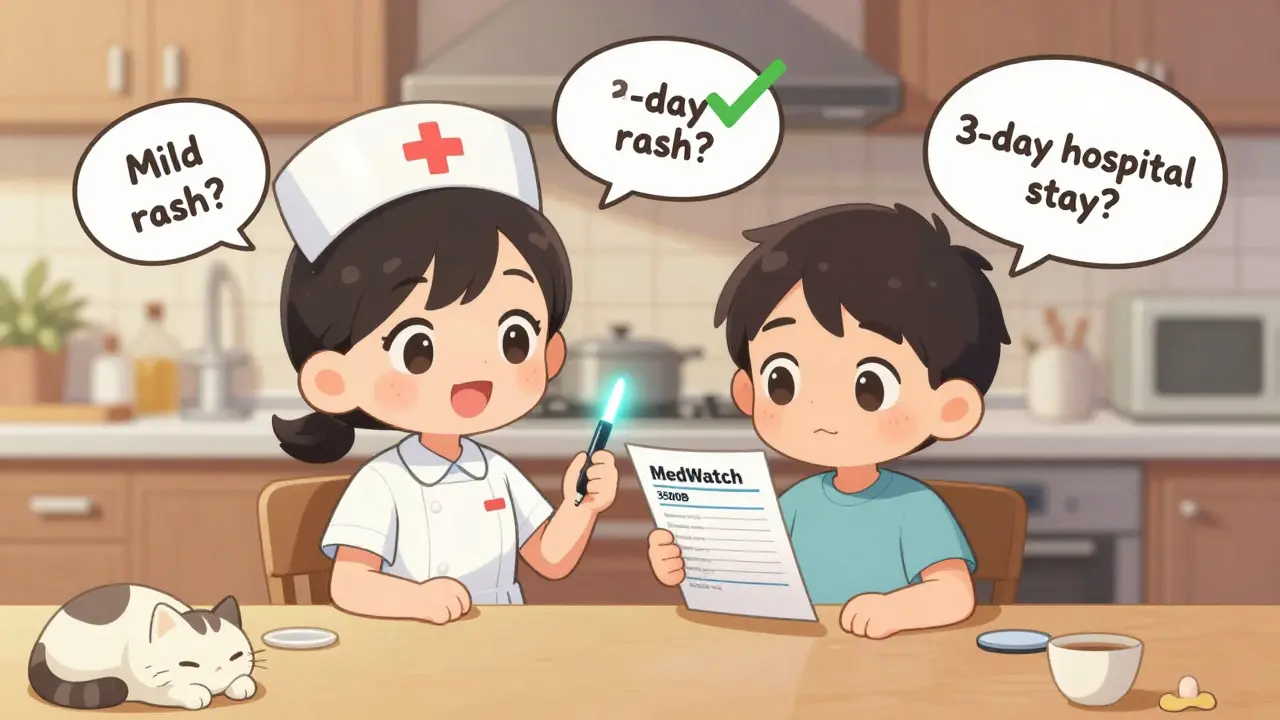
For example, if you get a bad headache that makes you miss work for a week, that’s uncomfortable. But unless it leads to hospitalization or permanent damage, it’s not an SAE. On the other hand, if you get a mild rash that doesn’t hurt but ends up requiring a 3-day hospital stay to rule out infection, that’s an SAE.
Why the Confusion Between Serious and Severe?
This is where most patients get tripped up. Doctors and drug labels often talk about severity - how bad a symptom feels. The FDA uses a different scale for that:- Grade 1: Mild (annoying but doesn’t interfere with daily life)
- Grade 2: Moderate (needs minor treatment, like an OTC painkiller or anti-nausea pill)
- Grade 3: Severe (requires hospitalization or strong meds)
- Grade 4: Life-threatening (needs ICU-level care)
- Grade 5: Fatal
So here’s the key point: a Grade 3 event (severe) isn’t automatically a Serious Adverse Event. If you get severe nausea that sends you to the ER but you’re sent home after 6 hours with IV fluids and meds, that’s Grade 3 but not an SAE - because you weren’t hospitalized for 24+ hours. But if you get a mild fever that doesn’t feel bad at all, yet leads to sepsis and a 5-day ICU stay? That’s an SAE - and it’s the kind the FDA tracks.
Dr. Robert Temple, a former top FDA official, says this mix-up causes unnecessary panic. In cancer trials, 68% of Grade 3 or 4 side effects weren’t classified as serious because they didn’t meet the five criteria. Patients thought they were in danger - but the system was just doing its job: filtering out expected side effects to find real red flags.
How the FDA Uses This Info to Protect You
The whole point of tracking SAEs isn’t to scare you. It’s to catch problems early.Every time a serious event is reported - whether by a doctor, hospital, or patient - it goes into the FDA’s Adverse Event Reporting System (FAERS). In 2022 alone, this system helped trigger 128 safety alerts and 47 changes to drug labels. That means drugs got new warnings, dosing limits, or even restrictions because someone noticed a pattern.
One real example: A diabetes drug was linked to rare but fatal pancreatitis in a small group of patients. The SAE reports piled up. The FDA reviewed the data, updated the label, and told doctors to avoid prescribing it to patients with a history of pancreatitis. That saved lives.
The FDA also uses AI now to scan reports faster. In a pilot program, AI cut the review time for critical SAEs from 30 days to just 7. That’s huge when you’re trying to stop a new danger before it spreads.
What About Underreporting? Is This System Reliable?
No system is perfect. Experts estimate only 1% to 10% of all adverse events get reported - especially if they happen outside hospitals or to people who don’t know how to report.Patients often don’t realize they can report side effects themselves. The FDA’s MedWatch program lets anyone submit a report using Form 3500B. In 2022, over 38,000 reports came directly from patients - up 12% from the year before. That’s progress.
Still, there’s a gap. A 2022 study found that drug companies underreport serious events by 27% to 35% because they’re not always motivated to highlight risks. That’s why the FDA is pushing for more transparency and patient input. Since 2016, the 21st Century Cures Act requires drug makers to include patient perspectives when defining what counts as serious.
What You Should Look For in Your Medication Guide
When you get a new prescription, read the Medication Guide. It’s required by law to have a section called “Warnings and Precautions.” That’s where they list the SAEs seen in clinical trials - with numbers. For example:“Serious infections occurred in 2.3% of patients taking this drug.”
That means about 2 out of every 100 people had an infection serious enough to require hospitalization or cause permanent damage. Not a high number - but important to know.
In clinical trials, you’ll see SAEs listed in the consent form under “Risks and Discomforts.” If you don’t see a plain-language explanation, ask your doctor or research nurse to clarify. Don’t assume you know what “serious” means.
What You Can Do as a Patient
You’re not just a data point. You’re part of the safety system.- Know the five criteria. If you end up in the hospital because of a side effect, that’s an SAE - even if you think it’s “just” a bad reaction.
- Report it. Use the MedWatch form at fda.gov/medwatch. You don’t need a doctor’s note. Just describe what happened, when, and what you were taking.
- Ask questions. If a trial says “Grade 3 fatigue,” ask: “Is this considered serious?” If they say no, ask why. The answer might surprise you.
- Use plain language. The FDA now recommends defining SAE as: “An event that causes death, hospitalization, permanent damage, life-threatening conditions, or birth defects.” Keep that definition handy.
One patient in a diabetes trial said she only understood the risk when her nurse explained: “If you get so sick you need to go to the hospital for ketoacidosis, that’s an SAE - and we need to know right away.” That clarity helped her act fast when symptoms returned - and likely prevented a crisis.
The Future: More Patient-Friendly Safety
The FDA is working to make this easier. By 2025, all clinical trial websites will have to include plain-language summaries of SAEs. A new patient education portal is launching in late 2024, built on lessons from the pandemic, when over a million reports were processed accurately under pressure.What’s changing? More focus on what matters to patients. If a side effect makes you unable to work, care for your kids, or leave the house - even if it’s not life-threatening - that’s now being weighed in safety decisions. The system is finally starting to listen.
Is a serious adverse event the same as a severe side effect?
No. A severe side effect means it’s intense or uncomfortable - like high fever or vomiting. A serious adverse event means it led to one of five specific outcomes: death, hospitalization, life-threatening condition, permanent damage, or birth defect. You can have a severe side effect that isn’t serious - and a mild symptom that turns into a serious event.
Can I report a side effect myself to the FDA?
Yes. The FDA’s MedWatch program lets patients report adverse events directly using Form 3500B. You don’t need a doctor’s permission. Just go to fda.gov/medwatch and fill out the form. In 2022, over 38,000 reports came from patients - and those reports helped identify new safety signals.
Why do some side effects get listed as serious and others don’t?
The FDA only classifies events as serious if they meet one of five specific criteria - not because they feel bad. For example, a Grade 3 headache (severe) that doesn’t require hospitalization isn’t serious. But a mild rash that leads to a 3-day hospital stay for allergic reaction is. The system filters for outcomes that truly threaten safety, not just discomfort.
Do all drug companies report serious events honestly?
Not always. Studies show industry reporting underestimates serious events by 27% to 35% because companies may delay or downplay reports. That’s why the FDA relies on multiple sources - including patient reports, hospital records, and independent researchers - to cross-check data. Patient reports are critical to catching what companies miss.
What should I do if I think I had a serious adverse event?
First, contact your doctor immediately. Then, file a report with the FDA using MedWatch Form 3500B. Even if your doctor reports it, your report adds valuable perspective. Write down the date, symptoms, medication dose, and any hospital visits. The more detail you give, the better the FDA can track patterns and protect others.


i read this and thought wow this is actually super helpful but also kinda terrifying? like i had a rash last year that sent me to the er and they just gave me benadryl and sent me home - turns out it was an allergic reaction that could’ve gone worse. i didn’t know that counted as an SAE. now i’m kinda mad i didn’t report it.
THEY’RE HIDING THINGS FROM US AGAIN I TOLD YOU THIS WAS A TRAP THE PHARMA COMPANIES ARE LYING TO THE FDA AND THE FDA IS LYING TO YOU I’VE SEEN THE DOCUMENTS THEY DON’T EVEN TRACK MOST OF THE HOSPITALIZATIONS THEY JUST DELETE THEM IF THE DRUG MAKES TOO MUCH MONEY I SAW A VIDEO ON TIKTOK OF A WOMAN WHO DIED FROM A VACCINE AND THEY SAID IT WAS A HEART ATTACK BUT SHE NEVER HAD HEART PROBLEMS BEFORE AND WHY ISN’T ANYONE TALKING ABOUT THIS
bro this is actually one of the clearest explainers i’ve read on this. i was in a trial last year and kept asking if my nausea was serious and they just said ‘it’s grade 3’ like that meant something. now i get it - if i didn’t get admitted for 24 hours it doesn’t count. thanks for the clarity.
you ever notice how the FDA’s definition of ‘serious’ is basically a legal loophole dressed up as medical science? like yeah, a headache that doesn’t hospitalize you isn’t an SAE - but what if that headache makes you quit your job, lose custody of your kid, or spiral into depression? those aren’t in the five criteria but they’re real as hell. the system’s built to count bodies, not broken lives. we need a new metric: ‘life-altering event.’
so if i get dizzy and fall and break my wrist but don’t go to the hospital, that’s not serious? but if i get a tiny rash and end up in the hospital for a day, that is? that feels weird. i get why they do it but it’s still confusing for regular people.
😮💨 the irony… the system designed to protect us… is so rigid… it misses the human cost… the silent suffering… the lost jobs… the sleepless nights… the fear… the loneliness… we’re not data points… we’re souls with schedules… with kids… with bills… and the FDA… is still stuck in 1987… 🤦♂️
My sister took a new antidepressant and got a mild rash. No itching, no swelling. Just a few red dots. But it landed her in the hospital for three days because they were afraid it was Stevens-Johnson. Turns out it wasn’t - but the fear, the IVs, the isolation… that trauma? That’s real. And the FDA doesn’t track that. Maybe they should. Because ‘serious’ isn’t just about the body - it’s about the whole damn life.
the system is designed to make you feel safe while quietly ignoring everything that matters