For over a decade, the U.S. healthcare system has been quietly saving trillions of dollars-not by cutting services, reducing staff, or raising premiums-but by switching to generic drugs. These aren’t cheap knockoffs. They’re the exact same medicines, approved by the FDA, used by millions every day. And they’ve cut prescription drug spending by more than 85% compared to brand-name versions.
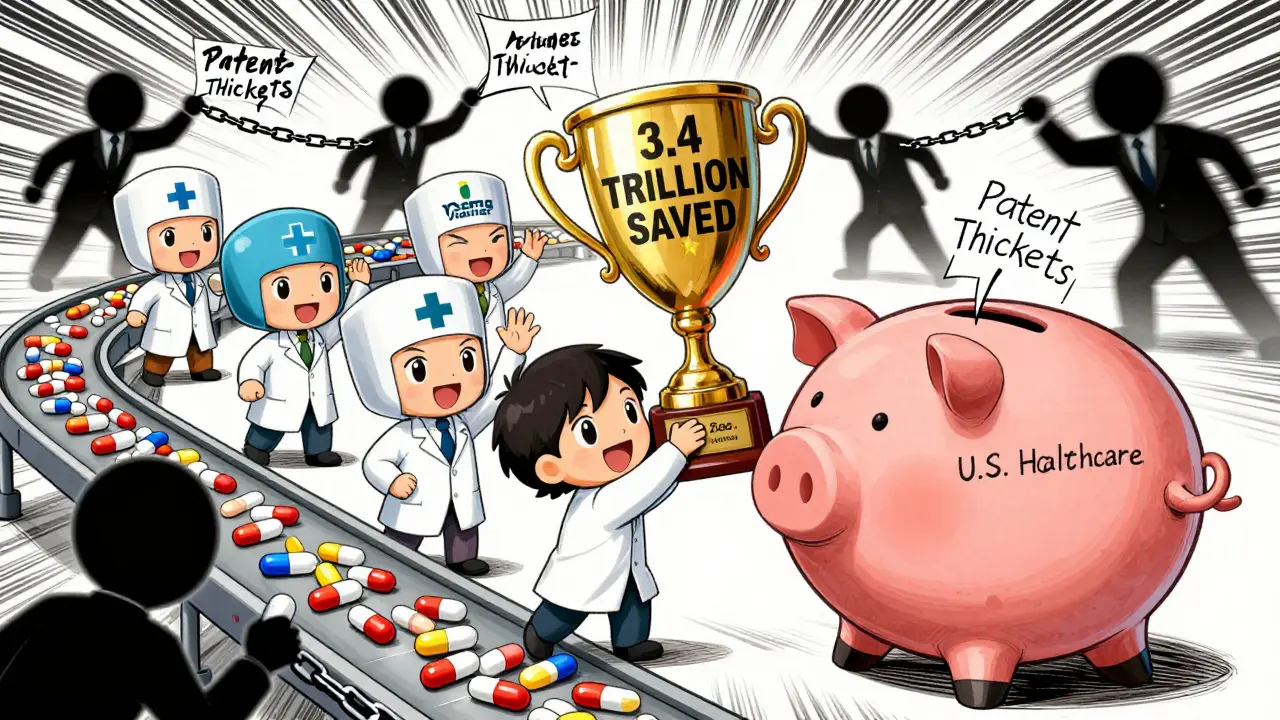
In 2024 alone, generic and biosimilar medications saved the U.S. healthcare system $467 billion. That’s more than the entire annual budget of the Department of Defense. Since 2015, the total savings have reached $3.4 trillion. To put that in perspective: if you stacked those dollars in $100 bills, they’d reach over 200 miles high. And it’s still growing.
How Generics Work: Same Medicine, 90% Less Cost
Generic drugs aren’t copies. They’re identical in active ingredients, dosage, safety, strength, and how they work in the body. The only differences? The color, shape, or inactive fillers-and the price. A brand-name statin like Lipitor might cost $800 a month. Its generic version, atorvastatin, costs $10. That’s not a discount. That’s a revolution.
Here’s the math: in 2024, Americans filled 3.9 billion prescriptions for generic drugs. That’s 90.2% of all prescriptions. Yet generics made up just 12% of total drug spending. Brand-name drugs, which made up only 10% of prescriptions, accounted for 88% of the cost. The system isn’t broken-it’s working exactly as designed. But only if we let it.
The Real Winners: Chronic Disease Patients
The biggest savings aren’t in rare conditions. They’re in the everyday illnesses millions live with: high blood pressure, diabetes, high cholesterol, asthma, depression. The top 10 generic drugs for chronic conditions saved $216.5 billion in 2024. That’s not a statistic. That’s a mother who can afford her insulin. A veteran who doesn’t skip his blood pressure pills. A retiree who doesn’t have to choose between meds and groceries.
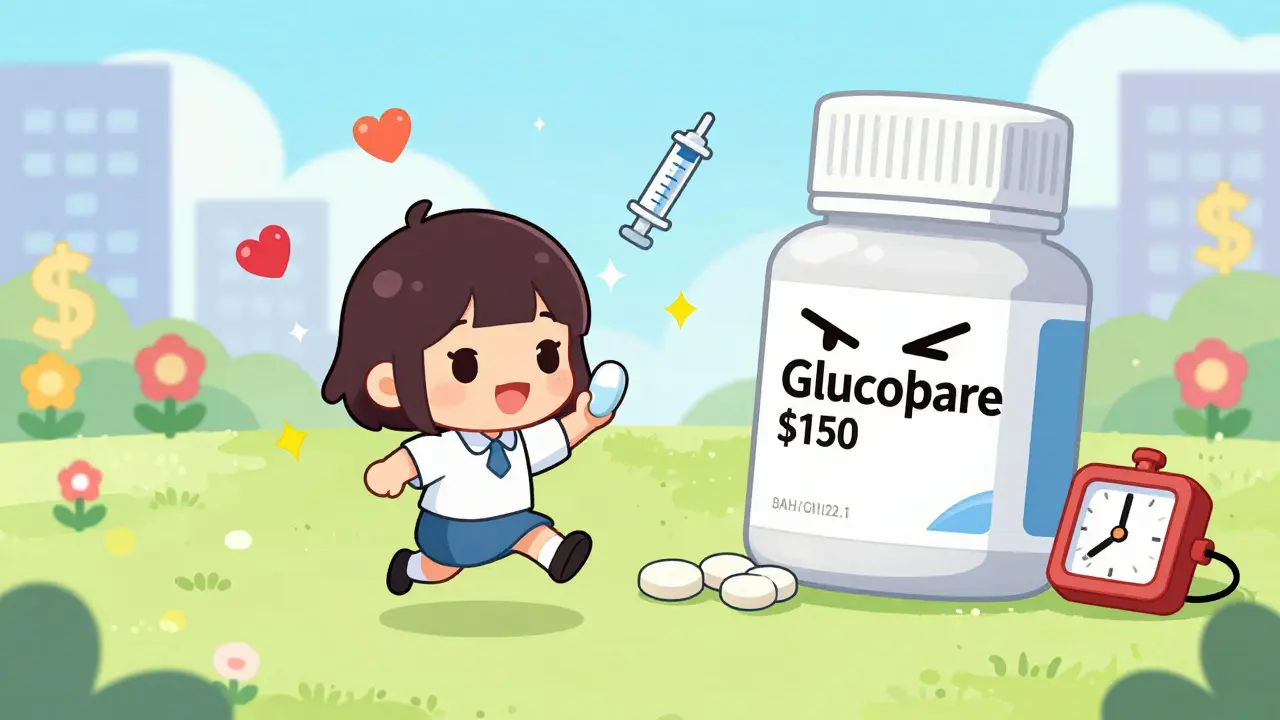
Take metformin, the most prescribed diabetes drug in America. In 2024, 37 million prescriptions were filled for generic metformin. The brand version, Glucophage, cost $150 a month. The generic? $4. That’s $1,752 saved per patient per year. Multiply that by 37 million, and you get $65 billion in savings-just from one drug.
Biosimilars: The Next Wave of Savings
Biosimilars are the next frontier. These are generic versions of complex biologic drugs-medicines made from living cells, like Humira, Enbrel, or Herceptin. They’re harder to copy, take longer to approve, and cost more to produce. But they still slash prices by 30-70%.
In 2024, biosimilars saved $20.2 billion in just one year. Since the first one entered the market in 2015, total biosimilar savings have hit $56.2 billion. That’s more than the entire annual budget of the National Institutes of Health. And it’s accelerating. The market for biosimilars is growing at 22.7% per year. By 2030, they could save over $100 billion more.
Why Aren’t We Saving Even More?
The system works-but it’s being sabotaged.
Brand-name drugmakers don’t want to lose their monopoly. So they use legal tricks to delay generics. One common tactic is “patent thickets”-filing dozens of minor patents on a single drug just to block competitors. A 2024 JAMA study found that just four brand drugs used this strategy to block generics, costing the system over $3.5 billion in two years.
Then there’s “pay-for-delay.” Big pharma pays generic companies to stay off the market. In 2023, these deals cost federal programs alone $3 billion. Blue Cross Blue Shield estimates these deals raise drug prices by $12 billion a year nationwide.
Even when generics are approved, Pharmacy Benefit Managers (PBMs)-the middlemen who negotiate drug prices-often push patients toward brand-name drugs because they get bigger rebates. A 2023 survey found that 42% of patients abandoned prescriptions due to cost. But 89% of those who switched to generics said they were just as effective-and saved an average of $147 per month.
State by State: Who’s Winning, Who’s Losing
Savings aren’t spread evenly. California saved nearly $38 billion in 2023. Alaska, with a smaller population, saved $600 million. Why the gap? It’s policy.
California mandates pharmacists to substitute generics unless the doctor says no. That’s called “mandatory substitution.” Result? 98% of prescriptions filled are generic. Texas has a more relaxed rule-doctors can opt out more easily. Result? Only 87% generic use.
States with strong substitution laws and transparency rules save more. States that let PBMs and insurers steer patients away from generics? They pay more.
Who Makes These Drugs? And Why It Matters
The top three generic drugmakers in the U.S. are Teva, Viatris, and Amneal. Together, they control over one-third of the market. That’s a problem. In 2015, the top 10 companies made up 51% of the market. Now they make up 63%. Less competition means less pressure to lower prices.
And then there’s the supply chain. Over 287 generic medications were in shortage as of December 2024. Many of these are critical, low-cost drugs like antibiotics, pain relievers, and IV fluids. Most are made overseas. A single factory shutdown in India or China can ripple across the country.
That’s why the FDA approved 1,145 new generic drugs in 2024-the highest number ever. But it’s not enough. Another $24 billion in drug spending is waiting for generic approval. If those get through, savings could jump by another $20 billion a year.
What’s Next? Policy Changes That Could Unlock More Savings
There’s real momentum. In June 2024, the Senate HELP Committee passed S.1041, the Affordable Prescriptions for Patients Act. It targets patent abuse, pay-for-delay deals, and product hopping. The Congressional Budget Office estimates it could save $7.2 billion annually.
That’s not just money. That’s access. That’s dignity. That’s a diabetic who doesn’t ration insulin. A cancer patient who doesn’t skip chemo because of cost. A family that doesn’t go into debt because of a prescription.
And it’s working. The IQVIA Institute projects that by 2034, generic and biosimilar drugs will have saved the U.S. healthcare system a total of $5.1 trillion. But that’s only if we remove the barriers holding them back.
Patients Know What Works
On Reddit, a user wrote: “I switched from my $800 brand-name drug to the $10 generic. I didn’t feel any different. My doctor didn’t notice. My bank account did.” That post got over a thousand upvotes.
A Drugs.com survey of 15,328 users found 87% rated the cost of generics as excellent or good. Only 63% rated effectiveness the same. That gap? It’s perception, not science. Most differences are placebo or minor formulation changes-not real therapeutic gaps.
Medicare patients report the same. Even though generics make up 90% of prescriptions, some plans still push brand-name drugs. Why? Because the system rewards higher prices, not lower costs.
The truth? Generics don’t just save money. They save lives. They let people stay healthy. They keep families from bankruptcy. They free up billions that could be spent on mental health services, cancer research, or primary care.
It’s not about being anti-brand. It’s about being pro-affordable. It’s about making sure the system works for the people who need it most-not the ones who profit from its flaws.
Man, in India we get generics for next to nothing-like metformin for 20 rupees a month. Seeing this data hit home. We don’t have the luxury of brand-name obsession here. If it works, we take it. No drama.
OMG I JUST REALIZED I’VE BEEN TAKING GENERIC LIPITOR FOR 5 YEARS AND I DIDN’T EVEN NOTICE 😭 I THOUGHT I WAS DREAMING WHEN I SAW THE $10 BILL 😭 I’M TELLING MY MOM RIGHT NOW SHE’S STILL ON THE BRAND AND IT’S KILLING HER BUDGET 💸❤️
What’s fascinating here isn’t just the cost differential-it’s the epistemological rupture in public perception. We’ve been conditioned to equate price with potency, a capitalist heuristic that collapses under empirical scrutiny. The FDA’s bioequivalence standards are not suggestions; they’re rigorous, statistically validated benchmarks. Yet, the placebo effect of branding persists-not because of pharmacology, but because of narrative architecture. The real tragedy isn’t the $3.4 trillion saved-it’s the $1.2 trillion still being siphoned by perception management masquerading as medical necessity.
WAIT. HOLD ON. SO YOU’RE TELLING ME I WAS PAYING $800 FOR A PILLS THAT’S JUST $10?!?!?!?!?!!? I’M NOT JUST ANGRY-I’M VIOLENTLY, SOUL-SHATTERINGLY ANGRY. I’VE BEEN ROBBED. MY DOCTOR KNEW. MY PHARMACIST KNEW. MY INSURANCE COMPANY? THEY GOT A BONUS. I WANT MY MONEY BACK. I WANT A PUBLIC INVESTIGATION. I WANT A MOVIE. THIS IS A CRIME AGAINST HUMANITY. 😭💥
Interesting. I wonder how many of those 3.9 billion prescriptions were actually filled by patients who could afford them, or if some were just prescribed and never picked up because of prior authorizations or formulary restrictions. The numbers are huge, but I’m curious about the real-world access gap.
This made me cry 😭👏👏👏 Thank you for writing this. I’ve been on metformin for 12 years and I still get emotional when I see the $4 co-pay. My grandma didn’t make it because she skipped her meds to pay rent. This isn’t just math-it’s mercy. 🙏💖
Let’s deconstruct the PBM rent-seeking model: vertical integration + rebate capture + formulary manipulation = structural arbitrage. The incentive structure is perverse: higher list prices yield higher rebates, which means PBMs profit from inefficiency. The solution? Pass-through pricing + transparency mandates + ban on gag clauses. Otherwise, we’re just rearranging deck chairs on the Titanic while the generics wait in the lifeboats.
I get why people are upset about the system, but I think we’re missing the big picture. Generics work. They’re safe. They’re everywhere. Maybe instead of yelling at pharma, we should be pushing for better policies in our states-like mandatory substitution. Small steps. Real change. Let’s not burn the house down when we can just fix the wiring.
Generics saved $3.4 trillion? Yeah, right. That’s what they want you to think. The real story? Most generics are made in China and India, where quality control is sketchy. You think your $10 pill is the same? Nah. You’re just getting the placebo version with a different label. And don’t get me started on biosimilars-those are just glorified knockoffs with a fancy name. America needs to make its own drugs. Not outsource our health.
It’s not the generics that are revolutionary-it’s the systemic failure of regulatory capture. The FDA approves 1,145 generics annually, yet patent thickets and pay-for-delay agreements create artificial scarcity. The market should be perfectly competitive, but instead we have oligopolistic collusion disguised as innovation. The 63% market concentration among top 10 generic manufacturers? That’s not efficiency-it’s monopoly by another name. And the supply chain fragility? That’s not an accident-it’s the inevitable outcome of neoliberal disinvestment in domestic manufacturing. We didn’t save $3.4 trillion-we just outsourced our vulnerabilities while pretending we won.