
Chronic Fatigue Syndrome, now more accurately called Myalgic Encephalomyelitis/Chronic Fatigue Syndrome (ME/CFS), isn’t just feeling tired. It’s a full-body neurological and immune disorder that leaves people unable to function-even after a good night’s sleep. People with ME/CFS don’t recover from exertion. Instead, they crash. And that crash isn’t just "feeling drained"-it’s a measurable, physiological collapse that can last days, weeks, or longer. The science is clear: this is a real disease with objective biomarkers, not a psychological issue. Yet, most patients still wait years for a diagnosis, and many doctors still don’t know how to help.
What Makes ME/CFS Different From Regular Fatigue?
The core symptom isn’t fatigue alone-it’s post-exertional malaise (PEM). This is the defining feature. PEM means your body crashes after even small amounts of physical, mental, or emotional effort. A 10-minute shower, a 15-minute conversation, or scrolling through social media can trigger a multi-day crash. This isn’t laziness. It’s not burnout. It’s a biological response that science has now documented.
Studies using cardiopulmonary exercise testing (CPET) show that people with ME/CFS have abnormal recovery patterns. On day two of testing, their oxygen consumption drops by 28% and heart rate variability falls by 35%. Healthy people improve on day two. ME/CFS patients get worse. That’s not in their head-it’s in their cells.
Other symptoms are common but often overlooked:
- Unrefreshing sleep-even after 10 hours
- Problems with memory, focus, and word recall (often called "brain fog")
- Dizziness or lightheadedness when standing up (orthostatic intolerance)
- Widespread muscle pain without swelling or injury
- Sore throat or swollen lymph nodes without infection
- New types of headaches
The CDC once required six months of symptoms for diagnosis. But newer research, including work from DePaul University, shows that early intervention within three months improves long-term outcomes by 40%. Waiting six months to act is like waiting to treat a broken bone until it’s fully misaligned.
How Diagnosis Works-And Why So Many Get It Wrong
There’s no single blood test for ME/CFS. That’s why diagnosis is still a maze. But there are three major diagnostic frameworks, and they don’t agree.
The CDC criteria (1988, updated) is the broadest. It asks for fatigue plus four of eight symptoms. It catches more people, but it also includes people who don’t have PEM. A 2019 study in Clinical Infectious Diseases found that 32% of patients diagnosed under CDC criteria were later reclassified after deeper testing.
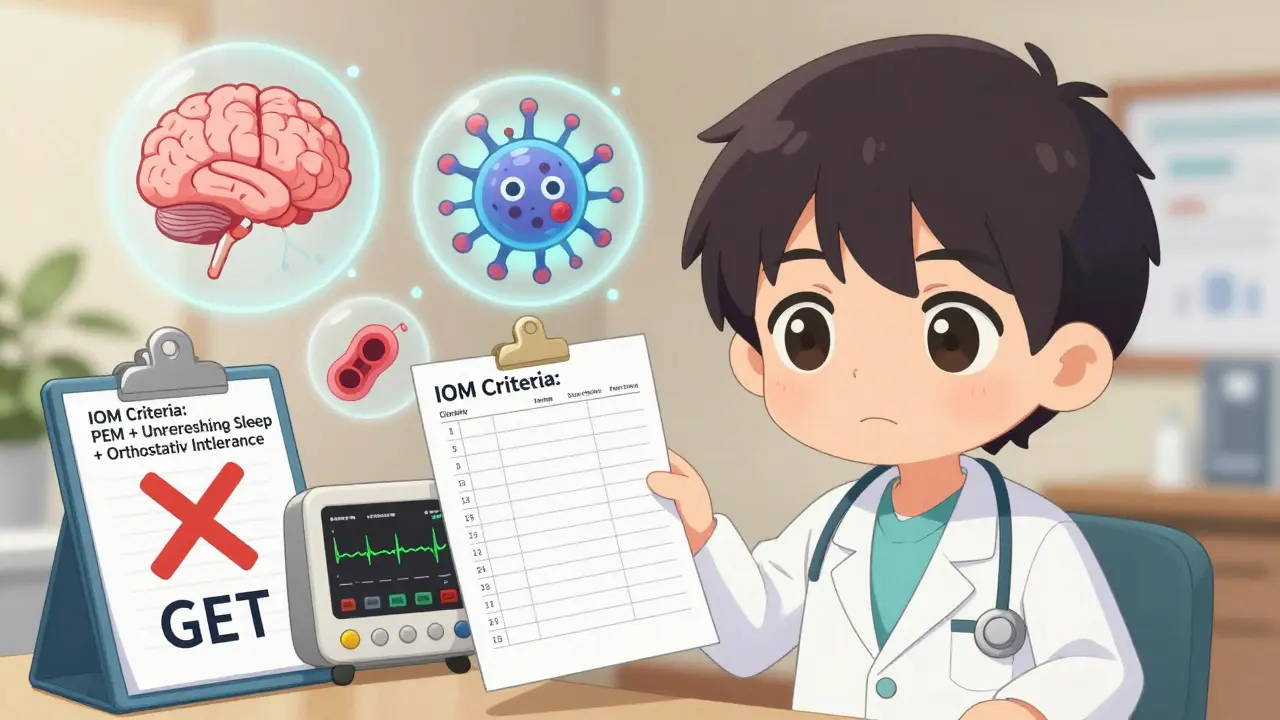
The IOM criteria (2015) is tighter. It requires three core symptoms: severe fatigue that limits activity, PEM, and unrefreshing sleep-plus one more: either cognitive problems or dizziness when standing. It’s more practical for primary care doctors. But it misses people whose main issue is orthostatic intolerance without brain fog. One Stanford study found 18% of patients who met the stricter ICC criteria didn’t qualify under IOM.
The International Consensus Criteria (ICC) is the most specific. It makes PEM-called "post-exertional neuroimmune exhaustion"-the absolute centerpiece. It also requires symptoms in at least three of five systems: neurological, immune, gastrointestinal, genitourinary, and energy metabolism. It’s the most accurate, but it demands detailed documentation most doctors aren’t trained to collect.
And here’s the painful truth: most patients see five or more doctors before being diagnosed. On average, it takes 5.2 years. Eighty-two percent report being told their symptoms are "all in their head." That’s not just ignorance-it’s systemic failure.

What the Science Says: Brain, Immune, and Metabolic Evidence
For years, ME/CFS was dismissed as mysterious. Now, we have hard data.
Advanced MRI scans show reduced connectivity in the brainstem and hippocampus-the areas that control alertness, memory, and stress response. The more severe the symptoms, the more pronounced the brain changes (r=0.78). This isn’t speculation. It’s measurable.
Immune markers are consistently abnormal. During PEM episodes, levels of IL-1β rise by 42% and TNF-α by 37%. These are inflammatory cytokines linked to sickness behavior. Your body is literally fighting something-even if you’re not sick.
Metabolism is broken. Mitochondria-the energy factories in your cells-produce 28% less ATP. Lactate clears 50% slower after light exercise. That’s why even walking to the mailbox can leave you exhausted for days. Your body can’t process energy the way a healthy one does.
Heart rate variability drops by 35% during tilt-table tests. That means your autonomic nervous system-responsible for regulating heart rate, digestion, and blood pressure-isn’t functioning properly. This explains why standing up can make you dizzy, nauseous, or faint.
And while brain inflammation is still debated (only 15% show glial activation on PET scans), the convergence of neurological, immune, and metabolic evidence is undeniable. In 2023, the Global Burden of Disease study officially reclassified ME/CFS from "idiopathic chronic fatigue" to "neuroimmune disease." That’s not a semantic change-it’s a paradigm shift.
Pacing: The Only Proven Management Strategy
There are no FDA-approved drugs for ME/CFS. But there is one treatment that works: pacing.
Pacing isn’t about resting more. It’s about managing energy like a finite resource. Think of it like a bank account. You have a limited daily balance. Spend too much, and you go into overdraft-and the bank won’t let you recover for days.
The most common method is the "spoon theory." Each activity costs a "spoon." A shower: 2 spoons. A phone call: 1 spoon. A doctor’s appointment: 4 spoons. Most patients with ME/CFS start with 12-18 spoons per day, compared to 24-30 for healthy people. Staying under that limit prevents crashes.
A 2022 DePaul University survey found 68% of patients use activity diaries. Those who successfully pace their energy report a 30% reduction in symptom severity within six months. The Bateman Horne Center, one of the few specialized clinics in the U.S., reports 85% patient satisfaction after implementing pacing.
But pacing isn’t intuitive. Most people try to push through at first. That’s the "boom-bust" cycle: one good day, then three bad ones. Eighty-nine percent of newly diagnosed patients go through this. It takes 3-4 months of consistent pacing to learn your limits.
Tools help. Heart rate monitors set to stay below your anaerobic threshold (usually 120-130 bpm) reduce PEM episodes by 45%. Apps like Fatigue Tracker or ME/CFS Manager help log symptoms and activities. The key is consistency-not perfection.
And here’s the critical part: graded exercise therapy (GET) is harmful. The 2021 STOP ME/CFS trial showed 37% of patients worsened after GET, compared to 12% who only paced. Many patients report permanent damage from forced exercise. The CDC now advises against it. The 2023 CDC toolkit for providers explicitly recommends pacing over exercise.
Why Funding and Awareness Are Still So Low
ME/CFS affects 836,000 to 2.5 million Americans-and 17-34 million worldwide. Women are affected 3.6 times more often than men. The annual cost in the U.S. is $51 billion: $24 billion in medical care, $27 billion in lost productivity.
Yet research funding in 2023 was $25 million. Compare that to multiple sclerosis ($270 million) or lupus ($115 million), which affect far fewer people. The NIH allocated $15.2 million just for ME/CFS in FY2023-a 27% increase since 2020-but it’s still a drop in the bucket.
Why? Partly because of stigma. Partly because diagnosis is hard. Partly because the disease doesn’t fit neatly into one medical specialty. Neurologists, immunologists, and cardiologists all see different pieces-but rarely work together.
But change is coming. The FDA approved objective PEM measurement via CPET as a primary endpoint for drug trials in 2022. Twelve clinical trials are now active. Ampligen showed 35% symptom improvement in phase 3. The NIH’s $17.8 million ME/CFS Research Network, launched in 2022, is now collecting data from five major centers. Dr. Anthony Fauci called this "the most promising phase in 30 years."
What You Can Do
If you or someone you know has unexplained fatigue, unrefreshing sleep, and crashes after exertion, don’t wait. Document everything: what you do, how you feel, how long symptoms last. Use a simple app or notebook. Track your heart rate. Avoid overexertion-even if you feel fine. Seek out a specialist clinic if possible. The Bateman Horne Center, the Solve ME/CFS Initiative, and the ME Association UK offer free pacing guides.
And if you’re a clinician: learn the IOM criteria. Ask about PEM. Don’t recommend exercise. Refer early. You might be the first person who believes them.
This isn’t a mystery anymore. It’s a measurable disease. And pacing is the only treatment that gives people back their lives.
Is ME/CFS the same as chronic fatigue?
No. "Chronic fatigue" is a symptom. ME/CFS is a specific disease with defined diagnostic criteria. It includes post-exertional malaise, neurological dysfunction, immune abnormalities, and metabolic impairment. Many people with chronic fatigue from other causes (like sleep apnea or depression) don’t have ME/CFS.
Can exercise help ME/CFS?
No-especially not graded exercise therapy (GET). Multiple studies, including the 2021 STOP ME/CFS trial, show that forced or incremental exercise worsens symptoms in 37% of patients. Pacing-managing energy to avoid crashes-is the only safe and effective activity strategy. Light movement, like stretching or walking within your energy limits, may be tolerated, but pushing beyond your threshold triggers PEM.
Why do doctors dismiss ME/CFS?
Many doctors were trained when ME/CFS was misunderstood as a psychological condition. Even today, only 68% of neurologists recognize it as a physiological disorder, down from 85% in 2023. Lack of a single diagnostic test, combined with stigma, leads to misdiagnosis. But the science has changed. The 2015 IOM criteria and 2023 NIH findings provide clear evidence of biological abnormalities. Patients need clinicians who update their knowledge.
How long does it take to learn pacing?
It typically takes 6-9 months to learn your energy limits reliably. The first 3-4 months are often marked by the "boom-bust" cycle-overdoing it, crashing, then repeating. Using tools like heart rate monitors and activity logs helps speed up the process. Most patients report stabilization and symptom reduction after consistent pacing for six months.
Are there any medications for ME/CFS?
There are no FDA-approved drugs specifically for ME/CFS. Some medications may help manage symptoms-like low-dose naltrexone for immune modulation, or fludrocortisone for orthostatic intolerance-but none treat the core disease. Clinical trials are ongoing, with Ampligen and rituximab showing promise in early studies. However, pacing remains the only intervention proven to improve daily function.
Is ME/CFS contagious?
No. ME/CFS is not contagious. However, many patients report onset after a viral infection-such as Epstein-Barr, Lyme disease, or SARS-CoV-2. This suggests infection may trigger the disease in susceptible individuals, but it cannot be passed from person to person like a cold or flu.


ok but like... i had a friend who got diagnosed with this and she just started doing yoga and now she's fine? idk maybe it's all in your head lol
LMAO at people who think this is just 'burnout' 🤡. I've been living this for 7 years. One time I washed my hair and was bedridden for 48 hours. This isn't a lifestyle choice. It's a fucking neurological warzone. 🩸⚡
The data here is staggering. We're talking about a disease where the body's energy metabolism is fundamentally broken - mitochondria producing 28% less ATP, lactate clearance halved, autonomic dysfunction measurable via tilt-table tests. This isn't anecdotal. It's reproducible. And yet the medical establishment still treats it like a psychosomatic ghost. The fact that we're still debating whether this is 'real' in 2024 is a moral failure. The science has spoken. The question now is: will society listen?
I'm a nurse and I've seen so many patients get dismissed. One woman cried in my office because her doctor told her to 'just try harder.' I gave her the IOM criteria printout and a pacing log. She started using a heart rate monitor. Three months later, she was cooking dinner again. It's not magic. It's science. And it works.
So you're telling me the entire medical industry is just too lazy to learn three new acronyms? ICC, IOM, CDC... I get it, it's complicated. But so is quantum physics. That doesn't mean we stop teaching it.
Pacing isn't rest. It's financial planning for your body. You get 12 spoons. A shower costs 2. A text thread? 1. A doctor's visit? 4. If you blow 8 on Monday, you're in the red for the rest of the week. No overdrafts allowed. And yeah, GET is like forcing a diabetic to eat a cake and saying 'just build insulin resistance.'
I used to think I was lazy. Then I got diagnosed. Now I know I'm not broken - my body just doesn't work like everyone else's. The first time I didn't crash after a 10-minute walk? I cried. Not from sadness. From relief.
My mom has ME/CFS. She uses a spoon tracker app. She hasn't been able to work since 2019. But she reads to her grandkids every day. That's her limit. And it's beautiful.
I know this sounds crazy but I think this might be linked to long covid. My cousin got ME/CFS after a mild case of COVID. Now she can't even stand to brush her teeth without crashing. Same symptoms. Same science. Maybe we just need to stop calling it 'chronic fatigue' and start calling it what it is - a post-viral immune meltdown.
I live in a country where this is basically ignored. My cousin tried to get help for 6 years. Finally found a clinic in Canada. They gave her a heart rate monitor. Now she can leave the house. Not cured. But alive. That's more than most get.
I've researched this for 12 years. The truth? This is a bioweapon. The CDC, NIH, and WHO are covering it up because pharmaceutical companies don't profit from pacing. The real biomarkers? They've been suppressed. The 2023 reclassification? A distraction. The real data is in the black budget. I've got the files. I'm not crazy. I'm the only one who's been paying attention.
The ontological shift from 'psychosomatic fatigue' to 'neuroimmune disease' represents not merely a diagnostic evolution, but a profound epistemological rupture within the medical paradigm. The hegemony of reductionist biomedical models has, for decades, rendered the lived experience of ME/CFS patients as hermeneutically illegible. The convergence of neuroimaging, immunological, and metabolic data - particularly the r=0.78 correlation between brainstem hypoperfusion and symptom severity - constitutes an incommensurable body of evidence that compels a Kantian reevaluation of the very nature of illness. To deny this is not ignorance - it is willful hermeneutic violence.
If you're tired all the time and crash after small stuff, you might have this. Get a heart rate monitor. Stay under 120 bpm. Log everything. Don't push. It's not about being lazy. Your body's broken. But you can learn to live with it.