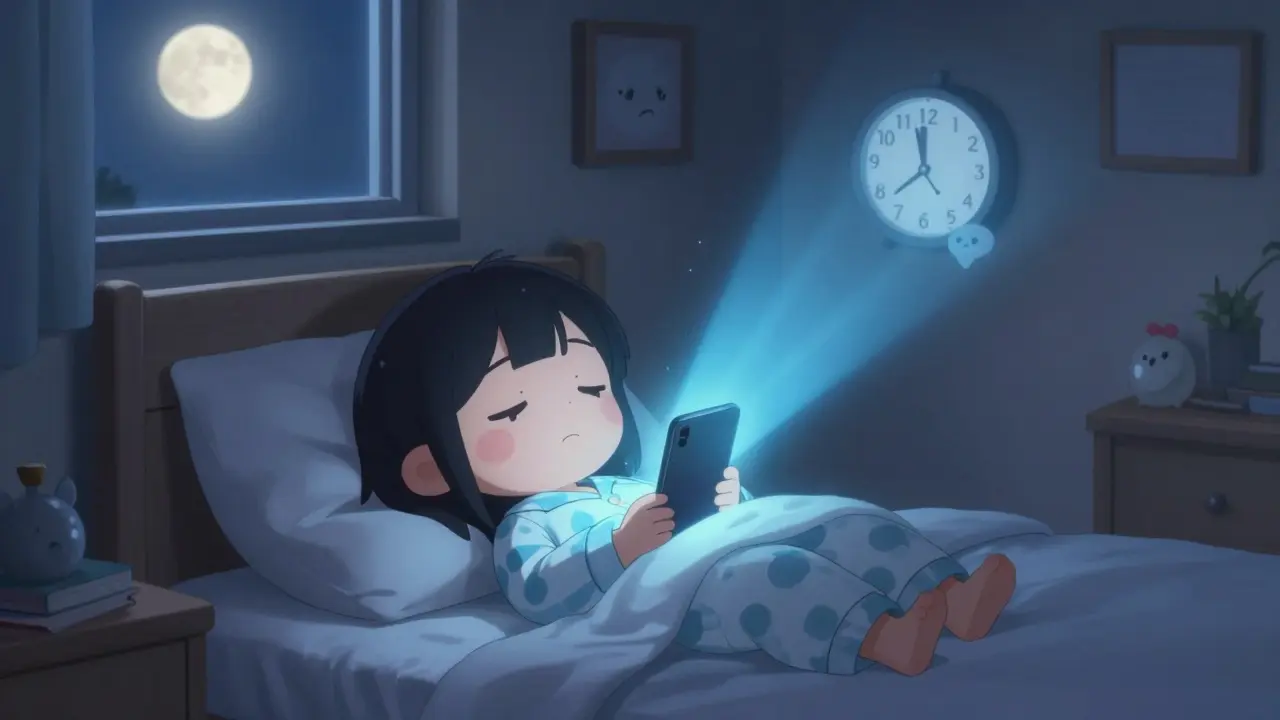
Most people know they should put their phones down before bed. But few realize that the real problem isn’t just scrolling-it’s the blue light hitting their eyes. This specific wavelength of light, invisible to the naked eye, is quietly sabotaging sleep for millions. If you’ve ever lain awake for 45 minutes after checking your phone, or woke up feeling tired even after eight hours in bed, blue light might be why.
How Blue Light Disrupts Your Body’s Natural Clock
Your body runs on a 24-hour cycle called the circadian rhythm. It’s controlled by a tiny region in your brain called the suprachiasmatic nucleus. But it doesn’t work alone. It listens to signals from your eyes-specifically from special cells called intrinsically photosensitive retinal ganglion cells (ipRGCs). These cells don’t help you see shapes or colors. They’re built for one thing: detecting light to tell your brain whether it’s day or night.
When sunlight hits your eyes in the morning, these cells signal your brain to stop making melatonin, the hormone that makes you sleepy. As the sun sets, melatonin rises naturally, preparing you for sleep. But artificial light-especially from screens-confuses this system. Blue light, in the 460-480 nanometer range, is the most potent at suppressing melatonin. A 2012 Harvard study found that 6.5 hours of blue light exposure suppressed melatonin for three hours, compared to just 1.5 hours with green light. That’s not a small difference. That’s enough to push your bedtime back by hours.
The Science Behind the Screen
Modern LED screens emit 30-40% blue light. Incandescent bulbs? Only 15%. That means your phone, tablet, or laptop is flooding your eyes with the exact kind of light your body is designed to avoid at night. Research from Scientific Reports (2023) showed that two hours of smartphone use at 30 cm distance delivers 30-50 lux of blue light-enough to cut melatonin production by half compared to dim red light.
Some studies challenge this. A 2022 University of Toronto experiment found that when researchers controlled for total light intensity and ipRGC stimulation, blue versus yellow light didn’t change melatonin levels. But here’s the catch: real life isn’t a lab. Most people don’t use screens at dim, controlled levels. They scroll at full brightness in dark rooms. That’s when the damage happens.
And it’s not just melatonin. Blue light before bed increases alertness, raises heart rate, and delays the natural dip in body temperature that helps you fall asleep. A 2023 study using the Pittsburgh Insomnia Rating Scale found that people who wore blue-light-blocking glasses for two hours before bed reported better sleep satisfaction and longer sleep duration.
What Experts Say: Consensus and Controversy
There’s no debate that blue light suppresses melatonin. The controversy is whether it’s the main reason people sleep poorly. Dr. Charles Czeisler of Harvard calls it a major contributor to diabetes, heart disease, and obesity. The American Academy of Sleep Medicine (AASM) says avoid screens for at least an hour before bed-based on data showing 83% of Americans use devices within that window.
But Dr. Christine Blume from the University of Basel argues that it’s not the color of light, but the total light exposure that matters. Her team found no difference between blue and yellow light when ipRGC stimulation was equal. So what’s the truth? Both are partially right. Blue light is more effective at suppressing melatonin-but even non-blue light, if bright enough, can disrupt sleep. The real issue? We’re not just exposed to light. We’re exposed to stimulation.
Dr. Matthew Walker, a sleep scientist at UC Berkeley, put it simply: “Even if blue light effects are partially overstated, the behavioral displacement of screen time-replacing wind-down routines with stimulating content-remains a significant sleep disruptor.”
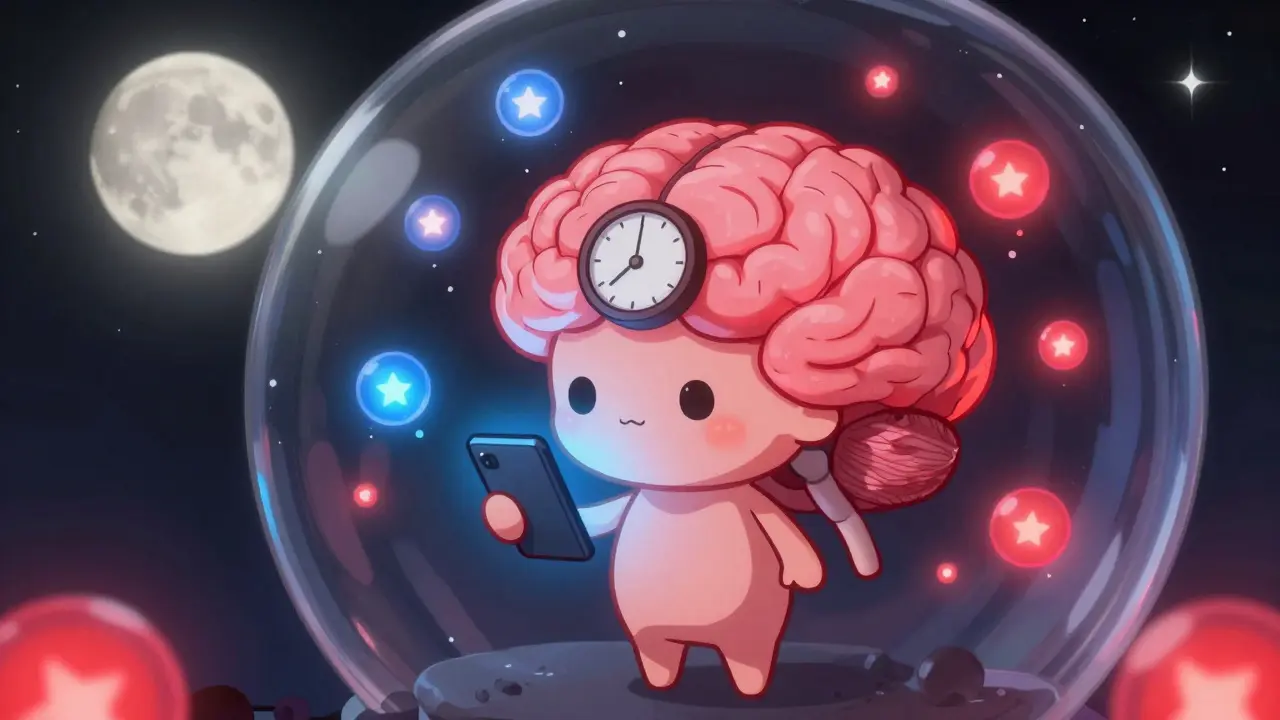
How Much Screen Time Is Too Much?
The AASM recommends at least one hour without screens before bed. Harvard researchers suggest two hours if you go to sleep at 11 p.m. But here’s what works in real life:
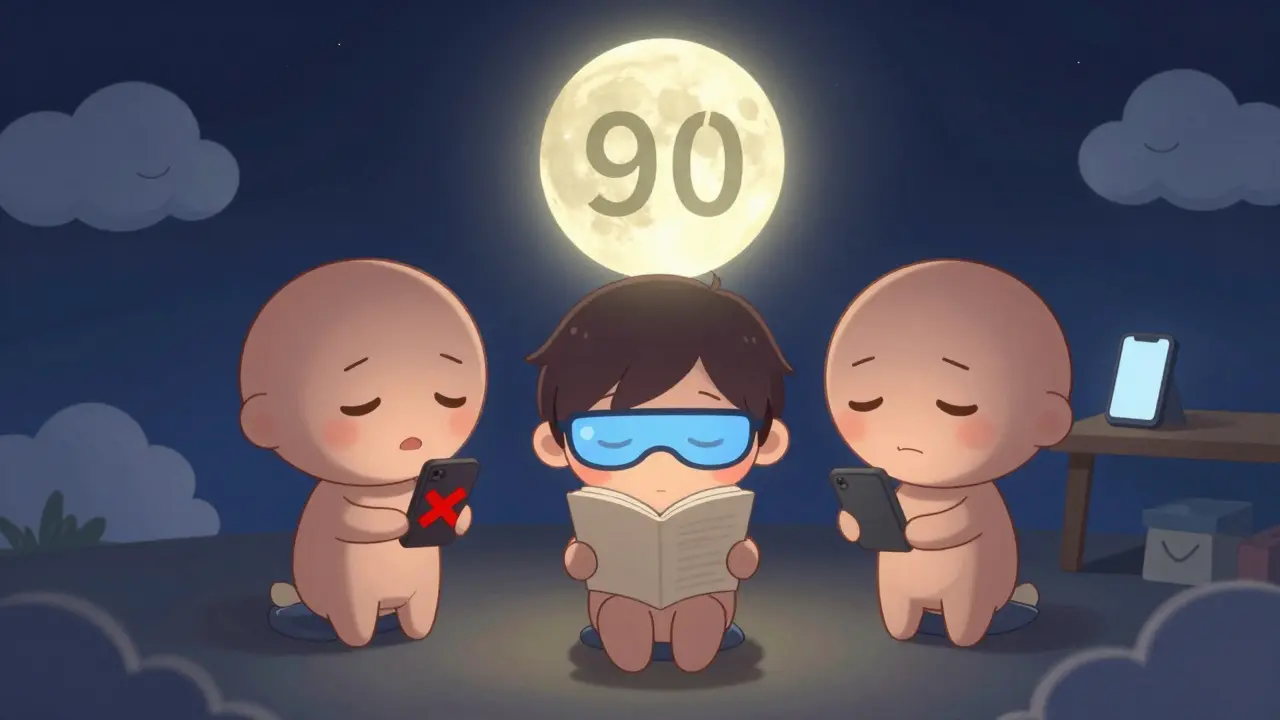
- 90-minute rule: A 2022 Sleep Foundation survey found that 83% of people who stopped all screens 90 minutes before bed cut their sleep onset time from 45+ minutes to under 20 minutes.
- Dimming matters: Reduce screen brightness to below 50 nits (about 30% of max). Most people leave it at 70-100%, which is way too bright at night.
- Distance helps: Hold your device at least 40 cm (16 inches) away. The closer you are, the more light hits your eyes.
- Use night modes: Night Shift (iOS) and f.lux (Android/PC) reduce blue light by 60%. They’re not perfect, but they help.
One study from the University of Glasgow found it takes about 5.7 days on average to build a habit of avoiding screens before bed. That’s not long. But it does require consistency. Skip a night, and your body resets.
Blue Light Glasses: Do They Work?
They’re everywhere. Amazon has over 2,800 reviews for blue-light-blocking glasses. 68% of users say they fall asleep faster. But 22% report no change-and some say the yellow tint makes reading screens harder.
Here’s the catch: glasses only block blue light. They don’t stop the mental stimulation of scrolling TikTok or replying to work emails. A 2023 Reddit analysis of 1,243 users found that 78% saw improvement-but only when they also stopped using screens. The glasses alone? Not enough.
Think of them like sunscreen. They help, but they won’t save you if you’re lying in the sun all day.
What Actually Works: A Simple Routine
You don’t need expensive gadgets or radical changes. Just three habits:
- Turn off screens 90 minutes before bed. Use that time to read a physical book, take a shower, or sit quietly.
- Use night mode and dim your screen. Even if you’re using your phone, reduce brightness and enable blue light filters.
- Charge your phone outside the bedroom. Out of sight, out of mind. If your phone isn’t on the nightstand, you’re less likely to reach for it.
A 2023 program called “Darkness Before Dawn” by the Sleep Health Foundation helped 82% of participants stick to a 7-day screen curfew. No apps. No gadgets. Just a schedule.
The Bigger Picture: Why This Matters Now
The global market for blue light protection is projected to hit $11.7 billion by 2030. That’s because more people are realizing sleep isn’t optional. The American Academy of Ophthalmology reports 65% of adults have digital eye strain-and 70% blame nighttime screen use.
Apple’s iOS 17 introduced “Sleep Focus,” which automatically dims the screen and silences notifications one hour before your set bedtime. That’s not a marketing gimmick. It’s a public health tool. And it’s backed by science.
Meanwhile, the NIH just funded a $2.4 million study on blue light and teen sleep, with results expected in 2025. Early data suggests adolescents are even more sensitive than adults.
Corporate America is catching on too. 43% of Fortune 500 companies now have “digital sunset” policies-no emails after 8 p.m., no Slack after 9 p.m. They know tired employees are less productive, more prone to errors, and more likely to quit.
Final Thought: It’s Not Just About Light
Blue light is a real problem. But it’s not the only one. The real enemy is the habit of using screens as a way to avoid boredom, stress, or quiet. We’ve trained ourselves to reach for our phones the second we feel tired. That’s not sleep hygiene. That’s addiction.
Try this tonight: Put your phone on the other side of the room. Turn off the lights. Sit in silence for 10 minutes. Breathe. Let your body remember what it feels like to wind down.
You don’t need to quit screens. You just need to give your brain a chance to turn off.
Does blue light from screens really affect sleep?
Yes. Blue light, especially between 460-480 nanometers, suppresses melatonin production-the hormone that tells your body it’s time to sleep. Studies show even one hour of screen use before bed can delay sleep onset by 20-45 minutes. The effect is strongest in dark rooms with bright screens.
How long before bed should I stop using screens?
The American Academy of Sleep Medicine recommends at least one hour. For best results, aim for 90 minutes. Research shows people who follow this rule cut their time to fall asleep in half. If you’re sensitive to light or have trouble sleeping, two hours is ideal.
Are blue light blocking glasses worth buying?
They can help, but they’re not a magic fix. 68% of users report better sleep, but only when they also reduce screen time. If you still scroll through social media while wearing them, you’ll still be mentally stimulated. Use them as a backup-not a replacement-for turning off screens.
Does Night Shift or f.lux make a big difference?
Yes. These modes reduce blue light by about 60%, which lowers melatonin suppression. But they don’t eliminate it. Combine them with dimming your screen (below 50 nits) and keeping it at least 40 cm away for best results. Don’t rely on them alone.
Is blue light the only reason I can’t sleep?
No. Mental stimulation from content-like checking emails, scrolling news, or watching intense videos-is just as disruptive. Your brain doesn’t relax just because the screen is dimmer. That’s why the 90-minute screen-free window works: it gives your mind time to shift from “doing” to “resting.”
Can I use my phone if I turn on the lights?
It helps, but not enough. Bright ambient light reduces the contrast between screen and room, which lessens the impact. But if you’re still staring at a bright screen in a dark room, your eyes are still flooded with blue light. The best approach: dim the screen, turn on soft warm light, and keep usage under 30 minutes.
Do children need even stricter limits?
Yes. Teenagers and pre-teens are more sensitive to blue light because their lenses are clearer and allow more light to reach the retina. The NIH is currently funding a major study on this. Experts recommend no screens for at least two hours before bedtime for kids under 18.
What if I work late and need to use my computer?
Use a blue light filter, dim your screen, and take a 5-minute break every 20 minutes to look at something 20 feet away. If possible, switch to a warm-colored desk lamp. After finishing work, avoid checking personal messages. Let your eyes and mind decompress for 30 minutes before bed-read, stretch, or listen to calm music.



I started doing the 90-minute screen rule last month and wow. I actually wake up feeling rested now. No more groggy mornings! 🌙✨ Also, charging my phone in the kitchen changed everything. I don’t even think about it until morning. Game changer.
This article is nothing short of a revelation. The way blue light infiltrates our circadian rhythm like a silent assassin-*chills*. I used to think I was just a bad sleeper. Turns out, I was being slowly poisoned by my own phone. I wept after reading this. My soul is now at peace.
Okay, let’s break this down statistically: 6.5 hours of blue light = 3-hour melatonin suppression? That’s not science-that’s a red flag. And where’s the control group? Did they account for caffeine intake? Screen distance? Ambient temperature? Also, the Harvard study? Please. They’ve been wrong about coffee, sugar, and fat. Why trust them on sleep? 🤔
I used to think blue light was the main issue til i started using f.lux + dimming + phone in another room. Honestly? The biggest win was stopping the mindless scrolling. My brain finally stopped racing. Also, typos are inevitable when you're tired lol.
You don’t need to be perfect. Just start small. One night. One hour. One less scroll. Your future self will thank you. Progress > perfection. You got this. 💪🌙
If you’re still using Night Shift, you’re doing it wrong. It’s a placebo. Real change requires discipline. And if you need glasses to ‘fix’ your habits, you’ve already lost.
Blue light isn’t the problem. It’s the corporate narrative. Apple and Samsung profit off your guilt. They sell you glasses, filters, ‘Sleep Focus’-all while designing screens to be addictive. The real villain? Attention economy. Wake up.
I’ve been watching this for years. They don’t want you to sleep well. Sleep is weakness. Sleep is inefficiency. The government, Big Tech, Big Pharma-they all profit when you’re tired, anxious, and dependent. The blue light? Just the cover. The real agenda? Control. You’re being manipulated. Look at the funding sources.
America's got it right. We got our sleep back when we stopped coddling people. If you can't put your damn phone down, maybe you need to get a job that doesn't involve staring at screens. Quit being soft.
I tried the 90-minute rule. Failed. Twice. Then I deleted TikTok. And suddenly, I slept. Coincidence? I think not.
I used to think I was just a night owl. Turns out I was just addicted to dopamine hits from notifications. Now I read physical books. I light a candle. I breathe. It’s not about blue light. It’s about reclaiming your quiet. And it’s beautiful.
I’ve been experimenting with this for six weeks now. I started with just turning off screens 60 minutes before bed, then moved to 90. I noticed my dreams became more vivid after about day 10. I also started journaling for 10 minutes before bed-just bullet points, no pressure. The combination of reduced light exposure and mental decompression has been transformative. I used to wake up at 3 a.m. every night. Now? I sleep through. I’m not saying it’s easy. I’m saying it’s worth it. I’ve also started using a warm lamp instead of overhead lights. The ambiance shift is subtle but powerful. I didn’t realize how much harsh lighting was stressing me out until I removed it. And honestly? I feel more present during the day. Less reactive. More grounded. I know it sounds woo-woo, but it’s science. And I’m not even that into ‘wellness.’ I just wanted to stop feeling exhausted all the time.
I’m from Ireland and we don’t have much daylight in winter so this hits different. I started using f.lux and charging my phone downstairs. It’s not perfect but I’m sleeping 2 hours more now. My partner noticed. I’m not a morning person but now I’m not a zombie either lol
In India, we have a tradition called ‘sandhya vandana’-evening rituals of stillness. No screens. Just prayer, tea, silence. I brought this into my life after reading this. It’s not about blue light. It’s about returning to rhythm. Your body remembers. You just have to let it.