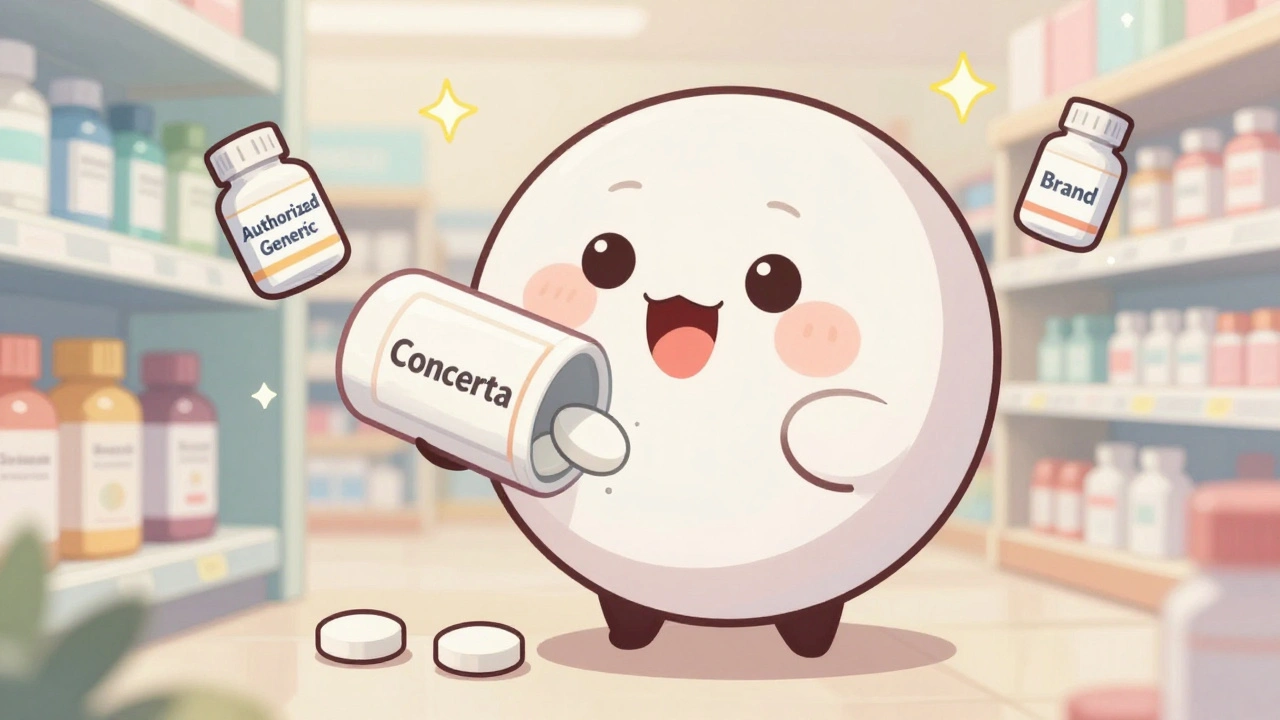
When you fill a prescription for a brand-name drug like Concerta or Celebrex, you might be surprised to get a pill that looks exactly the same-but without the brand name on it. That’s an authorized generic. It’s not a copy. It’s not a knockoff. It’s the exact same medication, made in the same factory, with the same ingredients, just sold under a different label. And it’s become one of the most misunderstood tools in modern pharmacy.
What Exactly Is an Authorized Generic?
An authorized generic is a brand-name drug that’s sold without the brand name on the label. The U.S. Food and Drug Administration (FDA) defines it clearly: it’s identical to the brand-name version in every way-active ingredient, dosage, strength, shape, color, and even inactive ingredients like fillers and coatings. The only difference? No brand name on the bottle or tablet.
Here’s the twist: it’s not made by a separate generic company. It’s made by the original brand manufacturer. Sometimes the brand company sells it directly under a generic label. Other times, they license the exact formula to another company to produce it. Either way, it’s the same pill you’ve always taken, just cheaper.
Unlike traditional generics, which must prove they work the same through expensive bioequivalence studies (ANDA process), authorized generics skip that step. They’re already approved under the brand’s New Drug Application (NDA). All the manufacturer has to do is notify the FDA they’re selling it under a generic name. That’s why they hit the market faster-and why they’re identical down to the last molecule.
How Are Authorized Generics Different From Regular Generics?
Let’s clear up the confusion. Traditional generics and authorized generics both cost less than brand-name drugs. But they’re not the same thing.
- Traditional generics: Made by a different company. May have different inactive ingredients (like dyes or binders). Must prove they’re bioequivalent to the brand. Listed in the FDA’s Orange Book.
- Authorized generics: Made by the brand company (or under license from them). Same inactive ingredients. No bioequivalence testing needed. Not listed in the Orange Book.
That difference matters. Some patients report side effects or reduced effectiveness when switching to a traditional generic-not because the active drug changed, but because the fillers did. A person with a sensitive stomach or an allergy to a dye might react to a traditional generic but have zero issues with the authorized version. That’s because the authorized generic has the same recipe as the brand.
For example, if you take Colcrys (brand) for gout and switch to the authorized generic made by Prasco, you’re getting the exact same colchicine, same coating, same release profile. But if you switch to a regular generic, you might get a different binder or coating that affects how fast the drug dissolves.
Why Do Drug Companies Make Authorized Generics?
It sounds odd: why would a company that just spent billions developing a drug turn around and sell a cheaper version of it? The answer isn’t altruism. It’s strategy.
When a brand-name drug’s patent expires, any company can file to make a generic version. But here’s the catch: the first generic company to file gets 180 days of exclusive rights to sell. That’s a huge financial windfall. Meanwhile, the brand company sees its sales plummet.
So they launch an authorized generic-sometimes even before the first generic hits the market. Now, instead of losing 90% of their customers to a single competitor, they split the market. They keep a chunk of sales, patients stay loyal, and pharmacies still get a lower-cost option to offer.
Between 2010 and 2019, there were 854 authorized generic launches. In 75% of cases where traditional generics entered the market, the brand company waited until after the generic was already selling to launch their own version. That’s not coincidence. That’s business.
It’s not always bad for consumers. Sometimes, the authorized generic is priced lower than the brand but higher than the traditional generic. But if you’re waiting for the cheapest option, you might end up paying more because the authorized generic blocks the full price drop you’d get from multiple generic competitors.
Where Can You Find Authorized Generics?
You won’t see them advertised on TV. Pharmacists don’t always mention them unless you ask. And they don’t show up in the FDA’s Orange Book, so even doctors might not know they exist.
Here’s how to find them:
- Ask your pharmacist: “Is there an authorized generic for this drug?”
- Check the FDA’s official list of authorized generics, updated as recently as October 2025.
- Look at the label: If the drug name matches your brand (like “methylphenidate ER”) but the company is different (like Watson or Greenstone), it’s likely an authorized generic.
Some common examples:
- Concerta (methylphenidate ER) → Authorized generic by Actavis
- Celebrex (celecoxib) → Authorized generic by Greenstone
- Unithroid (levothyroxine) → Authorized generic by Jerome Stevens
- Colcrys (colchicine) → Authorized generic by Prasco
These aren’t rare. They’re common-especially for high-cost, high-demand medications.
Do Authorized Generics Save You Money?
Yes-but not always as much as you’d hope.
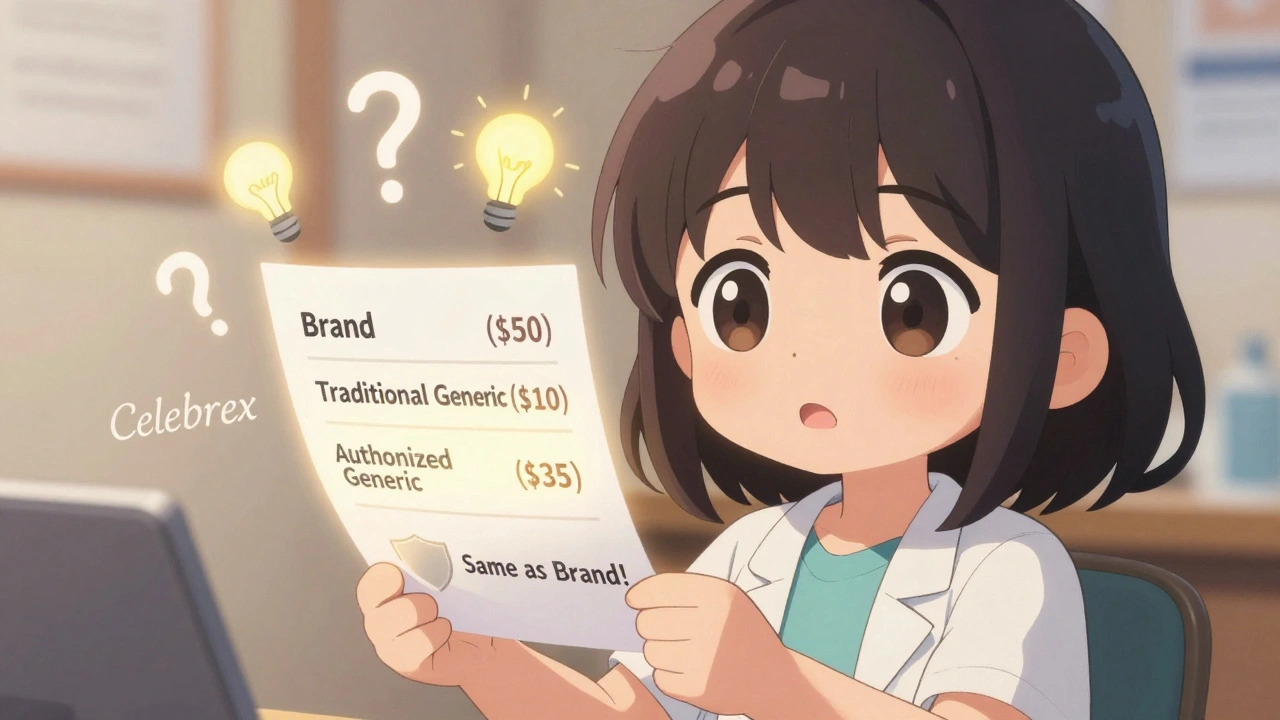
Typically, authorized generics cost 15% to 25% less than the brand-name version. That’s a real savings. But once multiple traditional generics enter the market, prices can drop 70% to 90%. So if you’re patient, you might pay even less later.
Here’s the trade-off:
- Buy now: Pay 20% less than brand. Get the exact same drug. No risk of formulation changes.
- Wait: Pay 80% less later. But risk different fillers, slower delivery, or inconsistent supply.
For people on chronic medications-like thyroid hormone, blood pressure pills, or antidepressants-consistency matters. If you’ve had bad reactions to other generics, the authorized version is the safest low-cost option.
Why Are Authorized Generics So Confusing?
Because they break the rules of how we think generics work.
We assume generics = cheaper = different company. But authorized generics = cheaper = same company. That’s counterintuitive.
Patients often ask: “Why does my pill look the same but the label says something else?”
Pharmacists get this question all the time. The answer is simple: it’s the same drug. But explaining it requires time-and most insurance plans don’t pay for counseling.
Some people are suspicious. “Is this just a trick to keep me buying their drug?”
It’s not a trick. It’s a business tactic. But that doesn’t make it bad. If you get the same medicine for less money, that’s still a win.
The real issue? Lack of transparency. You might never know you’re getting an authorized generic unless you check the label or ask. Insurance companies often don’t distinguish between authorized and traditional generics-they just drop the price to the lowest tier.
What Should You Do?
Here’s what works:
- Always ask your pharmacist: “Is there an authorized generic for this?”
- If you’ve had issues with traditional generics before, ask for the authorized version.
- Don’t assume the cheapest option is the best. Sometimes the authorized generic is the most reliable.
- Check the FDA’s list periodically-new authorized generics appear all the time.
- If your prescription switches without warning and you feel different, ask why. It might be a generic switch.
Authorized generics aren’t magic. They’re not always the cheapest. But they’re the only generic that’s truly identical to the brand. For many people, that’s worth something.
What’s Next for Authorized Generics?
They’re not going away. As more brand-name drugs lose patents, companies will keep using authorized generics to protect revenue. Regulators are watching. Some experts worry they slow down true competition. Others say they give patients a safe, affordable option when no other low-cost choice exists.
One thing’s clear: if you’re paying for a brand-name drug, you’re likely missing out. There’s probably a version out there that’s the same, just cheaper. You just have to know to ask for it.
Are authorized generics as safe as brand-name drugs?
Yes. Authorized generics are made in the same facility, with the same ingredients, under the same quality controls as the brand-name drug. The FDA considers them identical. If your brand-name drug is safe for you, the authorized generic is too.
Can I switch from a brand to an authorized generic without consulting my doctor?
Yes, because they’re the same drug. Your pharmacist can substitute it unless your prescription says “dispense as written” or “no substitutions.” But if you’ve had reactions to other generics in the past, it’s smart to mention that to your pharmacist.
Why aren’t authorized generics listed in the FDA’s Orange Book?
The Orange Book only lists traditional generics that went through the ANDA process and proved bioequivalence. Authorized generics are marketed under the original brand’s NDA, so they don’t need separate approval. That’s why they’re not listed-they’re not treated as a new generic, just a rebranded version of the original.
Do insurance plans cover authorized generics the same as traditional generics?
Usually, yes. Most insurance plans put authorized generics in the same low-cost tier as traditional generics. But some may not distinguish between them, so your copay might be the same regardless. Always check your plan’s formulary or ask your pharmacist.
How do I know if I’m getting an authorized generic?
Check the drug name on the label. If it matches the brand-name active ingredient (like “levothyroxine”) but the manufacturer is different (like Greenstone or Prasco), it’s likely an authorized generic. You can also ask your pharmacist directly or check the FDA’s official list online.

So let me get this straight - the same company that charges $500 for a pill makes a cheaper version and calls it a 'generic' just to screw over the real generics? Classic pharma scam. They're not saving you money, they're controlling the market. The FDA lets them do this because they're buddies with Big Pharma. You think this is transparency? It's a monopoly with a new label.
Thank you for this incredibly clear breakdown - seriously, this is the kind of info that can save people hundreds a month. If you’ve ever had a bad reaction to a generic, please, PLEASE ask your pharmacist about authorized generics. They’re not magic, but they’re the closest thing to the brand you’ll get at a discount. Your body deserves consistency, especially with meds like thyroid or seizure drugs. You’re not being picky - you’re being smart.
Authorized generics exist. They are identical. They are cheaper. End of story.
omg i had no idea this was a thing! i switched to generic celebrex and got really bad stomach cramps but when i asked for the 'same pill but no brand name' my pharmacist gave me the greenstone one and boom no issues. this is life changing info lol
This is such an important topic that flies under the radar. Many people assume all generics are created equal - but they’re not. The authorized version can be the difference between tolerating your medication and being miserable. I’ve seen patients cry because they couldn’t afford the brand, then panic when the generic made them sick. This isn’t just about cost - it’s about dignity and safety. Ask. Always ask.
Just asked my pharmacist about my Concerta and she said yeah we got the actavis one. Same pill, half the price. 🤯 I’m telling my whole family. This is the kind of hack you wish you knew 10 years ago.
Of course the brand companies do this. They’re not philanthropists. They’re predators with patents. They delay real competition by flooding the market with their own 'generic' to squash the first filer’s 180-day exclusivity window. This isn’t consumer-friendly - it’s anticompetitive manipulation disguised as affordability. The FDA should ban this practice. It’s corporate theater.
So the real genius move here is: the brand company makes the generic… then charges more than the real generic. So you’re paying more than you have to… for the same damn pill. Who’s the sucker now? The patient who doesn’t know to ask. The system isn’t broken - it’s designed this way.
Let’s be clear: authorized generics are a legal loophole that lets pharma companies preserve profit margins while pretending to help consumers. They’re not ‘better’ - they’re just the original product with a different barcode. Meanwhile, real generic manufacturers are forced to jump through hoops to prove bioequivalence… while the brand company just re-labels and calls it a day. This isn’t innovation. It’s exploitation dressed in white coats.
In the UK, we don’t have this system - but I’ve seen patients here struggle with inconsistent generics. The idea that the same pill, made in the same factory, could be sold under two labels - one expensive, one cheap - is both brilliant and deeply unsettling. It speaks to a system where profit dictates access, not health. Still - if it saves someone money and keeps them stable? I won’t complain. But we need transparency. Patients deserve to know what they’re holding.