For decades, proving that a generic drug works the same as the brand-name version meant running expensive, time-consuming clinical trials with human volunteers. You’d measure blood levels over hours, compare averages, and wait months for results. But since 2023, that process has started to change - fast. Thanks to breakthroughs in artificial intelligence, advanced imaging, and automated lab systems, bioequivalence testing is no longer stuck in the past. It’s becoming faster, cheaper, and more precise - and the FDA is leading the charge.
What Bioequivalence Testing Really Means
Bioequivalence testing answers one simple question: Does a generic drug get into your bloodstream the same way as the original? It’s not about whether the pill looks the same or has the same ingredients. It’s about whether your body absorbs and uses those ingredients at the same rate and amount. If not, you might get too little of the drug - and it won’t work - or too much - and you could have dangerous side effects.
For simple, small-molecule drugs like aspirin or metformin, traditional methods still work fine. You give a group of healthy volunteers the brand drug, then the generic, draw blood at intervals, and compare the area under the curve (AUC) and peak concentration (Cmax). But for complex products - think inhalers, skin patches, or injectable implants - those old methods fall apart. That’s where new technologies are stepping in.
AI Is Cutting Study Time in Half
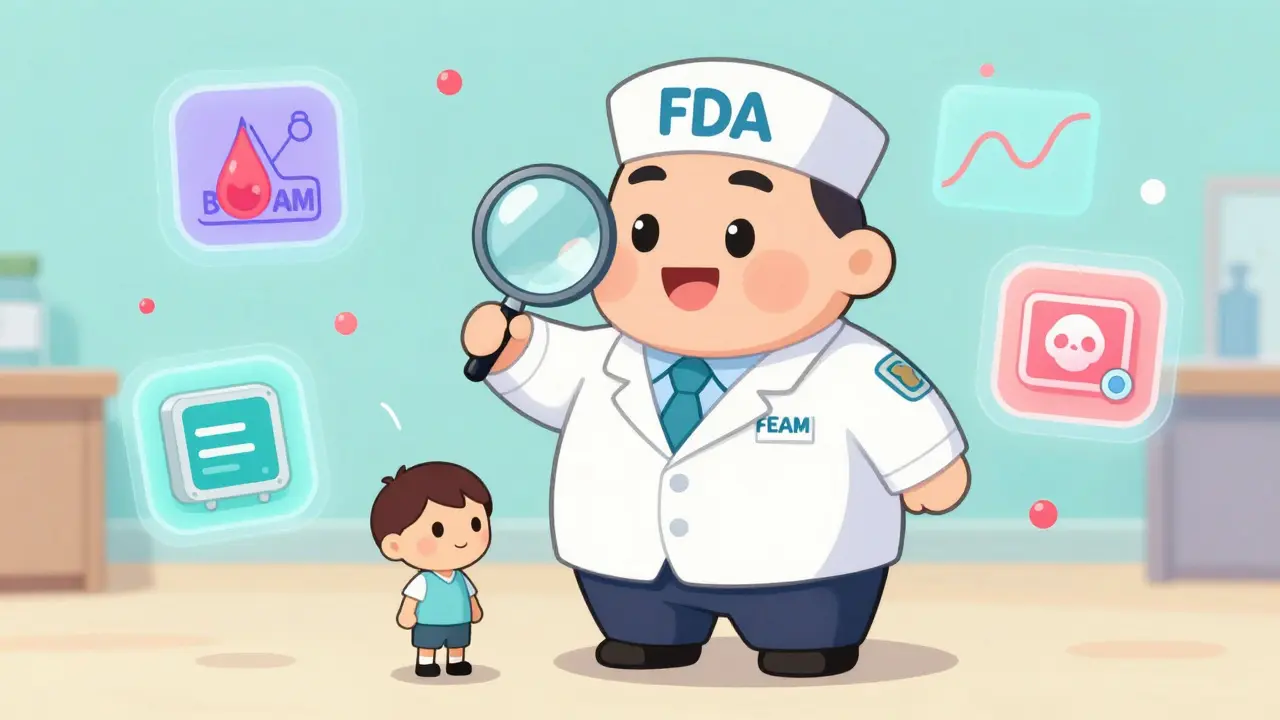
The biggest shift isn’t a new machine - it’s a new way of thinking about data. The FDA launched BEAM (Bioequivalence Assessment Mate) in Q2 2024. It’s not a lab instrument. It’s a software tool that reads through mountains of past bioequivalence studies, spots patterns, and predicts outcomes for new ones. Before BEAM, reviewers spent 70-90 hours per application just organizing data. Now, that’s down to under 20 hours. Internal FDA metrics show a 52-hour reduction per application during pilot testing.
Machine learning models now analyze pharmacokinetic (PK) and pharmacodynamic (PD) data faster than any human. They can detect subtle differences in drug absorption that older statistical methods missed. According to Artefact’s November 2024 white paper, AI-driven approaches cut study timelines by 40-50% and reduce costs by 35%. That’s huge when you consider that a typical bioequivalence study used to cost $1-2 million. Now, tech-enhanced studies run $2.5-4 million - but they’re faster and more reliable for complex drugs.
By 2030, experts predict AI will handle 75% of standard generic applications. For simpler drugs, the old way may still win on cost. But for anything tricky - delayed-release pills, nanoparticles, or biologics - AI is becoming the default.
In Vitro Testing Is Replacing Human Trials
Remember when we had to put people in a clinical unit just to test a patch? Now, we’re using Dissolvit - a proprietary in vitro dissolution system designed to mimic how drugs break down in the body. It’s not a test tube. It’s a dynamic system that simulates stomach acid, intestinal fluids, and even the mucus layer in the lungs for inhalers.
For orally inhaled products, traditional methods couldn’t tell if two inhalers delivered the same dose to the lungs. Dissolvit changes that. FDA research from March 2025 shows it can detect differences in particle size, drug distribution, and aerosol behavior that older systems ignored. The same goes for transdermal patches. Instead of waiting for skin irritation data from human subjects, labs now use advanced imaging to map how the drug moves through layers of synthetic skin.
This isn’t science fiction - it’s routine now. Virtual bioequivalence platforms, funded by the FDA since August 2024, are replacing clinical endpoint studies for certain complex products. These platforms use computer models built from real-world data to predict how a drug will behave in the body. The FDA estimates they could reduce the need for human trials by 65% for things like PLGA implants and long-acting injectables.

Imaging Tech Is Seeing What We Couldn’t Before
Old bioequivalence tests relied on blood samples. Now, we’re looking directly at the drug. Scanning electron microscopy (SEM) shows the exact shape and surface texture of drug particles. Focused ion beam imaging reveals internal structure at the nanoscale. Optical coherence tomography maps how a topical cream spreads on skin in real time. Atomic force microscopy infrared spectroscopy tells us not just where the drug is, but how it’s chemically bonded.
These tools aren’t just for research. They’re now part of regulatory submissions. For example, when a company submits a generic version of a complex topical ointment, they now include high-res images showing the physical structure matches the brand product. No more guessing. No more assumptions. Just hard evidence.
Combined with AI, these imaging techniques create what’s called an in vitro-in vivo correlation (IVIVC). That means a lab test can now reliably predict how the drug will behave in a person. The FDA has funded two major projects: one to build a mechanistic IVIVC for PLGA implants (funded April 2024) and another for a full virtual BE platform (funded August 2024). Both aim to eliminate unnecessary human testing.
Regulatory Harmonization Is Making Global Approval Easier
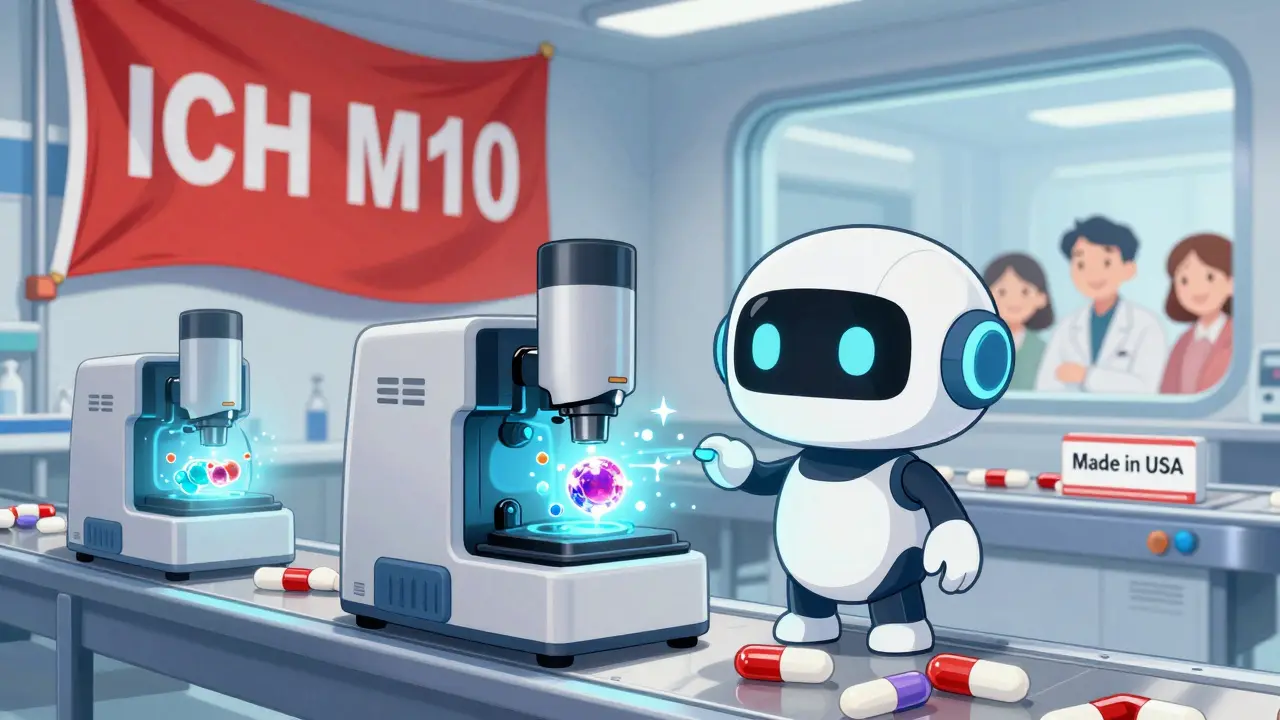
Before 2024, getting a generic drug approved in the U.S. and Europe meant following two different sets of rules for bioanalytical methods. The FDA had one standard. The EMA had another. Companies spent months aligning their data. That changed in June 2024 when the FDA adopted the ICH M10 guideline - a unified framework endorsed by the WHO.
Market.us reported in February 2025 that this harmonization cut method validation discrepancies by 62% between regions. Now, a lab in India can run a test using ICH M10 standards, and the FDA will accept it without extra review. That’s speeding up global access to generics - especially important as biosimilar approvals climb. The FDA had approved 76 biosimilars by October 2025, and more are coming.
The Catch: Where Tech Still Falls Short
It’s not magic. Emerging tech struggles with certain products. Transdermal systems still need better ways to measure skin irritation and adhesion. Orally inhaled products lack a standardized method for charcoal block PK studies - a test that blocks absorption so you can measure what’s delivered. Topical semisolids (like creams and ointments) need integrated modeling that accounts for composition changes across batches.
And there’s a real risk. Dr. Michael Cohen of ISMP warned in September 2025 that over-relying on in vitro models for narrow therapeutic index drugs - like warfarin or digoxin - could be dangerous. If the model doesn’t perfectly mimic human response, patients could get underdosed or overdosed. That’s why the FDA still requires some clinical data for high-risk drugs.
Domestic API Rules Are Shifting the Game
In October 2025, the FDA launched a pilot program requiring bioequivalence testing for ANDAs to be done in the U.S. using only domestically sourced active pharmaceutical ingredients (APIs). This isn’t about quality - it’s about supply chain control. The goal is to reduce reliance on foreign manufacturers, especially for critical drugs.
It’s a double-edged sword. Companies now need U.S.-based labs with the latest tech - which raises costs. But it also pushes investment into American bioanalytical labs. GCC nations like Saudi Arabia and the UAE are racing to build their own advanced testing centers, but the U.S. remains the leader in regulatory innovation.
What’s Next? The Road to 2030
The FDA’s research agenda through 2027 includes building validated in vitro models for advanced injectables, ophthalmic drops, otic solutions, peptides, and oligonucleotides. These are the next frontier - drugs that are too complex for traditional testing.
By 2030, we’ll likely see:
- 75% of standard generics approved using AI and virtual BE models
- Most complex products approved without human trials
- Automated sample-handling systems handling 90% of lab workflows
- BEAM fully integrated into FDA’s review pipeline
The market for bioequivalence studies is projected to grow from $4.54 billion in 2025 to $18.66 billion by 2035 - a 15.54% CAGR. That growth isn’t just about more drugs. It’s about smarter, faster, more reliable science.
Final Thought: Better Drugs, Faster
These advances aren’t just about saving time or money. They’re about getting safe, effective generic drugs to patients sooner. A diabetic who can’t afford the brand insulin now has a real shot at a cheaper, equally effective version. A cancer patient on a complex IV therapy doesn’t have to wait years for a biosimilar. The technology is here. The regulators are adapting. And the patients? They’re the ones who win.
What is bioequivalence testing?
Bioequivalence testing determines whether a generic drug delivers the same amount of active ingredient into the bloodstream at the same rate as the brand-name version. It ensures that the generic works the same way in the body, with no meaningful difference in safety or effectiveness.
How has AI changed bioequivalence testing?
AI tools like BEAM automate data analysis, reduce review times by over 50%, and improve accuracy by spotting patterns humans miss. Machine learning models now predict how a drug will behave based on historical data, cutting study timelines by 40-50% and reducing costs by up to 35% for complex products.
Can virtual bioequivalence replace human trials entirely?
For many complex products - like implants, inhalers, and topical creams - yes. The FDA’s virtual BE platforms can reduce the need for clinical endpoint studies by up to 65%. But for narrow therapeutic index drugs (e.g., warfarin), some human data is still required to ensure safety.
What is the Dissolvit system?
Dissolvit is an advanced in vitro dissolution system developed to simulate real physiological conditions for complex drug forms like orally inhaled products. Unlike traditional dissolution testers, it mimics lung mucus, airflow, and particle behavior, allowing regulators to compare generic and brand inhalers without human testing.
Why does the FDA require U.S.-based bioequivalence testing now?
Since October 2025, the FDA’s pilot program requires bioequivalence studies for ANDAs to be conducted in the U.S. using only domestically sourced active pharmaceutical ingredients (APIs). The goal is to strengthen domestic supply chains and reduce reliance on foreign manufacturers, especially for critical medications.
Are newer bioequivalence methods more expensive?
Yes, upfront costs are higher - technology-enhanced studies run $2.5-4 million compared to $1-2 million for traditional PK studies. But they’re faster, reduce long-term development time, and eliminate the need for large human trials. For complex drugs, they’re more cost-effective overall.
What products still require traditional bioequivalence testing?
Simple small-molecule generics - like tablets of ibuprofen or metformin - still rely on traditional pharmacokinetic studies because they’re cheaper and well-understood. Also, drugs with a narrow therapeutic index (e.g., lithium, cyclosporine) often still require clinical data due to safety risks.
How is ICH M10 helping global drug approval?
ICH M10, adopted by the FDA in June 2024 and endorsed by WHO, harmonized bioanalytical method validation rules between the U.S. and Europe. This cut validation discrepancies by 62%, allowing labs worldwide to use one standard, speeding up global approval of generic and biosimilar drugs.
As of 2026, the shift from human trials to AI and imaging-based testing is no longer a possibility - it’s the new normal. The question isn’t whether these technologies work. It’s whether regulators, manufacturers, and labs can keep up.