When your pharmacist hands you a pill bottle with a different name than what your doctor wrote, it’s not a mistake. It’s generic substitution-a routine part of how insurance controls drug costs in the U.S. But navigating this system isn’t as simple as just accepting the change. You might end up with a different pill, a higher bill, or even health issues if the switch isn’t handled right. Understanding how insurance requirements work for generic substitution can save you money, avoid side effects, and keep your treatment on track.
What Exactly Is Generic Substitution?
Generic substitution means your pharmacist gives you a cheaper version of your brand-name drug because the insurance company requires it. The FDA says these generics must have the same active ingredient, strength, dosage form, and route of use as the brand. They’re not knockoffs-they’re legally required to be bioequivalent. That means they work the same way in your body, usually within a 80-125% range of the brand’s absorption rate. But here’s the catch: bioequivalence doesn’t mean identical. Inactive ingredients like fillers, dyes, or coatings can differ. For most people, that’s fine. For others-especially those with allergies, sensitivities, or on narrow therapeutic index drugs like warfarin, lithium, or seizure medications-those small differences can cause problems. A 2023 review of 1,247 patient complaints on Drugs.com found that 37% of negative experiences came from unexpected substitutions, even when the prescription said "dispense as written."How Insurance Makes You Switch
Insurance companies don’t just suggest generics-they enforce them. Most plans have a formulary, a list of approved drugs. If your brand-name drug isn’t on that list, or if it’s placed in a higher cost tier, your insurer will deny coverage unless you switch. Some plans go further: they’ll cover the generic fully but make you pay the full price difference if you insist on the brand. That’s called a mandatory generic program. For example, if your brand-name drug costs $150 and the generic is $30, your copay might be $10 for the generic. But if you want the brand, you pay $150 minus the $10 the insurer covers-you’re on the hook for $140. That’s a $130 surprise bill. Private insurers like Sun Life and Great West Life in Canada started these policies in 2011-2012. In the U.S., pharmacy benefit managers (PBMs) like Express Scripts, OptumRx, and CVS Caremark drive 85% of these rules. They decide what’s on the formulary, and doctors and pharmacists have to follow.State Laws Vary-A Lot
Federal law lets generics be sold, but state laws control whether pharmacists can substitute them without asking you. This is where things get messy. - In 19 states, pharmacists are required to substitute generics unless the doctor says otherwise. - In 7 states and Washington, D.C., the pharmacist must get your explicit consent before switching. - In 31 states, they must notify you that a substitution happened-even if you didn’t have to agree to it. - In 24 states, pharmacists have no extra legal protection if something goes wrong after substitution. Texas has some of the strictest rules. For substitution to happen, three things must be true: 1. The generic must cost you less than the brand. 2. You can’t say no. 3. Your doctor didn’t write "Brand Medically Necessary" on the prescription. And pharmacists in Texas must use the FDA’s "Orange Book" to check if the generic is rated "A" for therapeutic equivalence. If it’s not, they can’t swap it.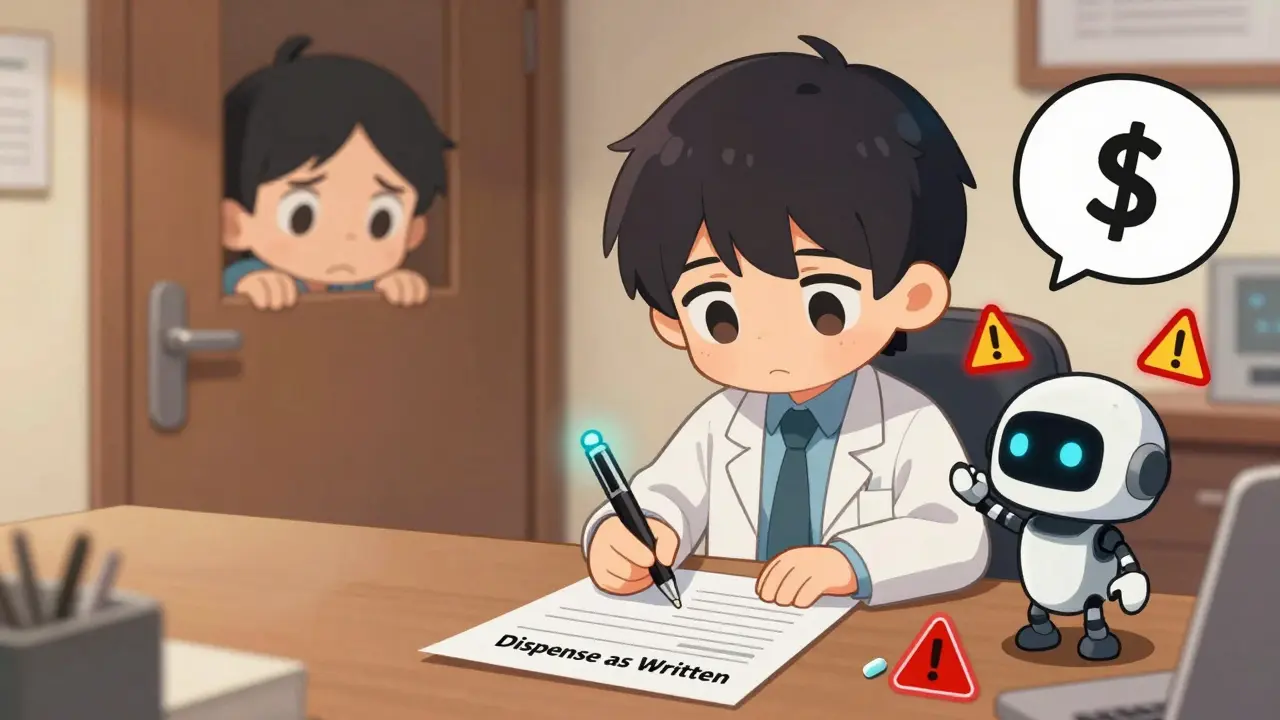
When You Can Fight Back
You don’t have to accept a switch if it’s not safe for you. The most reliable way to block substitution is to have your doctor write "Dispense as Written" or "Brand Medically Necessary" directly on the prescription. That’s legally binding in most states. The Merck Manual confirms: even if your doctor and pharmacist recommend the generic, you can still demand the brand-though you’ll pay the full price difference. For insurance coverage, you’ll likely need prior authorization. This means your doctor submits documentation proving why the generic won’t work for you. Common reasons include: - Previous adverse reaction to a generic version - Therapeutic failure (cholesterol didn’t drop, seizures returned, thyroid levels became unstable) - Allergy to an inactive ingredient in the generic Blue Cross Blue Shield of Michigan approved 78% of prior auth requests in 2023 when proper documentation was provided. But requirements vary wildly. Aetna wants three clinical criteria met; UnitedHealthcare wants five. Your doctor might need to spend hours filling out forms.Real Stories: The Good, the Bad, and the Ugly
On Reddit, user u/MedPatient87 switched from brand-name Synthroid to generic levothyroxine after their insurer forced it. Within six months, their TSH levels fluctuated three times. They needed three dose adjustments and ended up paying more in doctor visits than they saved on the drug. Meanwhile, u/CostSaver2022 switched from Lipitor to atorvastatin and saw no change in cholesterol levels. They saved $45 a month-$540 a year-with zero side effects. The biggest complaint? Inconsistent manufacturing. One generic manufacturer’s atorvastatin might have a different filler than another’s. On LinkedIn, a pharmacist named u/PharmaTech99 explained that patients with sensitivities to lactose or dyes can react to one generic but not another-even if both are "therapeutically equivalent."
Biosimilars Are a Whole Different Game
If you’re on a biologic drug-like Humira, Enbrel, or insulin-substitution gets even trickier. These are complex proteins made from living cells, not chemicals. The FDA calls them "biosimilars," not generics. They’re "highly similar," but not identical. As of November 2023, only 38 biosimilars have been approved in the U.S., compared to over 10,000 small-molecule generics. And 45 states require extra steps for substitution: prescriber notification, patient consent, or both. The 2020 CARES Act forces pharmacists to tell your doctor within five business days if they switch you to a biosimilar. Even then, many insurers won’t cover biosimilars unless you’ve already failed on the brand. That’s called "non-medical switching"-and it’s a major point of contention among doctors.What You Can Do Today
You don’t need to be a lawyer or a doctor to protect yourself. Here’s what works:- Check your prescription. Look for "Dispense as Written" or "Brand Medically Necessary." If it’s not there, ask your doctor to add it.
- Ask your pharmacist. Before they fill your script, ask: "Is this a substitution?" If they say yes, ask why and if you can opt out.
- Review your Explanation of Benefits (EOB). If you see a higher charge than expected, it might be because you got the brand instead of the generic.
- Know your plan’s formulary. Log into your insurer’s website and search your drug. If the generic is listed, expect to be switched.
- Keep a log. If you switch to a generic and feel different-fatigue, headaches, mood changes, unstable lab results-write it down. That’s your evidence if you need prior authorization later.
Why This Matters Long-Term
Generics save the U.S. healthcare system $373 billion a year. That’s real money. But cost savings shouldn’t come at the cost of safety or patient autonomy. The system is designed to push generics because they work-for most people. But for those who need the brand, the process is intentionally hard to navigate. As specialty drugs and complex biologics grow, substitution will get more complicated. Inhalers, injectables, and transdermal patches often can’t be swapped easily because the delivery device matters as much as the drug. And with only 38 biosimilars approved, patients on these drugs are stuck paying high prices for now. The bottom line: generic substitution isn’t good or bad. It’s a tool. Used right, it saves money without harm. Used carelessly, it disrupts care. Your job isn’t to fight the system-it’s to understand how it works so you can use it wisely.Can my pharmacist substitute my brand-name drug without telling me?
In 31 U.S. states and Washington, D.C., pharmacists must notify you when they substitute a generic, even if they don’t need your permission. In 19 states, they’re required to substitute unless your doctor says "dispense as written." In 7 states and D.C., they need your explicit consent. Always ask your pharmacist if a substitution occurred.
What if I want to stay on my brand-name drug?
You can, but you’ll likely pay more. Ask your doctor to write "Brand Medically Necessary" or "Dispense as Written" on the prescription. That legally blocks substitution in most states. You’ll still need to pay the full price difference unless your insurer approves a prior authorization based on medical need.
Are generic drugs really as safe as brand-name drugs?
Yes-for most people. The FDA requires generics to be bioequivalent, meaning they deliver the same amount of active ingredient into your bloodstream at the same rate. But inactive ingredients can differ, which may affect people with allergies or sensitivities. For narrow therapeutic index drugs like warfarin or lithium, close monitoring after a switch is recommended, even though the FDA says approved generics are safe for all medications.
Why do some generics make me feel different?
Different manufacturers use different inactive ingredients-fillers, dyes, coatings-that can affect how your body reacts. One person might tolerate one generic version fine but have side effects from another, even if both are labeled the same. If you notice changes after a switch, document your symptoms and talk to your doctor. You may need to stick with one specific generic manufacturer.
Can my insurance force me to switch to a biosimilar?
Insurers can try, but rules are stricter for biosimilars. In 38 states, pharmacists must notify your prescriber within 5-7 days if they switch you. In 27 states, they need your consent. Most insurers require you to fail on the brand-name drug first before covering the biosimilar. Always check your plan’s policy and ask your doctor before any switch.
How do I know if my drug has a generic version?
Check the FDA’s Orange Book online or ask your pharmacist. You can also search your drug name on your insurer’s formulary list. If a generic is listed and you’re on a mandatory substitution plan, you’ll likely be switched unless your doctor blocks it. For newer drugs, generics may not exist yet-especially biologics.


This hit home for me 😭 I switched from brand Synthroid to generic and started having panic attacks I couldn’t explain. Took me 3 months and 4 doctor visits to figure out it was the filler. Now I demand "Dispense as Written" and keep a little card in my wallet. You’re not crazy if you feel different - your body knows.
PS: My pharmacist now gives me a side-eye when I walk in. Worth it.
So let me get this straight - the FDA says generics are bioequivalent, but then you’re told to monitor your labs like you’re running a clinical trial? That’s not safety, that’s corporate liability dressed up as policy. They don’t care if you crash, they care if the stock price dips.
Generic substitution isn’t healthcare - it’s a spreadsheet with a stethoscope.
My mom died because they switched her lithium without telling us. Don’t let this happen to you.
Just had this happen last week with my blood pressure med. Switched to generic, felt fine, saved $80. But I asked the pharmacist: "Which manufacturer?" - turns out it’s the same one I’ve always used. No drama.
Key takeaway: Not all generics are equal. Ask for the brand name of the generic. Some are way more consistent. And if you’re on warfarin? Don’t switch unless you’re getting weekly INRs.
Also - if your doc doesn’t know the Orange Book, find a new one. 😅
i read this whole thing and just wanna say thank you. i’ve been scared to ask my pharmacist anything bc i dont wanna look dumb. but now i know to ask "is this a substitution?" and check my eob. also i wrote "dispense as written" on my scrip and my doc actually did it. feels good.
also i spelled "scrip" wrong but you get it lol
The notion that patients require consent for generic substitution is a dangerous erosion of fiscal responsibility. The FDA’s bioequivalence standards are rigorous, and the cost savings are not merely beneficial - they are existential for a system drowning in pharmaceutical inflation. To equate inactive ingredient variance with clinical risk is to misunderstand pharmacology at its most fundamental level. This article indulges in fearmongering under the guise of patient advocacy. The system works - if you stop treating yourself like a fragile commodity.
Moreover, the idea that pharmacists must notify patients of substitutions is bureaucratic overreach. If you cannot trust the science, then you should not be taking medication at all.
Oh wow, a 37% complaint rate on Drugs.com? Shocking. Let me guess - 90% of those people are just lazy and don’t want to pay $10 more for a pill that does the exact same thing. You know what’s worse than a generic? A patient who thinks their body is too special for the FDA’s standards. You’re not a snowflake, you’re a biological machine with a $150 co-pay problem.
And biosimilars? Please. If you can’t handle a protein that’s 99.9% identical, you should be on oxygen, not a pharmacy shelf.
Also, why do people still use "Dispense as Written"? That’s a 1998 workaround. The system evolved. Adapt or pay more.
Generic substitution saves lives by making treatment accessible. Period. If you can’t afford your medication, you’re not taking it. And if you’re not taking it, you’re dying. Stop romanticizing brand-name drugs like they’re luxury handbags. The science is settled. The system is working. Your discomfort is not a policy failure - it’s a privilege problem.
Document your symptoms? Good. But don’t confuse correlation with causation. You felt bad after the switch? Maybe it was stress. Maybe it was sleep. Maybe it was your cat. Don’t blame the pill.
There’s a deeper question here: Who owns your body when you’re on insurance? The pharmacist? The PBM? The algorithm that ranks drugs by cost per milligram? We treat medication like a commodity, but the human body doesn’t operate on supply chains. It operates on rhythm, on memory, on subtle biochemical signatures we barely understand.
Maybe the problem isn’t the generic. Maybe it’s that we’ve turned healing into a transaction.
And yet - I still take the generic. Because I can’t afford not to.
People like you are why healthcare is broken. You whine about a $130 difference like it’s a personal attack. Meanwhile, millions can’t afford insulin. You want to keep your brand-name drug? Fine. Pay for it. Don’t expect the rest of us to subsidize your ego. You think your thyroid is special? Newsflash: it’s not. The FDA doesn’t care about your feelings. Neither should you.
Stop treating your medication like a sacred ritual. It’s a chemical. Take it. Shut up. Save the system.