
Imagine waking up with a deep, throbbing lump under your arm or in your groin-so painful you can’t wear a shirt or sit comfortably. This isn’t a pimple. It’s not an infection you can just pop. It’s hidradenitis suppurativa (HS), a chronic skin disease that turns hair follicles into sources of relentless pain, abscesses, and tunnels under the skin. For millions, especially women between 20 and 29, this isn’t just a skin problem-it’s a life-altering condition that no one talks about enough.
What Exactly Is Hidradenitis Suppurativa?
HS isn’t caused by poor hygiene or diet alone. It starts deep inside hair follicles where skin cells overgrow and clog the pore. That blockage triggers inflammation, turning the follicle into a painful nodule. These nodules don’t go away. They rupture, form abscesses, and connect under the skin through tunnels called sinus tracts. The areas most affected? Where you sweat the most-armpits, groin, under the breasts, and between the buttocks.
It’s not rare. About 1 to 4% of people worldwide have HS. Women get it three times more often than men. And while it can start at any age, most people first notice it in their early 20s. Many suffer for years before getting a correct diagnosis-some wait over seven years. By then, the damage is often advanced.
Why Traditional Treatments Often Fail
For decades, doctors treated HS like an infection. Antibiotics like clindamycin or tetracycline were the go-to. Hormonal pills, like birth control or spironolactone, were tried for women. Weight loss was recommended. Surgery was the last resort-cutting out large patches of skin, sometimes requiring skin grafts.
But here’s the problem: none of these fix the root cause. HS isn’t just about bacteria. It’s about runaway inflammation. The body’s immune system goes into overdrive, flooding the area with inflammatory chemicals like TNF-alpha, IL-17, and IL-23. Antibiotics might calm things down temporarily, but they don’t stop the cycle. And surgery? It helps with scarring, but new nodules often form nearby.
The Biologic Revolution in HS Treatment
Everything changed in 2015 when the FDA approved adalimumab (Humira) for HS. It was the first drug ever designed to target the immune system’s specific role in HS-not just the symptoms. Adalimumab blocks TNF-alpha, one of the main drivers of inflammation. Patients started seeing fewer abscesses, less pain, and fewer new lesions.
But that was just the beginning. In early 2024, the FDA approved two more biologics: secukinumab (Cosentyx) and bimekizumab (BIMZELX). These target IL-17A, and in bimekizumab’s case, both IL-17A and IL-17F. These cytokines are even more directly tied to the formation of painful nodules than TNF-alpha.
The numbers speak for themselves:
- Adalimumab helps 42% of patients achieve at least a 50% reduction in lesions by week 12.
- Secukinumab hits 45% at week 16.
- Bimekizumab? It hits 67% at week 16-the highest rate ever recorded in a Phase III trial.
These aren’t small improvements. They’re life-changing. Patients report being able to wear shorts again, sleep through the night, and return to work without hiding their bodies.
How Do These Drugs Actually Work?
Biologics are made from living cells, not chemicals. They’re antibodies-proteins that lock onto specific targets in the body like a key in a lock.
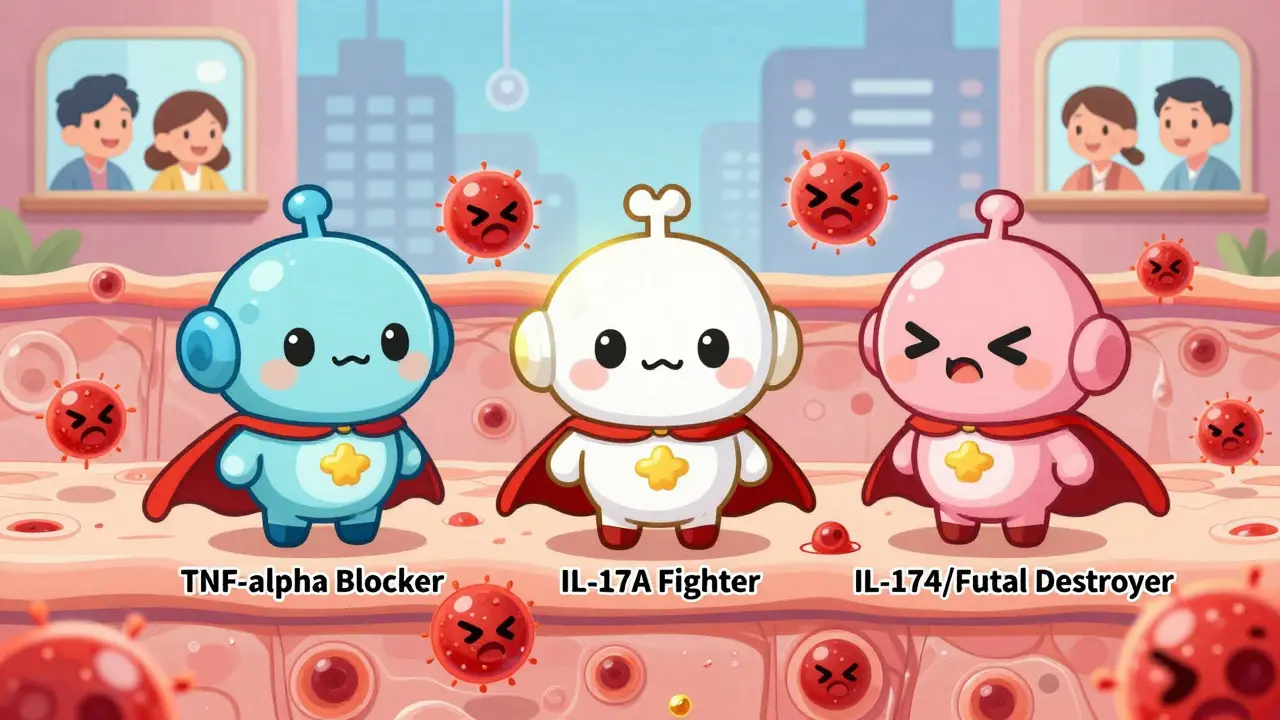
Adalimumab binds to TNF-alpha, a molecule that tells immune cells to attack. By blocking it, inflammation slows down. It’s given as a weekly or every-other-week injection. Many patients start with a higher dose for the first few weeks to get control fast.
Secukinumab goes after IL-17A, which is like the alarm bell for skin inflammation. It’s injected once a week for five weeks, then every four weeks after that. In clinical trials, patients saw pain drop from an average of 7.2 out of 10 to 2.4 in just four weeks.
Bimekizumab is unique. It blocks both IL-17A and IL-17F-two signals that work together to fuel HS. This dual action makes it more powerful. It’s given every four weeks after an initial double dose. Real-world data shows it works faster and more completely than older options.
Who Gets These Drugs-and Who Doesn’t?
Not everyone qualifies. Biologics are only approved for moderate to severe HS, which means Hurley Stage II or III:
- Stage II: Multiple abscesses and sinus tracts, but not all connected.
- Stage III: Widespread, interconnected tunnels with heavy scarring.
Doctors won’t start you on a biologic unless you’ve tried at least one oral antibiotic or hormonal therapy first. They also test you for tuberculosis, hepatitis B and C, and heart failure risks before prescribing.
And here’s the hard truth: biologics don’t work as well if you’ve already developed deep scarring. That’s why experts say: start early. The sooner you treat the inflammation, the less permanent damage you’ll have.
Cost, Insurance, and Real-World Barriers
These drugs are expensive. In the U.S., as of mid-2024:
- Adalimumab: $5,800 per month
- Secukinumab: $6,200 per month
- Bimekizumab: $6,900 per month
Insurance often covers them-but not always. Medicaid patients face approval rates as low as 45%. Commercial plans approve about 82%. Many patients pay $1,200 a month out of pocket even with insurance.
On patient forums like MyHSteam and Reddit, stories are mixed. About 70% report major improvement. But 40% say injection site reactions-redness, itching, swelling-are common. About 30% stop treatment because of cost or side effects like upper respiratory infections.
Beyond the Skin: The Hidden Health Benefits
HS isn’t just a skin disease. People with HS have higher rates of heart disease, diabetes, and depression. Why? Because the same inflammation that causes nodules also damages blood vessels and metabolism.
Here’s the surprising part: biologics don’t just clear skin-they improve heart health markers. Studies show patients on these drugs see:
- 15% drop in triglycerides
- 9% rise in HDL (good cholesterol)
That’s not a side effect. It’s a direct result of reducing systemic inflammation. One dermatologist put it bluntly: “Treating HS with biologics might be the best thing you can do for your heart.”

What’s Coming Next?
The next wave of HS drugs is already in trials. Guselkumab (targeting IL-23), spesolimab (targeting IL-36), and TAK-279 (a TYK2 inhibitor) are showing promise in early studies. One 2024 study found a 12-gene signature that can predict who will respond to adalimumab-with 85% accuracy. That means someday, we might test your blood before starting treatment and know if it’ll work.
Another breakthrough? Combining biologics with surgery. A recent study found that patients who got bimekizumab and surgical removal of scarred tissue had an 89% response rate-much higher than either alone.
By 2030, experts predict 70% of moderate-to-severe HS patients will be on biologics. Right now, it’s only 28%. The gap is closing fast.
What Patients Are Saying
On Reddit, one user wrote: “I hadn’t worn a tank top in 12 years. After six months on secukinumab, I wore one to the beach. My daughter took a picture. I cried.”
Another on MyHSteam said: “I used to schedule my life around abscesses. Now I travel. I go to the gym. I sleep through the night.”
But many still struggle. “I got approved for adalimumab, but the copay is $1,000. I have to choose between medicine and groceries.”
These stories aren’t just emotional-they’re data points. They show that biologics work. But access, cost, and timing matter just as much as the science.
What You Should Do If You Have HS
If you’re dealing with recurring, painful lumps in your armpits, groin, or under your breasts:
- See a dermatologist who knows HS. Not all do. Ask if they’ve treated HS patients before.
- Get staged using the Hurley system. This determines your treatment path.
- Ask about biologics-even if you’ve tried antibiotics. Don’t wait for scarring to get worse.
- Stop smoking. Smoking makes HS 5 times worse.
- Manage your weight. Even a 10% drop in body weight can cut flare-ups by half.
- Track your symptoms. Use a pain journal or app. This helps your doctor adjust your treatment.
HS is not your fault. It’s not contagious. It’s not caused by dirt. It’s a misunderstood disease with real, effective treatments now available. The biggest mistake? Waiting.
Is hidradenitis suppurativa the same as acne?
No. Acne is caused by clogged pores and bacteria on the surface of the skin. Hidradenitis suppurativa starts deep in hair follicles and triggers a strong immune response. HS causes painful, deep nodules and tunnels under the skin-not just surface pimples. It’s also chronic, recurrent, and often affects areas like the armpits and groin, which acne rarely does.
Can biologic therapy cure hidradenitis suppurativa?
No, biologics don’t cure HS. But they can put it into long-term remission. Many patients stay symptom-free for years while on treatment. If you stop the medication, symptoms often return. That’s why most people need to stay on biologics long-term, like someone with rheumatoid arthritis or psoriasis.
How long does it take for biologics to work?
Most patients start seeing improvement in 4 to 8 weeks. By 12 to 16 weeks, doctors can tell if the treatment is working based on the number of new lesions and pain levels. Some, especially on bimekizumab, report dramatic relief within 3 weeks. But full results can take 4 to 6 months.
Are biologics safe for long-term use?
Biologics are generally safe for long-term use, but they do carry risks. Because they suppress part of the immune system, you’re more vulnerable to infections like tuberculosis or pneumonia. That’s why doctors test for these before starting. Other risks include injection site reactions, headaches, and rarely, nervous system disorders. But for most patients, the benefits far outweigh the risks-especially when compared to the daily pain and disability of untreated HS.
Can I stop taking biologics if my skin clears up?
Most doctors advise against stopping. HS is a chronic disease. Stopping the drug often leads to a flare-up, sometimes worse than before. Some patients try to taper slowly under close supervision, but relapse rates are high. Think of it like high blood pressure medication-you don’t stop just because your numbers look good.
What if my insurance denies coverage for a biologic?
Denials are common. The first step is an appeal. Your doctor can write a letter of medical necessity explaining why other treatments failed. Many drug manufacturers offer patient assistance programs that reduce or eliminate out-of-pocket costs. Organizations like the Hidradenitis Suppurativa Foundation can help guide you through the process. Don’t give up-many approvals happen on the second or third try.

I was diagnosed with HS last year and honestly thought I’d never wear shorts again. Started secukinumab 3 months ago-my skin’s clearer than it’s been since high school. I cried the first time I wore a tank top. 🥹
You know what’s really ironic? We’re spending $7k/month on biologics while the same pharma companies sell nicotine patches at $120 a box. The system’s rigged. We’re not treating disease-we’re monetizing suffering.
This is why America’s healthcare is a joke. A man in India can get a full course of antibiotics for $20. Here, I need a $6000/month injection just to stop my armpits from leaking pus. We’re not sick-we’re bank accounts with skin.
Stop whining about cost. If you can afford a phone and Netflix, you can afford your meds.
Bimekizumab is the real MVP. 🙌 My dermatologist called it 'the unicorn drug'-and honestly? It’s the first thing that made me feel human again. Also, smoking = HS turbo button. Quit. Please.
I’ve read every paper on this. You people don’t understand the mechanism. TNF-alpha inhibition is a band-aid. The real issue is gut dysbiosis and endocrine disruption. Biologics are just another profit-driven placebo. You’re being manipulated by Big Pharma’s marketing team.
The data is statistically significant, but the clinical relevance is questionable. The PASI-50 endpoint is a surrogate marker with low correlation to patient-reported quality of life. Moreover, the dropout rate due to adverse events in Phase III trials exceeds 18%, which undermines the risk-benefit ratio.
If you’re struggling with cost, reach out to your pharma rep. Most companies have co-pay cards that drop your monthly bill to $0. I helped 3 people get on bimekizumab this way. It’s not magic-it’s persistence.
They’re hiding the truth. HS is caused by chemtrails. The government wants you dependent on drugs so they can track you through your injection pens. I stopped mine. My skin cleared in 3 weeks. Coincidence? I think not.
I’ve been on Humira for 4 years. I’ve had two abscesses since. But I’ve also had 12 UTIs, 3 pneumonia episodes, and a scare with MS. This isn’t treatment-it’s a slow suicide with a better-looking skin.
I get it. The cost is brutal. But I also know someone who died because she waited too long to start treatment. The scarring was irreversible. Don’t let fear of money kill your future self. There are options. Ask. Fight. Don’t quit.
I just want to say… thank you to everyone who shared their stories. I’ve felt so alone in this. Reading this thread made me feel seen. I’m starting bimekizumab next week. I’m scared… but also hopeful. 💛
You think you’re brave for using biologics? You’re just another pawn in the pharmaceutical circus. People with HS are broken by society’s refusal to acknowledge our pain-and now you’re buying the cure they sold you like a cult member. Pathetic.
While the clinical efficacy of biologics in HS is well-documented, the ethical imperative to ensure equitable access cannot be overstated. The disparity in insurance approval rates between Medicaid and commercial plans reflects a systemic failure in healthcare prioritization. A disease that affects 1–4% of the population deserves more than a market-driven solution.